
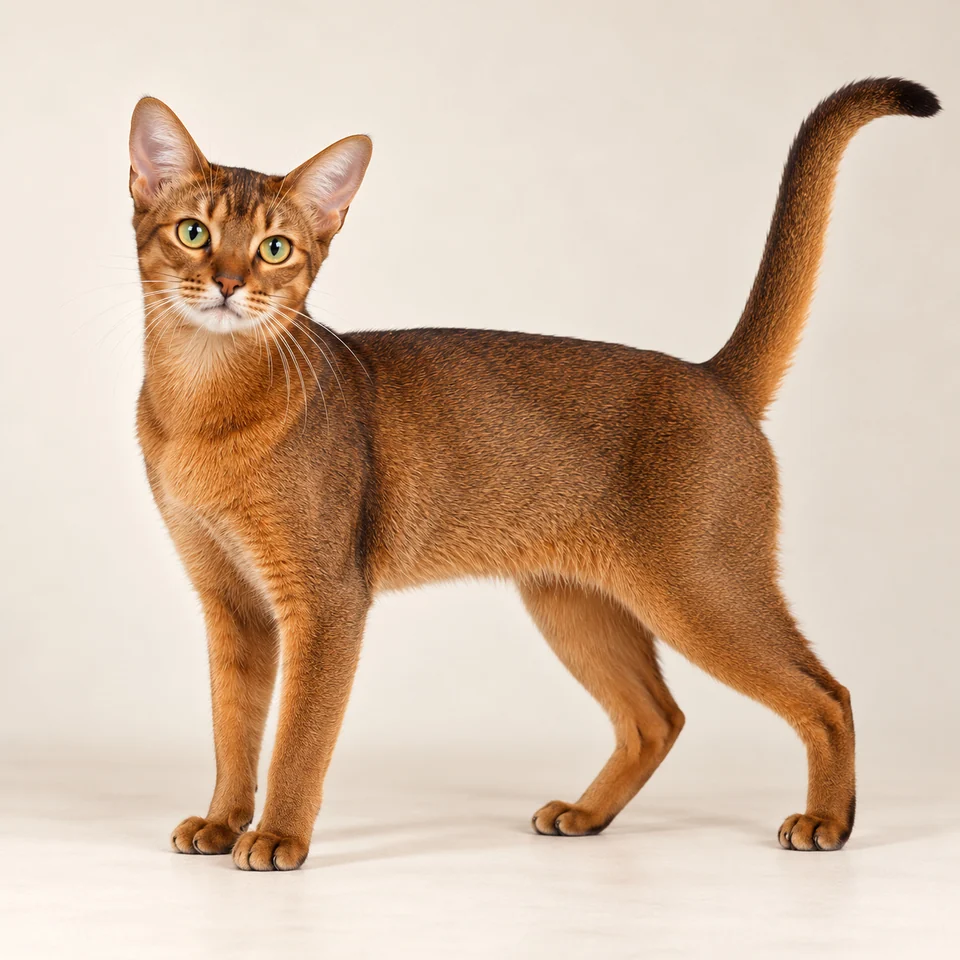
The Abyssinian is a colorful cat with a ticked coat.
Each hair has bands of color that give a 'wild' look. It is one of the oldest breeds and one of the most intelligent. Abys are very active, playful and curious. They are also friendly and very affectionate.
Source:CFA
Quick facts
- Where it beganCFATICA
- Genetic research places the breed's origin in the coastal areas of the Indian Ocean and in Southeast Asia. The first show Abys in England were imports from Ethiopia (once called Abyssinia). The breed was developed and refined in Britain.
- When it beganCFATICA
- The first Abyssinian at a cat show was 'Zula', at the Crystal Palace show in England in 1871. One story links Zula to a cat brought to England after the 1868 Abyssinian war.
- SizeCFA
- Medium
- Coat lengthCFA
- Shorthair
- Coat feelCFA
- Soft, silky and fine, but dense and resilient with a lustrous sheen. Each hair has bands of ticking.
- WeightCFATICA
- The Abyssinian is medium in size. The breed page gives two sets of figures. One section lists adult females at 6–9 lb and adult males at 7–12 lb. Another section says males weigh 8–10 lb and females 6–7 lb.
- LifespanTICA
- Life expectancy is 14 to 17+ years. Many have been known to live well into their 20s.
Appearance
The Aby is a medium-sized shorthair.
It has an arched neck and a lithe, muscular body. It looks like it is standing on tip-toe. It has large, cupped ears and almond-shaped eyes. Ruddy, a burnished red-brown, is the most popular color.
Source:CFA
Colors and patterns
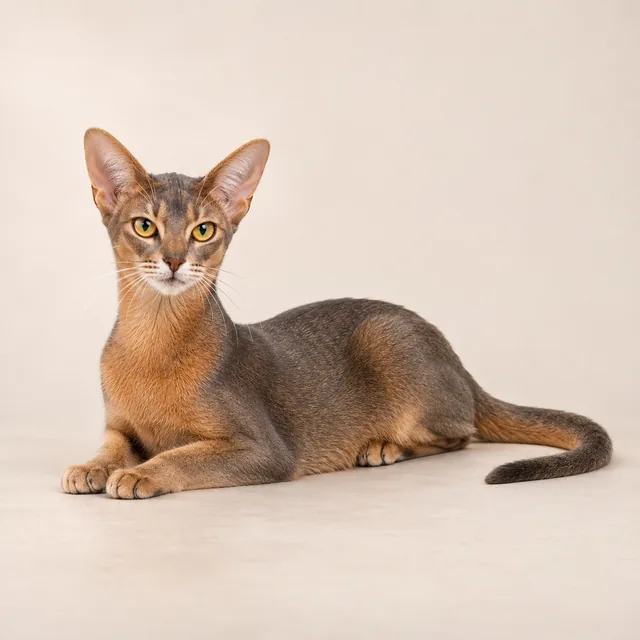
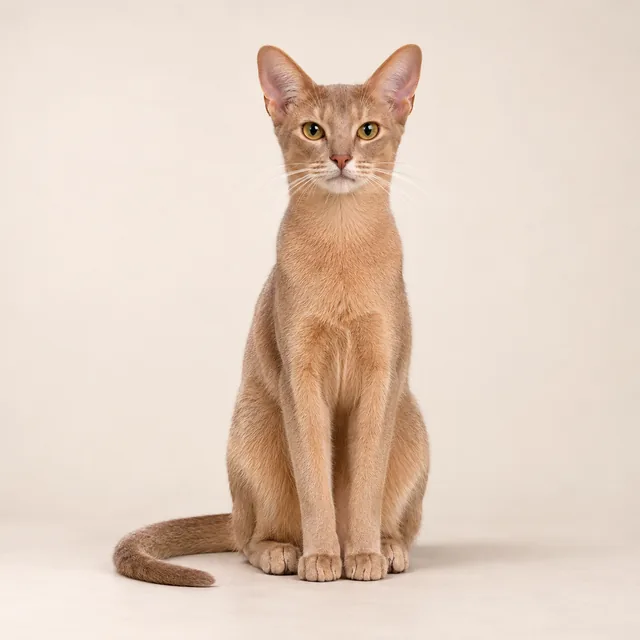
Ticked coat. One registry accepts four colors: ruddy, cinnamon, blue and fawn. Ruddy is the most popular. The other limits colors to eumelanistic colors in the agouti pattern, in Tabby and Silver/Smoke divisions.
Personality
The Aby is sociable, super-inquisitive and very intelligent.
It is a problem-solver that explores every inch of its home. It is friendly and very affectionate. Abys are fiercely loyal and highly people oriented.
With their people
Abys love their owners and seek attention. If they do not get it, they may reach out with a gentle paw. They do not like to be left alone for long. Quieter homes may want two cats instead of one.
Source:CFA
Lap time
An Aby may settle in your lap for a moment. Because it is so active, it is unlikely to stay long. They are not usually considered lap cats.
Voice
Abys are not particularly talkative. They make their wishes clear without much noise.
Source:CFA
Living with an Abyssinian
Their activity level suits families with children.
They are generally great with children, dogs and other cats. Well-socialized Abys handle changing surroundings well.
With children
The Aby is an excellent choice for families with children. Children enjoy playing toy and hunting games with it. They are generally great with children.
Activity
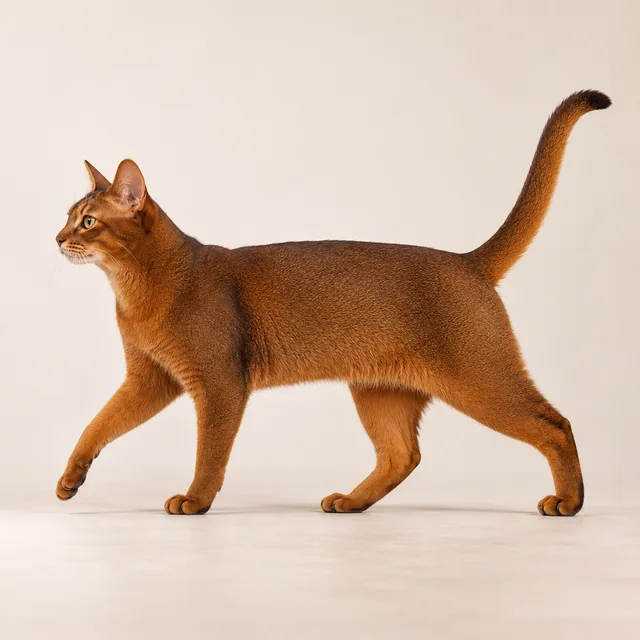
Abys are constantly on the move, unless asleep. They are fond of high places, so offer perches. Without enough toys, they will invent their own. Most stay kitten-like for much of their life.
Settling in
Well-socialized Abys are comfortable with changing environments. Some may even enjoy going out in public on a harness.
Source:CFA
Care
Abys need very little grooming.
Combing or brushing a few times a month to control shedding is recommended. A gentle rub with a chamois cloth on a dry coat adds sheen. The Aby is a 'wash and wear' cat.
Baths
Baths are generally not needed unless the cat is shown. For show baths, ask your breeder about method and products.
Source:CFA
Health
Known conditions are PK deficiency, progressive retinal atrophy (PRA), patellar luxation (PL) and renal amyloidosis (RA).
With PL the kneecap tends to slip out of place. Genetic testing lets breeders remove carriers of an inherited disease that once caused anemia.
Screening
PK deficiency and PRA can be found by genetic testing. It advises asking the breeder for certification. There is no DNA/genetic test for renal amyloidosis.
Source:TICA
CFA health notes
Genetic testing now lets Abyssinian breeders remove carriers of an inherited disease that once caused anemia. Some breeders also teach kitten buyers to brush teeth to prevent gingivitis.
Source:CFA
This is what CFA and TICA say about the breed. It is not a health promise for any kitten. TrueKitten verifies breeder identities and documents, but that does not guarantee a kitten's health. Ask the breeder for test results and talk to your vet.
History
The Aby's name does not mean it came from Africa.
The first Abys shown in England were imports from Ethiopia, once called Abyssinia. Genetic research places its origin around the Indian Ocean coast and Southeast Asia. The first Abyssinian at a cat show was 'Zula', in England in 1871. The breed was developed and refined in Britain. Abys came to the United States in the early 1900s. They were first shown there in 1909. They were one of the original registered breeds in 1906.
Did you know?
- The first Abyssinian at a cat show was 'Zula', at the Crystal Palace in England in 1871.
- Abys look like they are standing on tip-toe.
- If an Aby wants attention, it may reach out with a gentle paw.
- Abys were one of the original registered breeds in 1906.
Source:CFA
For breeders
Details from the CFA and TICA show standards. Cat show judges use them. They do not rate a kitten as a pet.
What the show standards ask for
- Overall a colorful, distinctly ticked, medium-sized cat, regal in appearance.
- Head: modified, slightly rounded wedge with gentle contours and no flat planes.
- Ears: alert, large, moderately pointed, broad and cupped at the base.
- Eyes: almond shaped, large, brilliant and expressive; neither round nor oriental.
- Body: medium long, lithe and graceful, muscular without coarseness; between cobby and svelte.
- Legs and feet: slim and fine boned; stands as if on tip toe; small, oval, compact paws.
- Tail: thick at base, fairly long and tapering.
- Coat: soft, silky, fine but dense and resilient; long enough for two or three dark bands of ticking.
- Points: head 35, body 35, coat/color/pattern 30.
Points show how much each part counts when a judge scores a cat at a show. They add up to 100.
CFA colors and patterns
Ruddy, cinnamon, blue and fawn — all ticked; 'any color other than the four accepted colors' disqualifies
Source:CFA
CFA allowances
- Jowls allowed in adult males.
- Darker shading along the spine allowed if fully ticked.
Source:CFA
CFA penalties
- Off-color pads.
- Long narrow head; short round head.
- Barring on legs, dark broken necklace markings, rings on tail.
- Coldness or grey tones in the coat.
- White undercoat on blue or fawn Abyssinians.
- Ears too high or too low that disrupt the modified wedge.
Source:CFA
CFA disqualifications
- White locket, or white anywhere other than nostril, chin and upper throat.
- Kinked or abnormal tail.
- Dark unbroken necklace.
- Grey undercoat close to the skin over a major portion of the body.
- Any black hair on a cinnamon Abyssinian.
- Incorrect number of toes.
- Any color other than the four accepted colors.
Source:CFA
Common questions
The Abyssinian is medium in size. The breed page gives two sets of figures. One section lists adult females at 6–9 lb and adult males at 7–12 lb. Another section says males weigh 8–10 lb and females 6–7 lb.
Life expectancy is 14 to 17+ years. Many have been known to live well into their 20s.
An Aby may settle in your lap for a moment. Because it is so active, it is unlikely to stay long. They are not usually considered lap cats.
Abys are constantly on the move, unless asleep. They are fond of high places, so offer perches. Without enough toys, they will invent their own. Most stay kitten-like for much of their life.
Their activity level suits families with children. They are generally great with children, dogs and other cats. Well-socialized Abys handle changing surroundings well.
Abys love their owners and seek attention. If they do not get it, they may reach out with a gentle paw. They do not like to be left alone for long. Quieter homes may want two cats instead of one.
Abys need very little grooming. Combing or brushing a few times a month to control shedding is recommended. A gentle rub with a chamois cloth on a dry coat adds sheen. The Aby is a 'wash and wear' cat.
Known conditions are PK deficiency, progressive retinal atrophy (PRA), patellar luxation (PL) and renal amyloidosis (RA). With PL the kneecap tends to slip out of place. Genetic testing lets breeders remove carriers of an inherited disease that once caused anemia.
PK deficiency and PRA can be found by genetic testing. It advises asking the breeder for certification. There is no DNA/genetic test for renal amyloidosis.
Ticked coat. One registry accepts four colors: ruddy, cinnamon, blue and fawn. Ruddy is the most popular. The other limits colors to eumelanistic colors in the agouti pattern, in Tabby and Silver/Smoke divisions.
Questions to ask a breeder
- Have the parents been DNA tested for PK deficiency and PRA? May I see the certificates?
- Is there any history of renal amyloidosis in your lines?
- Have the parents or earlier kittens had kneecap (patellar luxation) problems?
- Have you started tooth brushing with this kitten, and can you show me how?
- How has this kitten been socialized with children, dogs or other cats?
- Is this kitten used to perches and climbing spaces?
Sources
Every fact on this page comes from the two cat registries, CFA and TICA.
Last updated