
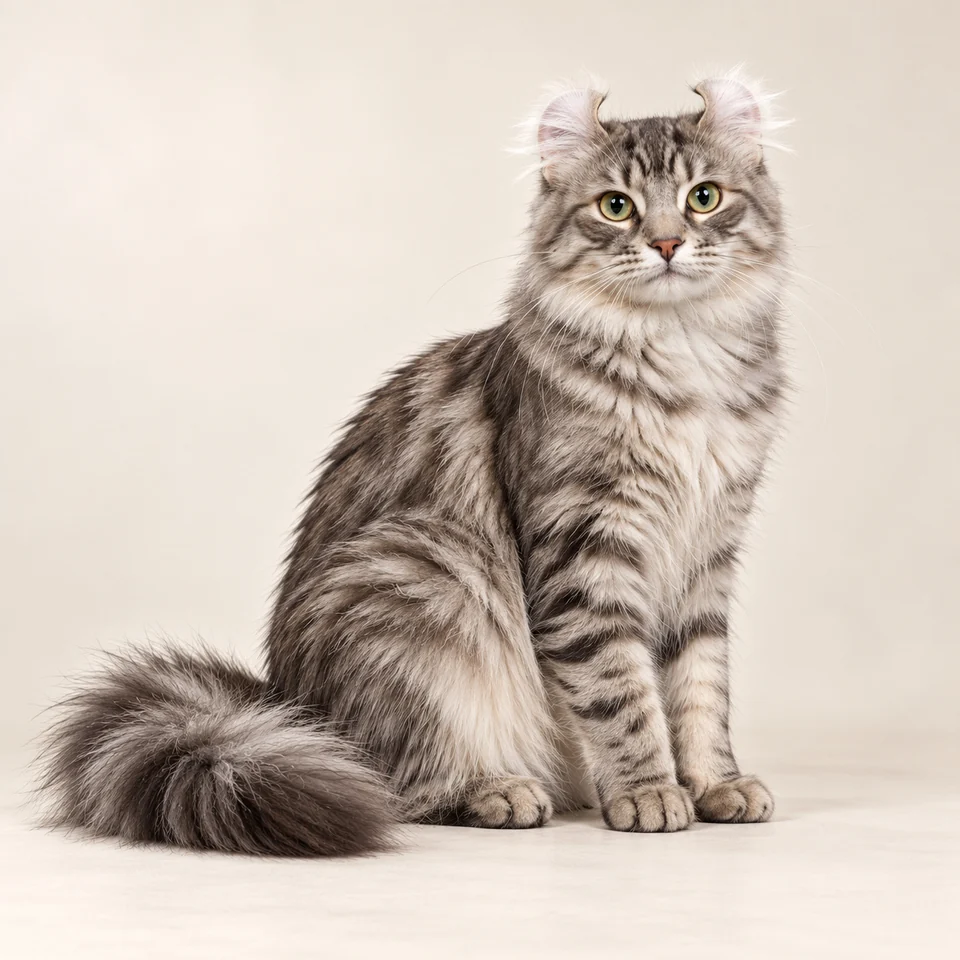
The American Curl's ears curl back, away from the face.
The breed began with one stray kitten in California in 1981. Curls are very people-oriented, affectionate and easygoing. They come in two coat lengths and any color. The American Curl Longhair is the longhaired version.
Quick facts
- Where it beganCFA
- California, United States. The first Curl appeared on a doorstep in California. Southern California.
- When it beganCFA
- 1981. Selective breeding began in 1983.
- Coat feelCFA
- Fine, silky and lying flat, with minimal undercoat; full, plumed tail.
- LifespanTICA
- Life expectancy is 10 to 20 years.
- Fully grownCFA
- Kittens are born with straight ears. The ears start to curl in three to five days. They become permanently 'set' at around 16 weeks.
Appearance
The ears are the key feature.
They curl back in a smooth arc. Show cats have a curl of 90 to 180 degrees. The body is a medium-sized rectangle. The eyes are walnut-shaped. The tail is about as long as the body.
Source:CFA
Body
Semi-foreign rectangle, elegant and moderately muscled; slender rather than massive; medium boning
Source:CFA
Colors and patterns
Any genetically possible color and pattern in both coat lengths, including pointed colors (blue eyes required in the colorpoint class).
Source:CFA
Eye colors
Clear and brilliant, with no relation to coat color, except blue eyes are required in the colorpoint class.
Source:CFA
Personality
The Curl is exceptionally people-oriented, affectionate, easygoing and adaptable.
It is intelligent and curious. It keeps a kitten-like personality well into adulthood. Curls are alert and active, with gentle, even dispositions.
Source:CFA
With their people
Curls are very people-oriented. They may want to help you make dinner or sort the mail. They pat you to get your attention. They want to include you in all their activities.
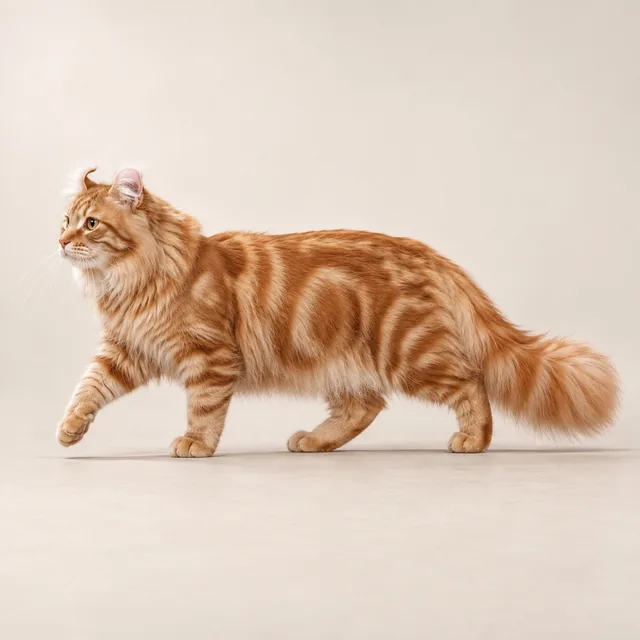
Living with an American Curl Longhair
Curls make themselves at home in any setting, often very fast.
They typically do well with children of all ages. They tend to respect other pets, including dogs and other cats.
Source:CFA
With children
Curls typically do well with children of all ages and enjoy regular play sessions.
Source:CFA
With other pets
Curls tend to respect other pets. They are quite compatible with dogs, other cats or other pets.
Source:CFA
Activity
The Curl is energetic enough to be fun, but never annoying. It looks forward to regular play sessions.
Source:CFA
Settling in
The Curl is an expert at making itself at home in any environment, often in record time.
Source:CFA
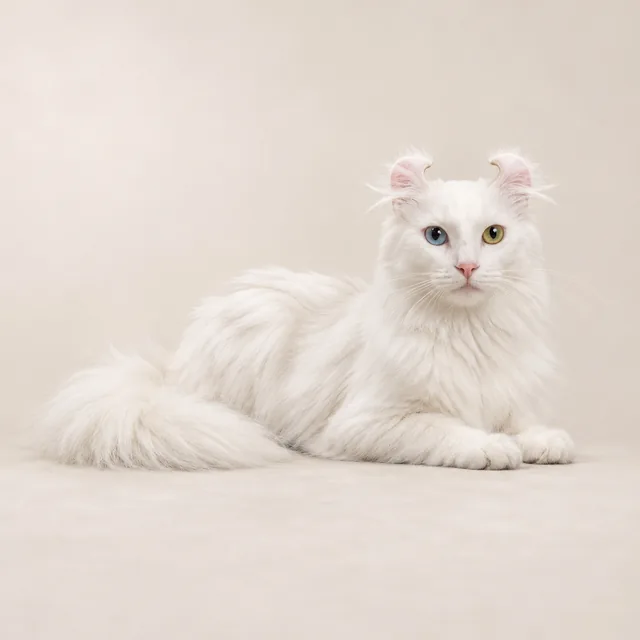
Care
Both coats are silky with minimal undercoat, so they are fairly easy to groom.
Combing or brushing two or three times a month is recommended. Longhairs should be brushed occasionally. One visitor guide says longhairs need weekly combing.
Shedding
Combing or brushing two or three times a month is recommended. This keeps shedding to a minimum.
Source:CFA
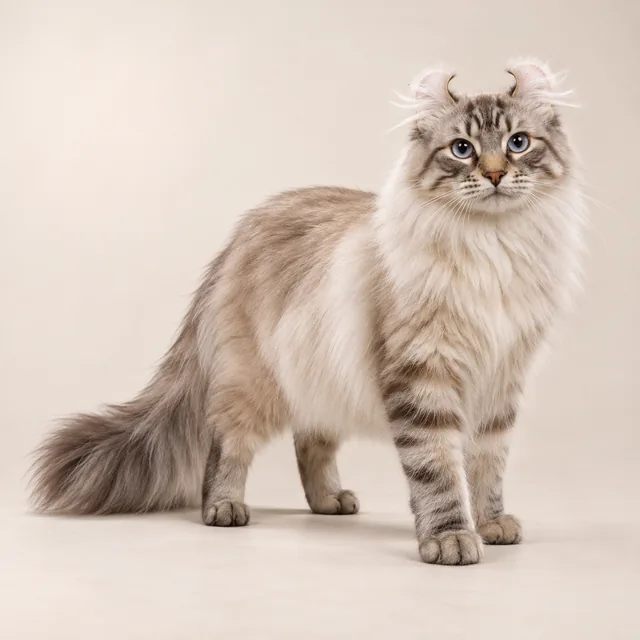
Health
No breed-linked health issues have come to light so far.
The credit goes to a very diverse gene pool, from outcrossing to random-bred cats until 2015.
Source:CFA
Screening
Many breeders still test regularly. This helps keep recessive issues from the wider cat population out of the breed.
Source:CFA
CFA health notes
Outcrossing to domestic random-bred cats was allowed until 2015, so the gene pool is very diverse. No breed-linked health issues have come to light. Many breeders still test regularly.
Source:CFA
This is what CFA says about the breed. It is not a health promise for any kitten. TrueKitten verifies breeder identities and documents, but that does not guarantee a kitten's health. Ask the breeder for test results and talk to your vet.
History
In 1981 a stray kitten with curled ears appeared on a doorstep in California.
She was a black female named Shulamith, the breed's foundation cat. Joe and Grace Ruga were the original breeders. Her kittens showed the curl is dominant; one copy of the gene is enough. Curl-eared cats were then crossed with domestic shorthairs and longhairs. Selective breeding began in 1983.
Did you know?
- Curl kittens are born with straight ears; the curl sets at around 16 weeks.
- Every American Curl traces back to one stray kitten, Shulamith.
- Only one copy of the curl gene is needed for the curled ear.
- American Curls are relatively rare in the U.S. but more popular in other parts of the world.
For breeders
Details from the CFA and TICA show standards. Cat show judges use them. They do not rate a kitten as a pet.
What the show standards ask for
- Ears: minimum 90-degree arc of curl, not over 180 degrees; firm cartilage from base to at least 1/3 of height.
- Ears: wide at base, open, smooth arc; rounded, flexible tips; moderately large; furnishings desirable.
- Head: modified wedge without flat planes, moderately longer than wide.
- Eyes: walnut shape — oval on top, round on bottom.
- Body: semi-foreign rectangle, 1.5 times height at shoulder; moderately muscled; medium boning.
- Tail: flexible, wide at base, tapering, equal to body length.
- Coat: silky, lying flat, minimal undercoat; longhair semi-long with plumed tail, shorthair short.
Points show how much each part counts when a judge scores a cat at a show. They add up to 100.
| Part | Points |
|---|---|
| HeadShape & Size 8, Profile 6, Muzzle 4, Chin 2 | 20 |
| EarsDegree of Curl 10, Shape & Size 10, Placement 8, Furnishings 2 | 30 |
| EyesShape & Size 6, Placement 3, Color 1 | 10 |
| BodyTorso & Neck 9, Size & Boning 6, Legs & Feet 5, Tail Length 5 | 25 |
| Coat and ColorSilky Texture 6, Minimal Undercoat 4, Body Coat Length 2, Tail Coat Length 2, Color 1 | 15 |
Source:CFA
| Part | Points |
|---|---|
| Head | 40 |
| Body | 30 |
| Coat/Color/Pattern | 20 |
| Other | 10 |
Source:TICA
CFA colors and patterns
All colors and patterns accepted in both divisions, including OACC (any other genetically possible color or pattern); blue eyes required in the colorpoint class.
Source:CFA
TICA allowed outcrosses
Domestic longhair/shorthair cats that are not members of a recognized breed
Source:TICA
CFA allowed outcrosses
Domestic longhair or shorthair, for litters born before 1/1/2015 only
Source:CFA
CFA penalties
- Ears: low set; abrupt change of direction; pinch, horizontal or vertical crimp; corrugated inner surface.
- Body: tubular or cobby; excessive size.
- Nose: deep nose break.
- Longhair: heavy undercoat; heavy ruff; coarse or cottony texture.
- Shorthair: heavy undercoat; coarse texture; dense or plush coat.
Source:CFA
CFA disqualifications
- Extreme curl in an adult where the ear tip touches the back of the ear or head.
- Ears that are straight, severely mismatched, thick or have inflexible tips.
- Lack of firm cartilage in the ear base.
- Tail faults.
Source:CFA
TICA disqualifications
- Tail faults of any kind.
- Straight or severely mismatched ears.
- Lack of firm cartilage in base of ear.
- Extreme curl in an adult cat where the tip of the ear touches the back of the head or the ear itself.
- Partial list; see the show standard for the rest.
Source:TICA
CFA breeding notes
Kitten ears are straight at birth and set at around 16 weeks. Only then can breeders tell pet from show quality. Ear curl ranges from almost straight (pet quality) to a 90–180 degree arc (show quality).
Source:CFA
Common questions
In 1981 a stray kitten with curled ears appeared on a doorstep in California. She was a black female named Shulamith, the breed's foundation cat. Joe and Grace Ruga were the original breeders. Her kittens showed the curl is dominant; one copy of the gene is enough. Curl-eared cats were then crossed with domestic shorthairs and longhairs. Selective breeding began in 1983.
Kittens are born with straight ears. The ears start to curl in three to five days. They become permanently 'set' at around 16 weeks.
Females weigh 5–8 lb and males 7–10 lb. Curls are small to medium, at 5–10 lb overall.
Life expectancy is 10 to 20 years.
Curls make themselves at home in any setting, often very fast. They typically do well with children of all ages. They tend to respect other pets, including dogs and other cats.
Keep the ears clean, but handle them with great care. Use a cotton swab soaked in ear cleaner. Work up and away from the ear canal. Do not pull on the delicate cartilage. Never force the ears into unnatural positions.
Both coats are silky with minimal undercoat, so they are fairly easy to groom. Combing or brushing two or three times a month is recommended. Longhairs should be brushed occasionally. One visitor guide says longhairs need weekly combing.
No breed-linked health issues have come to light so far. The credit goes to a very diverse gene pool, from outcrossing to random-bred cats until 2015.
Questions to ask a breeder
- How old is this kitten, and have its ears set yet?
- Is this kitten pet or show quality, and why?
- Can you show me how you clean the ears safely?
- What health testing do you do on your breeding cats?
- Has this kitten been around children, dogs or other cats?
Sources
Every fact on this page comes from the two cat registries, CFA and TICA.
Last updated