
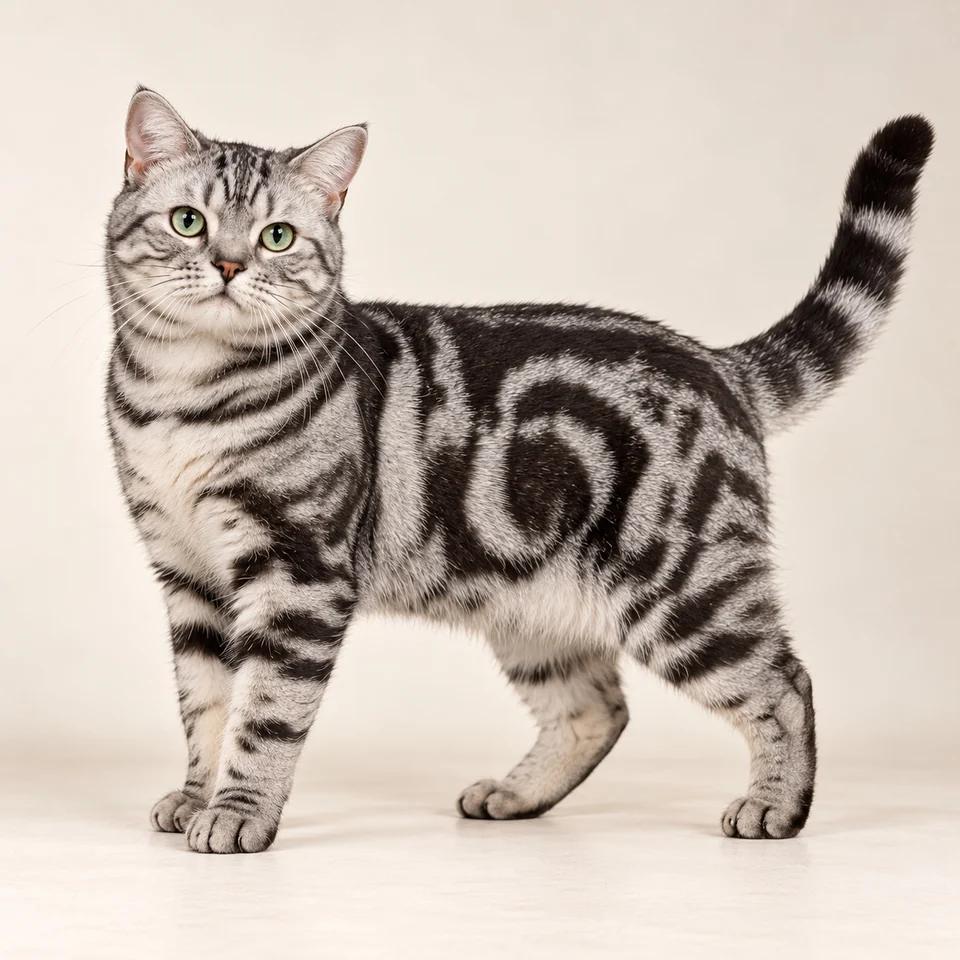
The American Shorthair is a sturdy, rugged working cat.
Its ancestors came to North America with early settlers. It is a perfect family cat: loving, playful and patient. It is easygoing and fairly calm. It can be calm but stays playful even into old age.
Quick facts
- Where it beganCFA
- North America. Short-haired cats arrived with early settlers on ships, then moved west with pioneers.
- When it beganCFA
- Early settler era (no year). First US cat show appearance: 1895.
- SizeCFA
- Medium to large
- Coat lengthCFA
- Shorthair
- Coat feelCFA
- Short, thick, even and hard. Dense enough to protect from moisture, cold and minor skin injuries.
- WeightCFA
- The breed is medium to large. Females may be less massive than males.
- Fully grownTICA
- American Shorthairs do not really mature until around three or four years old.
Appearance
The American Shorthair looks strong and powerful.
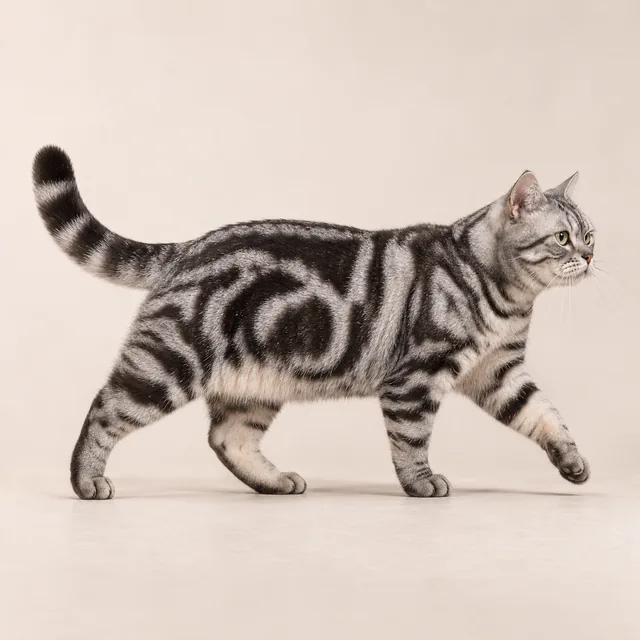
The breed has a medium to large, muscular body. Its thick, hard coat stands up to rough weather. The head is oval with a powerful jaw. The eyes curve gently on top and are rounder below.
Source:CFA
Colors and patterns
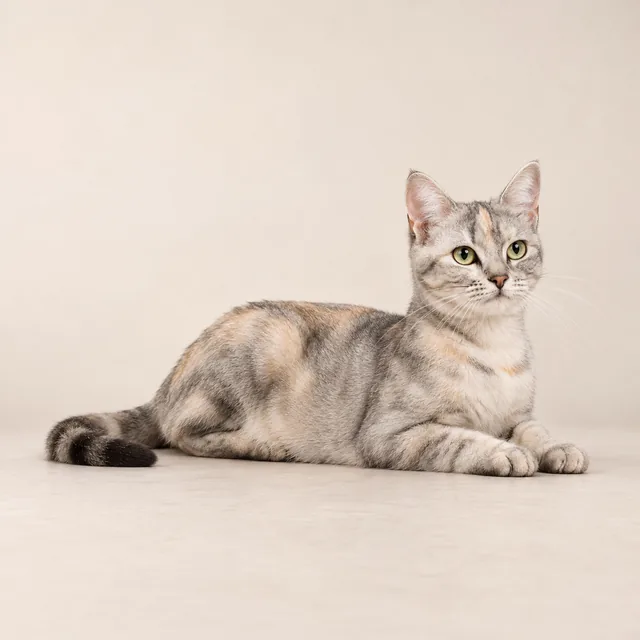
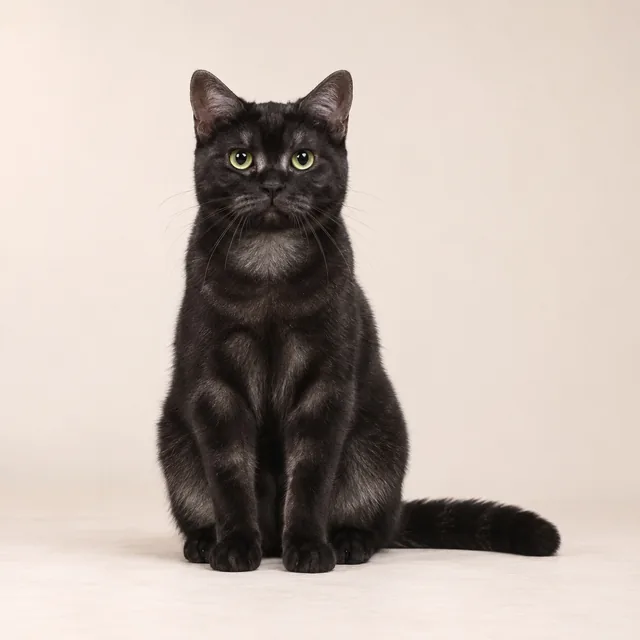
Over 100 color combinations. Silver and brown classic tabbies are very popular. Colors include solids, bi-colors, calicos, smokes, shadeds and tabbies (classic, mackerel or ticked). One registry accepts all colors. The other disqualifies chocolate, sable, lavender, lilac and pointed colors.
Eye colors
Depends on coat color. Most colors call for gold. Some silvers call for green or hazel. Whites may be deep blue, gold or odd-eyed.
Source:CFA
Personality
The American Shorthair is affectionate, easygoing and relatively sedate.
It is smart and independent. It is good-natured and easy-going, popular with families.
With their people
It enjoys human company and play with its family. It is independent enough to amuse itself while you are at work. They enjoy their people but keep their independence.
Voice
They communicate without loud sounds. The breed is known for its 'silent meow': an open mouth, but no sound.
Source:CFA
Living with an American Shorthair
It is a perfect family cat.
The breed is very tolerant of other animals and small children.
Source:CFA
Activity
It loves hunting games with feathers or wand toys. If you play at about the same time each day, it may dance as playtime nears. Its strong hunting instinct should be indulged with interactive toys. Many still hunt insects that get indoors.
Training
They are easily trainable. They can learn to stay off counters, use scratching posts and even retrieve toys. They can figure out how to open cupboard drawers and sometimes doors.
Source:CFA
Care
The breed does not need much grooming.
Daily brushing with a wire-toothed slicker brush or grooming mitt is recommended. Run a comb through the coat as needed, to help avoid swallowed hair.
Baths
Baths remove excess oils and reduce shedding, but are usually unnecessary unless the cat is shown. They keep themselves clean and don't typically need a bath.
Nails, ears, eyes and teeth
Keep nails trimmed and ears cleaned. Brush teeth regularly with a vet-approved pet toothpaste. A tall scratching post is recommended.
Source:TICA
Health
This hardy cat is not known for any breed-specific health problems.
Hypertrophic cardiomyopathy (HCM) was seen in some cats in the 1980s and 1990s. Testing and selective breeding have made it largely disappear.
Source:CFA
Screening
Preventive testing and selective breeding have made hypertrophic cardiomyopathy (HCM) largely disappear from the breed.
Source:CFA
CFA health notes
Not known for breed-specific health problems. HCM was noted in some cats in the 1980s and 90s and has largely disappeared through testing and selective breeding.
Source:CFA
This is what CFA says about the breed. It is not a health promise for any kitten. TrueKitten verifies breeder identities and documents, but that does not guarantee a kitten's health. Ask the breeder for test results and talk to your vet.
History
Short-haired cats came to North America with early settlers.
Ships kept cats to control rodents. Pioneers took their cats west to protect farms and homes. Over 50 were at the first US cat show in 1895. They were one of the first five breeds recognized in 1906. They were first shown as 'Domestic Shorthairs'. They got their current name in 1965.
Source:CFA
Recognition dates
- 1906CFA One of the first five recognized breeds
- 1965CFA Renamed from 'Domestic Shorthair' to American Shorthair
Source:CFA
Did you know?
- The breed is known for its 'silent meow': an open mouth with no sound.
- Over 50 American Shorthairs were at the first US cat show in 1895.
- They were called 'Domestic Shorthairs' until 1965.
- The breed comes in over 100 color combinations.
Source:CFA
For breeders
Details from the CFA and TICA show standards. Cat show judges use them. They do not rate a kitten as a pet.
What the show standards ask for
- A true working cat; no part so exaggerated as to foster weakness.
- Size: medium to large; females may be less massive than males.
- Head: large, full-cheeked oblong, slightly longer than wide; sweet, open expression.
- Eyes: upper lid like half an almond, lower lid fully rounded.
- Muzzle: squared; definite jowls in mature males; level or scissors bite both correct.
- Body: solid, powerful, muscular; back broad, straight and level; slightly longer than tall.
- Tail: medium long, heavy at base, blunt-looking end.
- Coat: short, thick, even and hard; seasonal variation allowed.
- Points: head 40, body 35, coat/color/pattern 15, other 10.
Points show how much each part counts when a judge scores a cat at a show. They add up to 100.
CFA colors and patterns
Solid and parti-colors (white, black, blue, red, cream, tortoiseshell, blue-cream); bi-color, van and calico; smokes; shaded/chinchilla silvers and cameos; tabbies (classic, mackerel, ticked, patched) in silver, blue silver, brown, blue, red, cream, cameo; tabby & white. Chocolate, sable, lavender, lilac and pointed colors disqualify.
Source:CFA
CFA allowances
- Females may be less massive than males and rewarded equally if balanced.
- Regional and seasonal variation in coat thickness allowed.
- Level and scissors bites equally correct.
Source:CFA
CFA disqualifications
- Hybridization colors: chocolate, sable, lavender, lilac or point-restricted.
- Any sign of hybridization: long or fluffy fur, nose break, bulging eye set, brow ridge.
- Kinked or abnormal tail.
- Locket or button where the color does not specify it.
- Incorrect number of toes.
- Undershot or overshot bite.
- Tongue persistently protruding.
- Obesity or emaciation.
- Any feature so exaggerated as to foster weakness.
Source:CFA
TICA standard version
Revised 05/01/04 American Shorthair Breed Group Standard, 05/01/2004
Source:TICA
Common questions
It is a perfect family cat. The breed is very tolerant of other animals and small children.
Many are lap cats, while some prefer just to be nearby.
It enjoys human company and play with its family. It is independent enough to amuse itself while you are at work. They enjoy their people but keep their independence.
The breed is medium to large. Females may be less massive than males.
American Shorthairs do not really mature until around three or four years old.
The breed does not need much grooming. Daily brushing with a wire-toothed slicker brush or grooming mitt is recommended. Run a comb through the coat as needed, to help avoid swallowed hair.
They are easily trainable. They can learn to stay off counters, use scratching posts and even retrieve toys. They can figure out how to open cupboard drawers and sometimes doors.
This hardy cat is not known for any breed-specific health problems. Hypertrophic cardiomyopathy (HCM) was seen in some cats in the 1980s and 1990s. Testing and selective breeding have made it largely disappear.
Questions to ask a breeder
- Have the parents been checked for heart disease such as HCM?
- Do you have any retired adults available as well as kittens?
- How have you socialized this kitten with children and other pets?
- What grooming routine is this kitten used to?
Sources
Every fact on this page comes from the two cat registries, CFA and TICA.
Last updated