
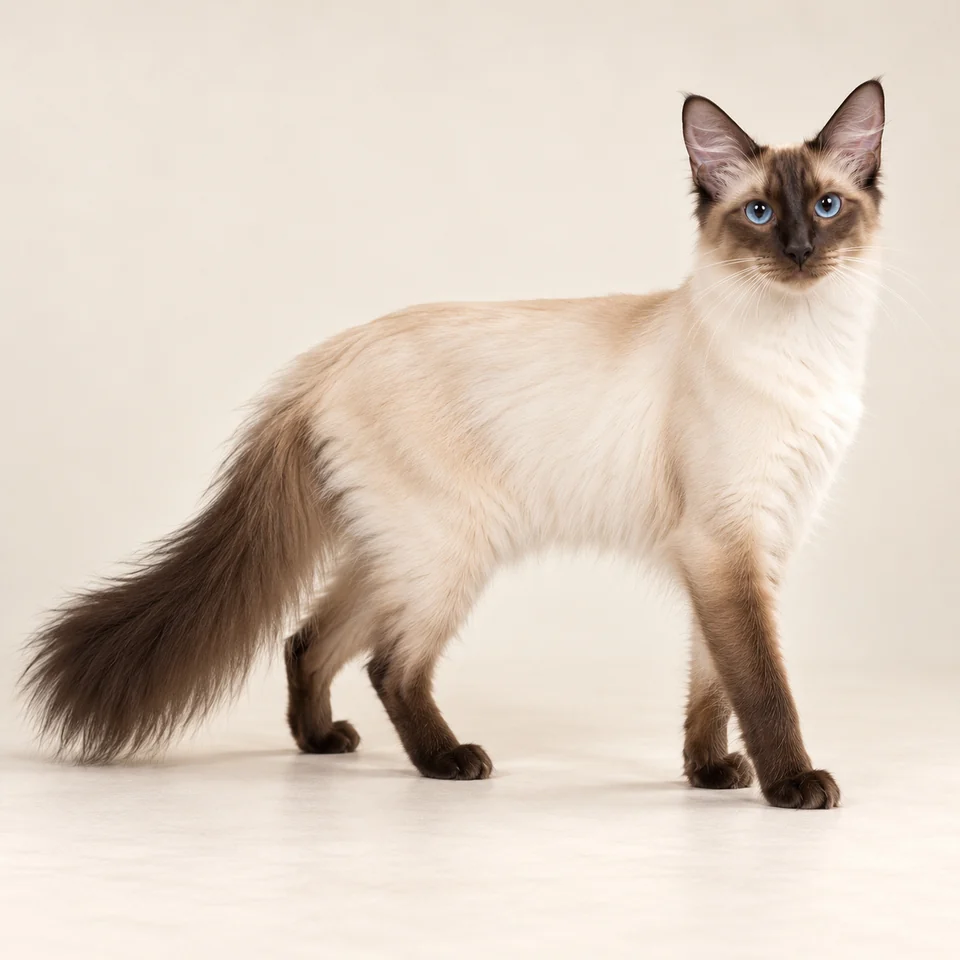
The Balinese is a Siamese with a longer, silkier coat.
It is svelte and elegant, with sapphire-blue eyes. It has the Siamese's outgoing, interactive personality. It is a bit less talkative, with a softer voice. Ongoing conversation is still normal.
Source:CFA
Quick facts
- Where it beganCFA
- Developed from long-haired kittens born in Siamese litters. It was developed by US breeders Helen Smith and Sylvia Holland.
- When it beganCFA
- Long-haired kittens appeared in Siamese litters as early as the early 1900s; breeders began developing the Balinese in the 1940s.
- Coat feelCFATICA
- Fine and silky, lying close to the body; flows into a plumed tail. Semi-long, close-lying, fine, silky texture.
- WeightTICA
- The breed page gives two sets of figures. One says males weigh 6-8 pounds and females 5-7 pounds. The other lists adult females at approximately 5-8 pounds and adult males at approximately 8-12 pounds.
- LifespanTICA
- Life expectancy is 10+ years. Balinese have been known to live 20+ years.
- Fully grownTICA
- Balinese kittens mature slowly. They do not fully develop until 18-24 months.
- CFA statusCFA
- Championship (since 1970)
Appearance
The Balinese has a long, svelte body with fine bones and firm muscles.
Its fine, silky coat lies close and flows into a plumed tail. The head is a long wedge with large, pointed ears. The eyes are almond-shaped and deep blue. Color is darker on the points: face, ears, legs, feet and tail.
Source:CFA
Body
Long, svelte and tubular; fine bones with firm muscles; hips never wider than shoulders. Long and tubular, medium-sized, fine-boned.
Colors and patterns
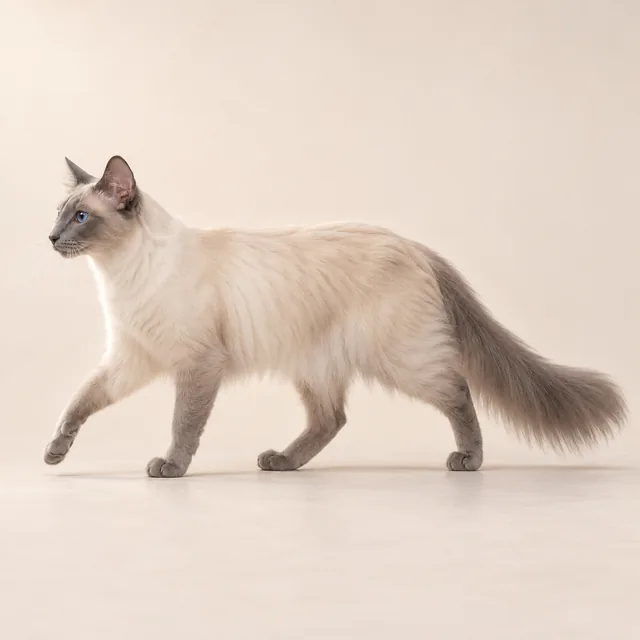
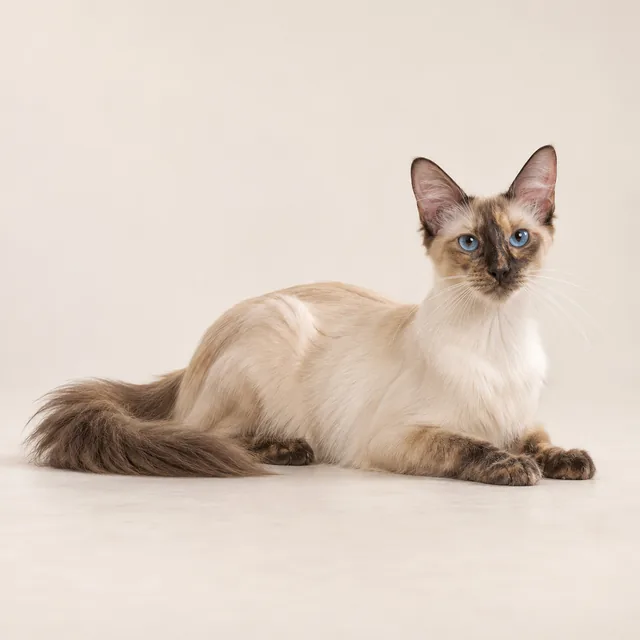
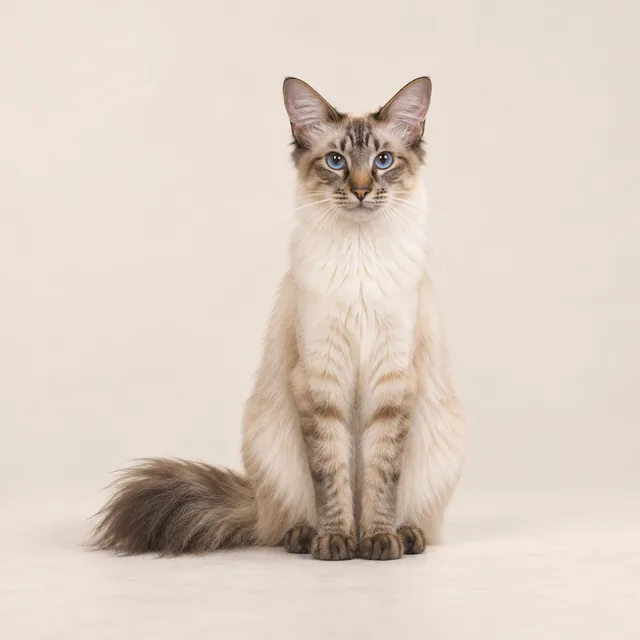
Pointed colors only: the body is lighter than the points (mask, ears, legs, feet, tail). The Balinese Division has seal, chocolate, blue and lilac points. The Javanese Division has other solid points (red, cream, cinnamon, fawn, smoke), lynx points and parti-color (tortie) points. One registry accepts all pointed colors. Coats often darken with age.
About this variety
At some shows the breed has two divisions. The Balinese Division covers seal, chocolate, blue and lilac points. The Javanese Division covers other point colors, including lynx and tortie points. Elsewhere the Balinese (BA) is judged with the Siamese group, as the semi-longhaired pointed breed.
Personality
Balinese believe they ARE people.
They are alert, affectionate and always curious. Every Balinese has a bit of a clown inside. They are vocal, affectionate and active. They have extremely loving temperaments and bond closely with their families.
With their people
Balinese want to help with all your daily activities. They may sleep under the covers with you. If not discouraged, they may eat off your plate. They may wail in protest if they feel ignored. Balinese demand lots of attention. They should not be left alone for long periods.
Voice
Balinese are somewhat less talkative than Siamese, with softer voices. But they are not quiet cats. Their talk ranges from a purr to an occasional wail for attention.
Source:CFA
Living with a Balinese
Balinese seem quite fond of dogs.
They become devoted members of any family. Older children may keep up with their high energy better than very young ones.
Source:CFA
With children
Balinese are very active. Older children may keep up with them better than very young ones.
Source:CFA
Activity
Balinese love to play. They easily learn fetch. They retrieve toys until you tire of throwing. Then they may open the drawer where you hid the toy.
Source:CFA
Care
Balinese have a single coat with no downy undercoat.
They do not mat easily and are very easy to care for. Combing or brushing several times a month to control shedding is recommended. The coat rarely tangles or mats. Weekly brushing keeps it easy to groom.
Shedding
Combing or brushing several times a month to control shedding is recommended. The coat does not shed much.
Undercoat
Single-coated, with no downy undercoat or only a slight one. A definite double coat is a show fault.
Baths
Some coats look greasy from natural oils; then a quick bath helps. Use a gentle cat shampoo and rinse well. Blow drying is not needed; let the cat air dry in a warm area.
Source:CFA
Health
Balinese are generally healthy.
But they may be prone to some conditions from their Siamese ancestors. Some are minor, such as crossed eyes or tail kinks. Others need genetic or physical testing to assess. Anesthesia can be a concern. To make the vet aware of this before any surgery, even routine ones. Amyloidosis is also mentioned. There is no available test to detect amyloids.
CFA health notes
Generally healthy, but some inherited conditions trace to Siamese ancestors. Minor ones include crossed eyes or tail kinks. Most breeders genetically screen out carriers. Breeders typically recommend pet insurance.
Source:CFA
This is what CFA and TICA say about the breed. It is not a health promise for any kitten. TrueKitten verifies breeder identities and documents, but that does not guarantee a kitten's health. Ask the breeder for test results and talk to your vet.
History
The longhair gene is recessive.
Long-haired kittens appeared in Siamese litters as early as the early 1900s. They were placed as pets. In the 1940s, breeders Helen Smith and Sylvia Holland began developing a separate breed. The name reflects the graceful movements of Balinese dancers. The breed was accepted for championship in 1970, in four colors. Other colors were accepted in 1979 as the Javanese. In 2008 the two merged into one breed with two divisions.
Source:CFA
Recognition dates
- 1970CFA Accepted for Championship competition (seal, chocolate, blue, lilac points)
- 1979CFA Non-traditional colors accepted as the Javanese
- 2008CFA Balinese and Javanese merged into one breed with two divisions
Source:CFA
Did you know?
- The name reflects the graceful movements of Balinese dancers.
- Balinese may sleep under the covers with you.
- Balinese coats often darken with age.
- Balinese are one of the rarer registered breeds.
Source:CFA
For breeders
Details from the CFA and TICA show standards. Cat show judges use them. They do not rate a kitten as a pet.
What the show standards ask for
- Both: svelte, medium-sized cat with long tapering lines, lithe and muscular.
- Head: long tapering wedge forming a triangle from nose to ear tips, no whisker break; the profile may be straight or slightly two-planed.
- Ears: strikingly large, pointed, wide at base, continuing the wedge (both).
- Eyes: almond shaped, slanted toward the nose; deep vivid blue / blue.
- Body: long, tubular, fine-boned, firm muscles; hips never wider than shoulders.
- Legs long and slim, hind legs higher; paws small and oval.
- Tail: long, thin, fine point; hair spreads like a plume.
- Coat: medium length or semi-long, fine, silky and close-lying, with no downy undercoat or only a slight one.
Points show how much each part counts when a judge scores a cat at a show. They add up to 100.
| Part | Points |
|---|---|
| HeadLong flat profile 6, Wedge, fine muzzle, size 5, Ears 4, Chin 3, Width between eyes 2 | 20 |
| EyesShape, size, slant, and placement 5 | 5 |
| BodyStructure and size, including neck 12, Muscle tone 10, Legs and feet 5, Tail 3 | 30 |
| CoatLength 10, Texture 10 | 20 |
| ColorBody color 10, Point color 10, Eye color 5 | 25 |
Source:CFA
| Part | Points |
|---|---|
| Head | 35 |
| Body | 35 |
| Coat/Color/Pattern | 30 |
Source:TICA
CFA colors and patterns
Balinese Division: seal, chocolate, blue, lilac point. Javanese Division: solid points (red, cream, cinnamon, fawn, incl. smoke; seal/chocolate/blue/lilac smoke), lynx points (incl. silver) and parti-color (tortie/cream) points (incl. smoke).
Source:CFA
CFA allowed outcrosses
Balinese, Javanese, Colorpoint Shorthair, Siamese, or Oriental Longhair (Oriental Longhair limited, for litters born on or before 12/31/2030)
Source:CFA
CFA allowances
- Jowls in the stud cat.
- Darker body color in older cats, if contrast with points remains.
Source:CFA
TICA allowances
- Dip above the eyes (headache band) in kittens and young adults to 12 months.
- Ghost barring in kittens and young adults to 12 months.
- SI/BA: incomplete point color and mask to 12 months.
- Darker body shading in older cats, with contrast.
- Jowls and larger size in males; shorter coat over shoulders (BA/OL).
Source:TICA
CFA penalties
- Lack of pigment in nose leather and/or paw pads (except as allowed for lynx and tortie points).
- Crossed eyes.
- Visible protrusion of the cartilage at the end of the sternum under normal handling.
- Soft or mushy body.
Source:CFA
TICA penalties
- Receding or excessively massive chin.
- Roman profile; Roman nose.
- Miniature size.
- Any evidence of poor condition.
- SI/BA: belly and/or flank spots; tabby markings on the torso of lynx points.
Source:TICA
CFA disqualifications
- Any evidence of illness or poor health.
- Weak hind legs.
- Mouth breathing from nasal obstruction or poor occlusion.
- Undershot or overshot chin.
- Emaciation.
- Visible kink in tail.
- Eyes other than blue.
- White toes and/or feet.
- Incorrect number of toes.
- Definite double coat (downy undercoat).
Source:CFA
TICA disqualifications
Partial: visible tail fault; crossed eyes; visible protrusion of the cartilage at the end of the sternum (xiphoid process); plus the general show-rule disqualifications. Withhold all awards: illness, poor health, emaciation; white lockets/buttons; white toes/feet or white patches in points (except 'any color with white'). The local text of the DQ list may be truncated.
Source:TICA
Common questions
The Balinese is a Siamese with a longer, silkier coat. It is svelte and elegant, with sapphire-blue eyes. It has the Siamese's outgoing, interactive personality. It is a bit less talkative, with a softer voice. Ongoing conversation is still normal.
Balinese are somewhat less talkative than Siamese, with softer voices. But they are not quiet cats. Their talk ranges from a purr to an occasional wail for attention.
After long play, a Balinese will often curl up in your lap and sleep.
Balinese seem quite fond of dogs. They become devoted members of any family. Older children may keep up with their high energy better than very young ones.
Balinese have a single coat with no downy undercoat. They do not mat easily and are very easy to care for. Combing or brushing several times a month to control shedding is recommended. The coat rarely tangles or mats. Weekly brushing keeps it easy to groom.
Pointed colors only: the body is lighter than the points (mask, ears, legs, feet, tail). The Balinese Division has seal, chocolate, blue and lilac points. The Javanese Division has other solid points (red, cream, cinnamon, fawn, smoke), lynx points and parti-color (tortie) points. One registry accepts all pointed colors. Coats often darken with age.
At some shows the breed has two divisions. The Balinese Division covers seal, chocolate, blue and lilac points. The Javanese Division covers other point colors, including lynx and tortie points. Elsewhere the Balinese (BA) is judged with the Siamese group, as the semi-longhaired pointed breed.
Balinese are generally healthy. But they may be prone to some conditions from their Siamese ancestors. Some are minor, such as crossed eyes or tail kinks. Others need genetic or physical testing to assess. Anesthesia can be a concern. To make the vet aware of this before any surgery, even routine ones. Amyloidosis is also mentioned. There is no available test to detect amyloids.
The breed page gives two sets of figures. One says males weigh 6-8 pounds and females 5-7 pounds. The other lists adult females at approximately 5-8 pounds and adult males at approximately 8-12 pounds.
Life expectancy is 10+ years. Balinese have been known to live 20+ years.
Balinese kittens mature slowly. They do not fully develop until 18-24 months.
Questions to ask a breeder
- Which genetic screening do you do on your breeding cats, and may I see the results?
- Have any cats in your lines had crossed eyes or tail kinks?
- Is this kitten in the Balinese or Javanese division, and what color is it expected to be as an adult?
- How much attention and play is this kitten used to?
- Does this kitten's coat tend to get oily?
- Have any cats in your lines had problems with anesthesia?
- Has amyloidosis come up in your lines, and what do you know about it?
- How big are this kitten's parents as adults?
Sources
Every fact on this page comes from the two cat registries, CFA and TICA.
Last updated