
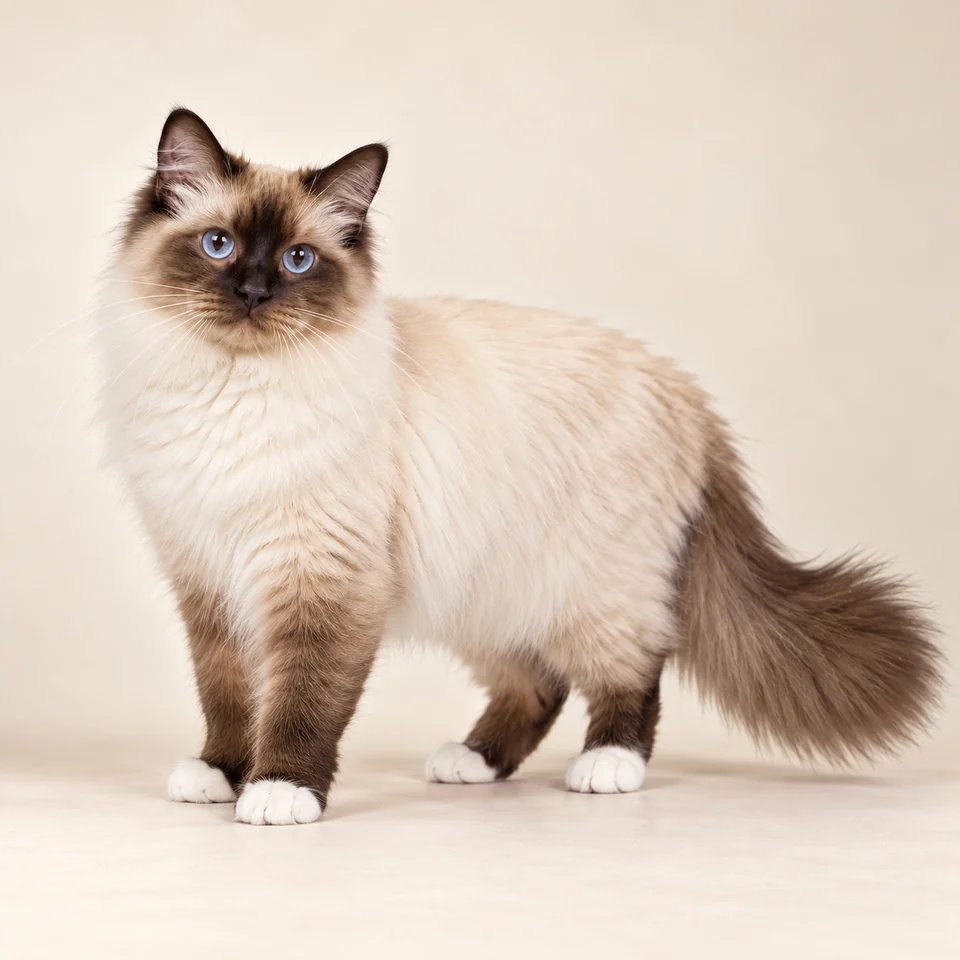
The Birman is known as the Sacred Cat of Burma.
This is a sweet, gentle cat with quiet dignity. It has striking blue eyes and a long, silky coat. Its four white feet set it apart. It is a cat of mystery and legend.
Source:CFA
Quick facts
- Where it beganCFA
- Burma. The breed was founded in France from a pair shipped from Burma.
- When it beganCFA
- About 1919, when a breeding pair was shipped from Burma to France
- Coat lengthCFA
- Longhair (medium long to long)
- Coat feelCFA
- Silken, with a heavy ruff around the neck and slightly curly on the stomach. The fur does not mat.
- WeightCFATICA
- The breed page shows a single figure of 12 pounds, not a range. Females are typically smaller than males.
- LifespanTICA
- Life expectancy is 9 to 15+ years. Birmans are generally healthy and can live 15 years or more.
- Fully grownCFA
- Birmans take about three years to mature.
Appearance
Birmans are medium-sized to large, with long yet stocky bodies.
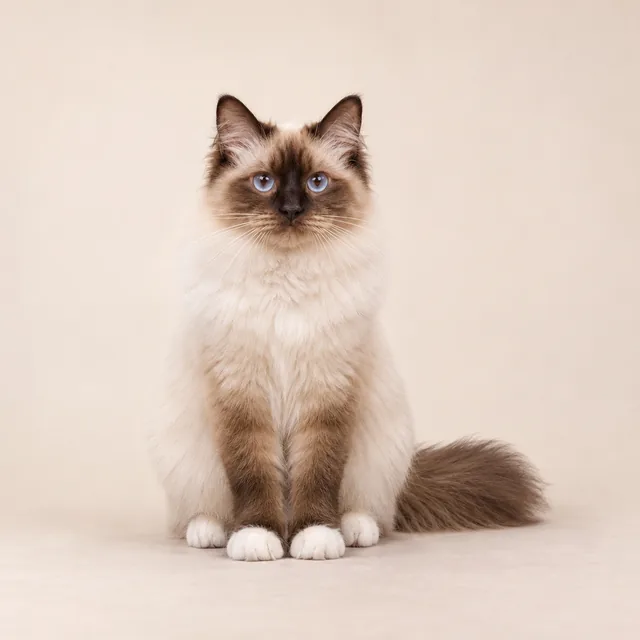
They have broad, rounded heads and Roman noses. The eyes are blue and almost round. The coat is pale on the body and darker on the face, legs and tail. All four paws are white. The white is on the front paws gloves and on the back legs laces. A faint “golden mist” may show on the back.
Source:CFA
Body
Elongated and stocky, strongly built, neither svelte nor cobby; substantial boning; heavy, medium-length legs
Colors and patterns
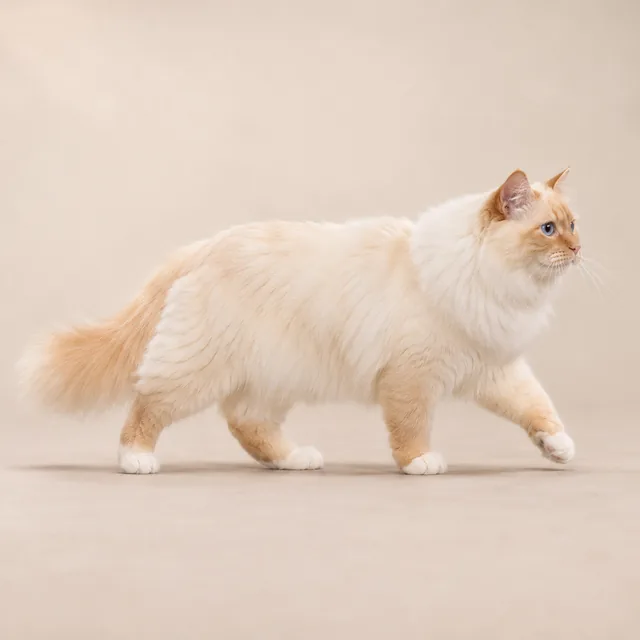
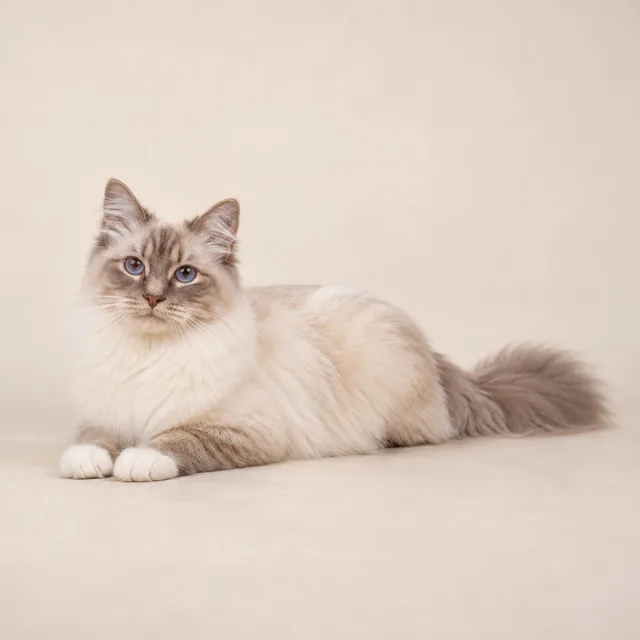
Color-pointed with four white feet (gloves on the front paws, gloves and laces behind). The body is pale and the face, ears, legs and tail are darker. Accepted colors are seal, blue, chocolate and lilac points, plus red and cream points, tortie points and tabby points.
Source:CFA
Eye colors
Blue only; the deeper and more vivid the better. Any other eye color disqualifies.
Source:CFA
Personality
Birmans are sweet and affectionate.
They are quite intelligent and enjoy learning. They are sociable and people-oriented. They are playful and like attention.
Source:CFA
With their people
Birmans love human company. They do not do well alone for long periods. If you work outside the home and have no other pets, consider a pair. The Birman has all the makings of a loyal, faithful companion.
Voice
Birmans are relatively quiet. Most have soft, chirp-like voices. If owners always answer when the cat meows, a Birman may become quite a talker.
Source:CFA
Living with a Birman
Care
The coat has no undercoat to tangle or mat.
A weekly combing should be enough. Birmans shed less than most longhaired cats. A metal comb once a week is recommended. They shed their winter coat in spring.
Baths
Most Birmans do not need regular baths. An occasional bath can add to their beauty. Ask your breeder which products to use.
Source:CFA
Health
Breeders test for hypertrophic cardiomyopathy (HCM) and other conditions.
This is what CFA says about the breed. It is not a health promise for any kitten. TrueKitten verifies breeder identities and documents, but that does not guarantee a kitten's health. Ask the breeder for test results and talk to your vet.
History
Folk tales explain the Birman’s markings, but its real history is uncertain.
About 1919, a breeding pair was shipped from Burma to France. The pregnant female founded the breed in France. The name comes from “Birmanie,” French for Burma. In World War II the breed nearly died out. Breeders rebuilt it with Persian and Siamese outcrosses. The Birman reached the U.S. in 1959. It was accepted for registration in 1967. The Birman was first recognized and shown in France in the 1920s. It was almost wiped out in World War II. Orloff and Xenia de Kaabaa are named in that story.
Recognition dates
- 1959CFA Arrived in the United States
- 1967CFA Accepted for registration
- 1920sTICA (breed page) First recognized and shown in France
Did you know?
- Many Birman breeders give all kittens born in a year names starting with the same letter.
- The name comes from “Birmanie,” the French word for Burma.
- Faultlessly gloved Birmans are a rare exception.
- A faint “golden mist” on the back and sides is desirable in the show standard.
- The breed was almost wiped out in World War II. Orloff and Xenia de Kaabaa are named in that story.
For breeders
Details from the CFA and TICA show standards. Cat show judges use them. They do not rate a kitten as a pet.
What the show standards ask for
- General: color pointed with long silky hair and four pure white feet; strongly built, elongated and stocky, neither svelte nor cobby.
- Head: strong, broad, rounded skull with slight flat spots; full cheeks, somewhat rounded muzzle; heavy jaws; strong chin.
- Nose: medium length, Roman (slightly convex).
- Ears: medium, almost as wide at base as tall, rounded point, set as much to the side as the top.
- Eyes: almost round, set well apart, outer corner tilted very slightly upward; deep vivid blue.
- Body and legs: elongated, stocky, muscular; legs medium and heavy; paws large, round, firm.
- Tail: medium length, in proportion.
- Coat: medium long to long, silken, heavy ruff, slightly curly on stomach, does not mat.
- Gloves: front gloves end in an even line at or between the second and third joints; back gloves cover all toes; laces run up the back of the hock, ideally 1/2 to 3/4 of the way.
- Color: strong contrast between body and points; golden mist desirable.
- Legs medium in length, heavily boned, well-muscled and in proportion to the body.
Points show how much each part counts when a judge scores a cat at a show. They add up to 100.
| Part | Points |
|---|---|
| Head, Body, Type & CoatHead (including boning, nose, jaw, chin profile, ear & eye shape & set) 30, Body/Type (including boning, stockiness, elongation, legs, tail) 25, Coat (including length, texture, ruff) 10 | 65 |
| Color – including eye colorColor except gloves (including body color, point color, eye color) 15, Gloves (including front & rear gloves, laces & symmetry) 20 | 35 |
Source:CFA
| Part | Points |
|---|---|
| HEAD | 35 |
| BODY | 25 |
| COAT/COLOR/PATTERN | 30 |
| OTHER | 10 |
Source:TICA
TICA divisions
Solid Point/White, Tortie Point/White, Tabby Point/White and Silver and/or Smoke Point/White; gloved pattern only
Source:TICA
CFA colors and patterns
- Solid point: Seal point, Blue point, Chocolate point, Lilac point, Red point, Cream point
- Parti color point: Seal-tortie point, Blue-cream point, Chocolate-tortie point, Lilac-cream point
- Tabby point: Seal tabby point, Blue tabby point, Chocolate tabby point, Lilac tabby point, Red tabby point, Cream tabby point, Seal-tortie tabby point, Chocolate-tortie tabby point, Blue-cream tabby point, Lilac-cream tabby point
- Pattern: All with white gloves and laces
Source:CFA
CFA allowances
No separate ALLOWANCES section. In-text: subtle body shading allowed in more mature cats; golden mist may be absent in kittens; lower or higher laces acceptable if not beyond the hock; slight freckling on red/cream points in mature cats not penalized; females may be proportionately smaller.
Source:CFA
CFA penalties
White not running across the front paws in an even line; lack of white on all front toes; Persian or Siamese type head; delicate bone structure; white shading on stomach and chest; lack of laces on one or both back gloves; white beyond the metacarpal (dew) pad.
Source:CFA
CFA disqualifications
Lack of white gloves on any paw; kinked or abnormal tail; structural defects or abnormalities; crossed eyes; incorrect number of toes; areas of pure white in the points not connected to the gloves; discrete areas of point color in the gloves not connected to leg point color (paw pads excepted); white on back legs beyond the hock; eye color other than blue; white tail tips or chin spots.
Source:CFA
CFA breeding notes
Birmans nearly died out in World War II. French breeders rebuilt the breed by outcrossing with Persians and Siamese. Pure Birman litters returned by the early 1950s. Today there are no allowable outcross breeds (reference note, not part of the standard).
Source:CFA
Common questions
The Birman is patient, even-tempered and tolerant. That makes it an excellent choice for families with children.
Birmans love human company. They do not do well alone for long periods. If you work outside the home and have no other pets, consider a pair. The Birman has all the makings of a loyal, faithful companion.
Birmans are relatively quiet. Most have soft, chirp-like voices. If owners always answer when the cat meows, a Birman may become quite a talker.
The coat has no undercoat to tangle or mat. A weekly combing should be enough. Birmans shed less than most longhaired cats. A metal comb once a week is recommended. They shed their winter coat in spring.
The breed page shows a single figure of 12 pounds, not a range. Females are typically smaller than males.
Life expectancy is 9 to 15+ years. Birmans are generally healthy and can live 15 years or more.
Birmans take about three years to mature.
Color-pointed with four white feet (gloves on the front paws, gloves and laces behind). The body is pale and the face, ears, legs and tail are darker. Accepted colors are seal, blue, chocolate and lilac points, plus red and cream points, tortie points and tabby points.
Breeders test for hypertrophic cardiomyopathy (HCM) and other conditions. This testing helps keep the gene pool healthy and diverse.
Folk tales explain the Birman’s markings, but its real history is uncertain. About 1919, a breeding pair was shipped from Burma to France. The pregnant female founded the breed in France. The name comes from “Birmanie,” French for Burma. In World War II the breed nearly died out. Breeders rebuilt it with Persian and Siamese outcrosses. The Birman reached the U.S. in 1959. It was accepted for registration in 1967. The Birman was first recognized and shown in France in the 1920s. It was almost wiped out in World War II. Orloff and Xenia de Kaabaa are named in that story.
Questions to ask a breeder
- Have the parents been tested for hypertrophic cardiomyopathy (HCM)? May I see the results?
- What other health tests have the parents had?
- Will this kitten have company at home, or would a pair suit my household better?
- How are this kitten’s gloves and laces? Is it a pet or show prospect?
- Which registry is this kitten registered with, and in what color?
- How do you handle nail trims, ear cleaning and tooth brushing with your kittens?
Sources
Every fact on this page comes from the two cat registries, CFA and TICA.
Last updated