
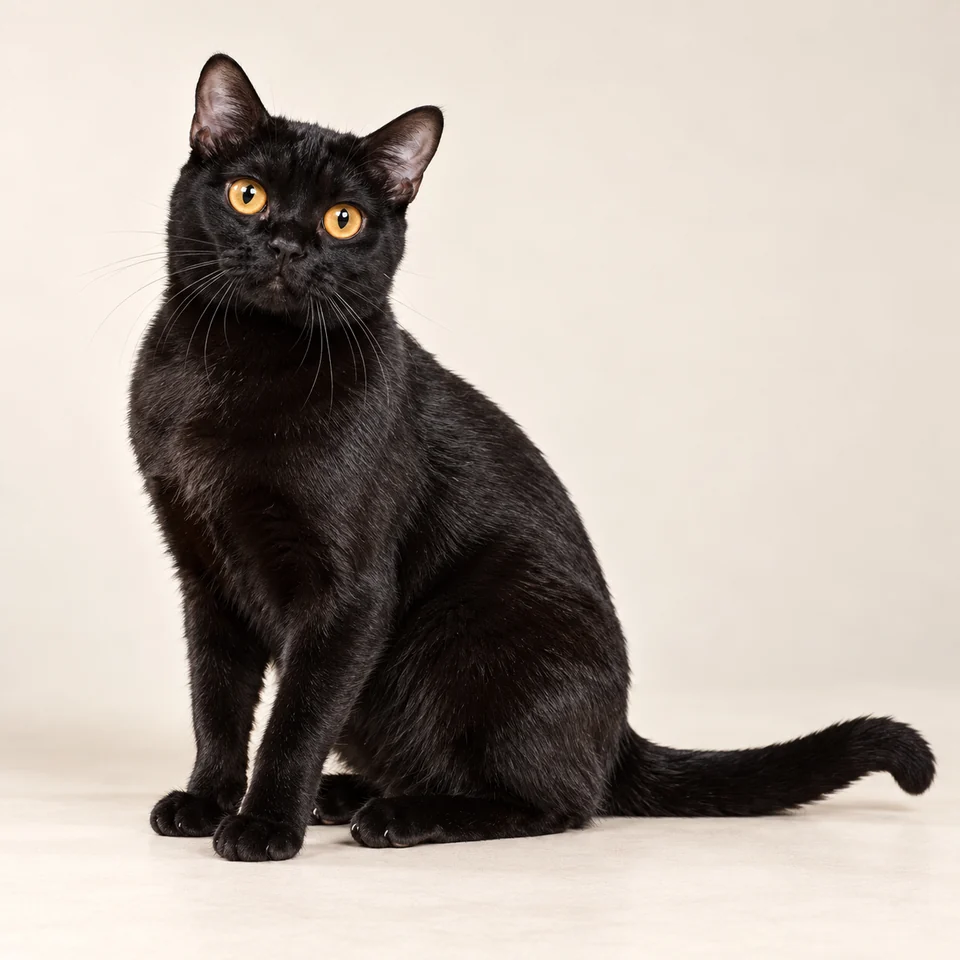
The Bombay looks like a small black panther.
It is a 100% domestic breed. It has a gleaming black coat and bright “copper-penny” eyes. The breed has a playful, outgoing personality. It was created in the 1960s from Burmese and American Shorthair cats.
Source:CFA
Quick facts
- Where it beganCFA
- United States: Kentucky breeder Nikki Horner created the breed.
- When it beganCFATICA
- The birth of the breed is given as 1966, in a decade of work through the 1960s. Another account says Nikki Horner began developing the breed in 1953.
- LifespanTICA
- Life expectancy is 12+ years.
- CFA statusCFA
- Championship (since 1976)
- TICA statusTICA
- Championship (accepted June 1979)
Appearance
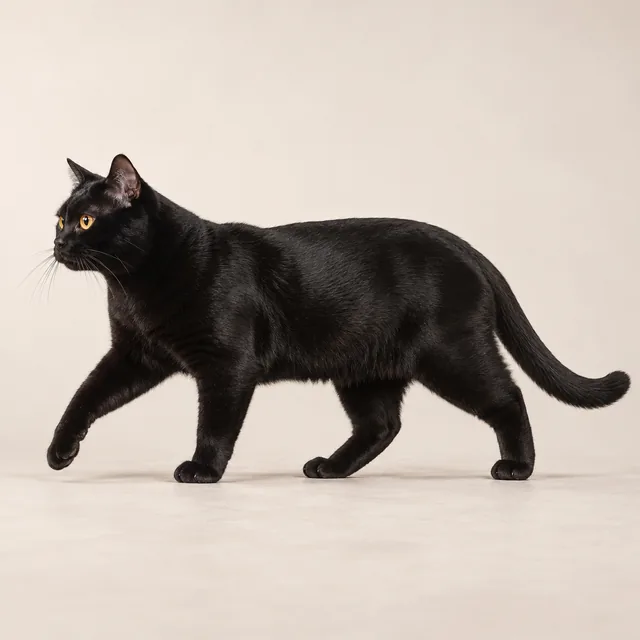
The Bombay is medium-sized, solid and muscular.
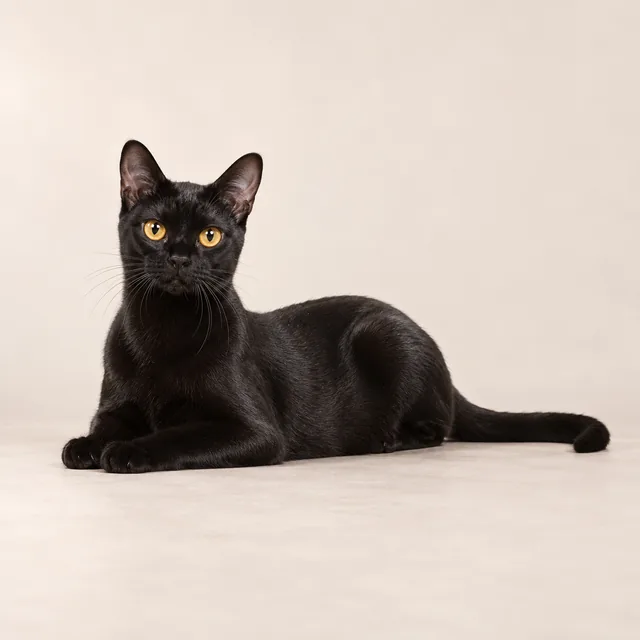
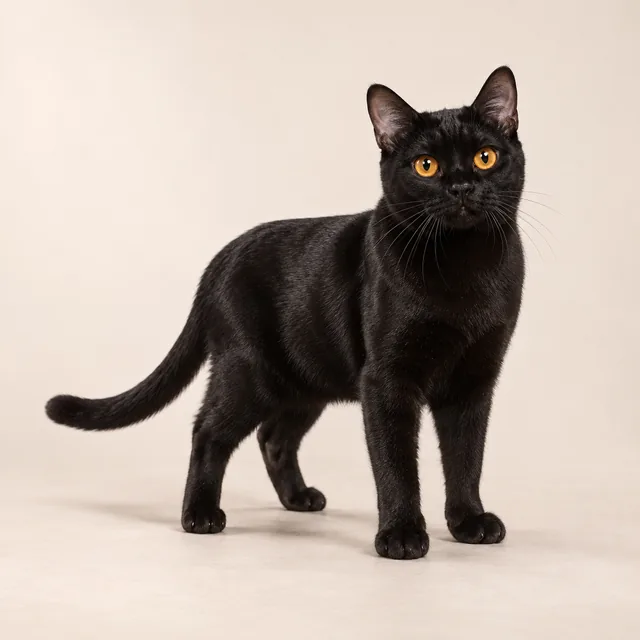
It feels heavier than it looks. The black coat is short, dense and close-lying. Its sheen can be so bright you almost see your reflection. The head is rounded with a short, broad muzzle. The eyes are round and gold to deep copper.
Source:CFA
Body
Solid and muscular, with surprising weight for its size. Neither compact nor rangy by one standard. Fairly compact by the other, with the Bombay torso somewhat longer than the Burmese.
Colors and patterns
Black only. Mature show cats should be black to the roots, with black nose leather and paw pads.
Personality
Bombays are sometimes called part cat, part dog and part clown.
They mix the easy-going American Shorthair with the curious, lap-loving Burmese. They are intelligent and mischievous. They love toys. They are playful and affectionate.
Source:CFA
With their people
Bombays like to be the center of attention when you have guests. They act as if every visitor came to see the cat. They greet family and visitors at the door with loving enthusiasm. They may be unhappy if left alone for long periods. Another cat if you will be gone most of the day.
Lap time
Bombays are lap cats. They like head-butting, kisses and snuggling with their people at night.
Source:CFA
Living with a Bombay
Care
Bombays may be one of the easiest breeds to groom.
Use a rubber curry brush two or three times a month to remove loose hair. The short, fine coat sheds little. Weekly brushing keeps it easy to care for.
Baths
A quick bath can help if brushing does not control shedding. Bombays usually take well to baths. Ask your breeder about shampoo and conditioner.
Source:CFA
Nails, ears, eyes and teeth
Bombays sometimes have overly teary eyes that need regular wiping.
Source:CFA
Health
Bombays are considered quite healthy because of their hybrid ancestry.
They sometimes have overly teary eyes. Hypertrophic cardiomyopathy (HCM), the most common heart problem in cats, has also been found in Bombays. The Bombay is generally healthy. But like all cats, it is at risk for HCM. HCM is a genetic disease that can lead to heart failure and death.
Screening
Responsible breeders test their cats for HCM before breeding. This lowers the chance of passing it to kittens. Breeders should screen with an echocardiogram (heart ultrasound) done by a veterinary cardiologist.
CFA health notes
Considered quite healthy due to hybrid ancestry; sometimes overly teary eyes needing regular wiping; HCM has been found, and responsible breeders test before breeding.
Source:CFA
This is what CFA and TICA say about the breed. It is not a health promise for any kitten. TrueKitten verifies breeder identities and documents, but that does not guarantee a kitten's health. Ask the breeder for test results and talk to your vet.
History
The breed was born in 1966.
Kentucky breeder Nikki Horner crossed the American Shorthair and the Burmese. She began with a black American Shorthair male and a Burmese female. She then used line breeding and careful outcrossing. Bombays were accepted for registration in 1970 and for championship in 1976. The first Bombay national winner came in 1982. Another account says Nikki Horner began developing the breed in 1953. A second registry accepted the Bombay for championship competition in June 1979.
Recognition dates
- 1970CFA Accepted for registration
- 1976CFA Advanced to championship status
- 1982CFA First Bombay national win
- 1979TICA Accepted for championship competition
Did you know?
- The name was inspired by the black leopards of India and the city of Bombay.
- The coat can shine so brightly you can almost see your reflection.
- Bombays are sometimes described as part cat, part dog and part clown.
- The Bombay is one of its rarer breeds, though it is popular in the show ring.
Source:CFA
For breeders
Details from the CFA and TICA show standards. Cat show judges use them. They do not rate a kitten as a pet.
What the show standards ask for
- General: medium-size hybrid of Burmese and American Shorthair; muscular, with surprising weight for its size.
- Head: rounded with no sharp angles or flat planes; full face; broad, rounded, well-developed muzzle.
- Profile: moderate visible stop, not a break and not pugged or snubbed; good depth from skull to jaw.
- Ears: medium, set well apart, broad at base, slightly rounded tips, tilting slightly forward.
- Eyes: large, round, set far apart; gold to copper, copper preferred.
- Body: medium and muscular, neither compact nor rangy to fairly compact; rounded ample chest.
- Tail: straight, medium length, neither short nor whippy; tapering to a rounded tip.
- Coat: fine, short, satin-like, close-lying, patent-leather sheen; little to no undercoat.
- Color: black to the roots; black nose leather and paw pads.
Points show how much each part counts when a judge scores a cat at a show. They add up to 100.
| Part | Points |
|---|---|
| Head and EarsRoundness of head 7, Full face and proper profile 7, Ears 7, Chin 4 | 25 |
| EyesPlacement and shape 5 | 5 |
| BodyBody 15, Tail 5 | 20 |
| CoatShortness 10, Texture 5, Close lying 5 | 20 |
| ColorBody color 20, Eye color 10 | 30 |
Source:CFA
| Part | Points |
|---|---|
| Head | 38 |
| Body | 35 |
| Coat/Color/Pattern | 27 |
Source:TICA
CFA allowed outcrosses
Black American Shorthair, Sable Burmese (reference note, not part of the official show standard)
Source:CFA
CFA allowances
No separate ALLOWANCES section. In-text: larger size in males; kitten coats darken and become sleeker with age.
Source:CFA
TICA allowances
ALLOWANCES: None (section heading). In-text allowances: paler eye color in older cats; for the Bombay coat, allowance for kittens and younger cats up to 2 years of age.
Source:TICA
TICA penalties
(BO): ranginess; fine boning; long, whippy tail; flat plane to forehead; flared ears; pointed ears; tufts; almond-shaped eyes; oriental slant to the eyes.
Source:TICA
CFA disqualifications
Kinked or abnormal tail; lockets or spots; incorrect number of toes; nose leather or paw pads other than black; green eyes; improper bite; extreme break that interferes with normal breathing and tearing of eyes.
Source:CFA
TICA disqualifications
DQ: improper bite; any sign of definite challenge in temperament; plus Show Rules Article Sixteen mandatory disqualifications. Withhold all awards (BO): green eyes; extreme exotic type of profile; extremely protruding eyes and/or protruding chin; thick or open-lying coat; lockets; nose leather or paw pads other than black.
Source:TICA
CFA breeding notes
Black American Shorthair and Sable Burmese are allowable outcross breeds (reference note, not part of the standard). Responsible breeders test for HCM before breeding.
Source:CFA
TICA standard version
Burmese/Bombay Breed Group, 05/01/2023 (Revised 2-Sep-2022, Updated 12-Oct-2022)
Source:TICA
Common questions
Bombays are sometimes called part cat, part dog and part clown. They mix the easy-going American Shorthair with the curious, lap-loving Burmese. They are intelligent and mischievous. They love toys. They are playful and affectionate.
Bombays are lap cats. They like head-butting, kisses and snuggling with their people at night.
Bombays like to be the center of attention when you have guests. They act as if every visitor came to see the cat. They greet family and visitors at the door with loving enthusiasm. They may be unhappy if left alone for long periods. Another cat if you will be gone most of the day.
If properly introduced, Bombays quickly bond with dogs and other pets.
Children will be enchanted by the Bombay’s devotion.
Burmese and Bombays are talkative, vocal and very happy to express their opinions.
Bombays may be one of the easiest breeds to groom. Use a rubber curry brush two or three times a month to remove loose hair. The short, fine coat sheds little. Weekly brushing keeps it easy to care for.
Life expectancy is 12+ years.
Bombays are considered quite healthy because of their hybrid ancestry. They sometimes have overly teary eyes. Hypertrophic cardiomyopathy (HCM), the most common heart problem in cats, has also been found in Bombays. The Bombay is generally healthy. But like all cats, it is at risk for HCM. HCM is a genetic disease that can lead to heart failure and death.
Gold to copper. The greater the depth and brilliance the better. Copper is preferred; green eyes are a show fault; paler color is allowed in older cats.
The breed was born in 1966. Kentucky breeder Nikki Horner crossed the American Shorthair and the Burmese. She began with a black American Shorthair male and a Burmese female. She then used line breeding and careful outcrossing. Bombays were accepted for registration in 1970 and for championship in 1976. The first Bombay national winner came in 1982. Another account says Nikki Horner began developing the breed in 1953. A second registry accepted the Bombay for championship competition in June 1979.
Questions to ask a breeder
- Have both parents had an echocardiogram for hypertrophic cardiomyopathy (HCM) before breeding? Who performed it, and may I see the results?
- Have the parents or this kitten had teary eyes? How do you care for them?
- Are there American Shorthair or Burmese outcrosses in this pedigree?
- How has this kitten been introduced to children, dogs or other pets?
- Which registry is this kitten registered with?
Sources
Every fact on this page comes from the two cat registries, CFA and TICA.
Last updated