
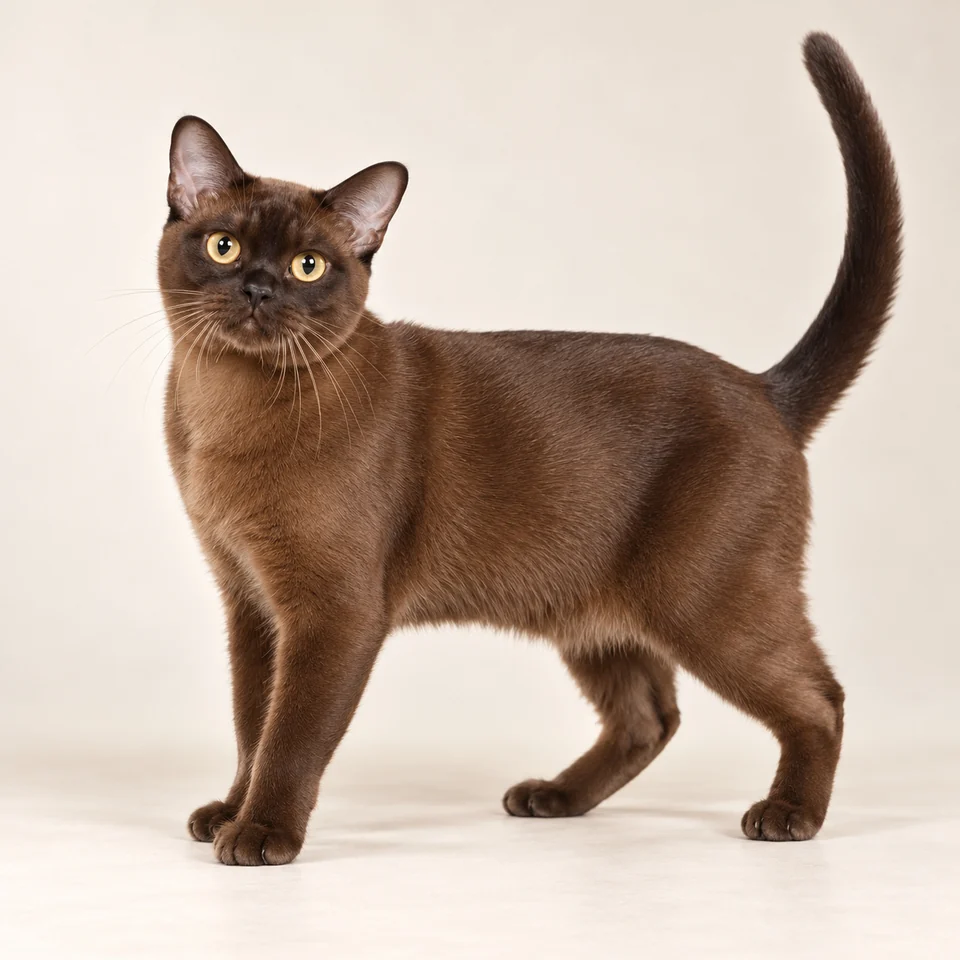
The Burmese is a medium-size cat with a lot of muscle.
It feels heavy for its size. Burmese are often called "Velcro kitties" because they stay close to their people. They have bright gold eyes and a short, glossy coat. The body is summed up as "a brick wrapped in silk."
Quick facts
- Where it beganCFA
- Burmese occur naturally on the Malay Peninsula. Most of today's Burmese were developed in America from one cat, Wong Mau.
- When it beganCFA
- 1930, when Wong Mau was brought to America; Burmese were first registered in 1936.
- Coat feelCFA
- Fine, glossy and satin-like; very short and close-lying
- WeightCFA
- A mature male may reach or exceed 12 pounds. Females are usually smaller. No full weight range is published.
- Fully grownCFA
- Burmese are fully grown at 18 months.
- CFA statusCFA
- Championship (since 1959)
Appearance
The Burmese is compared to a small bulldog.
It has a rounded head and a short, broad muzzle. The gold eyes are set well apart. The look is sweet and innocent. The coat is very short, fine and glossy, with a satin-like finish.
Source:CFA
Colors and patterns
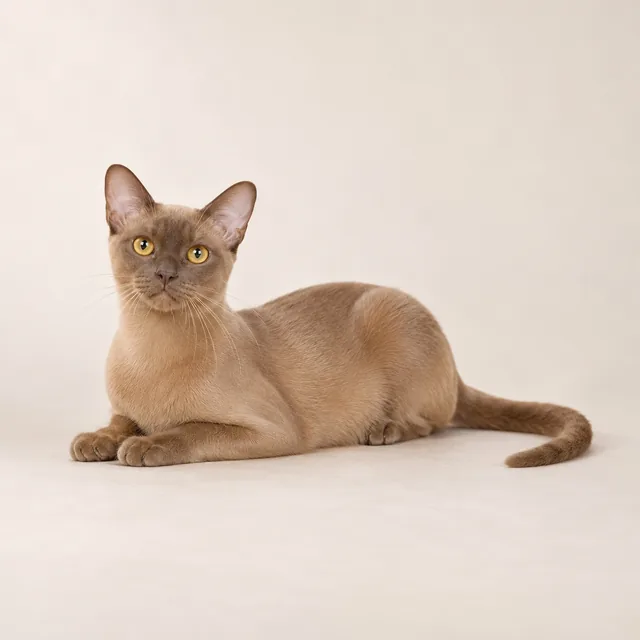
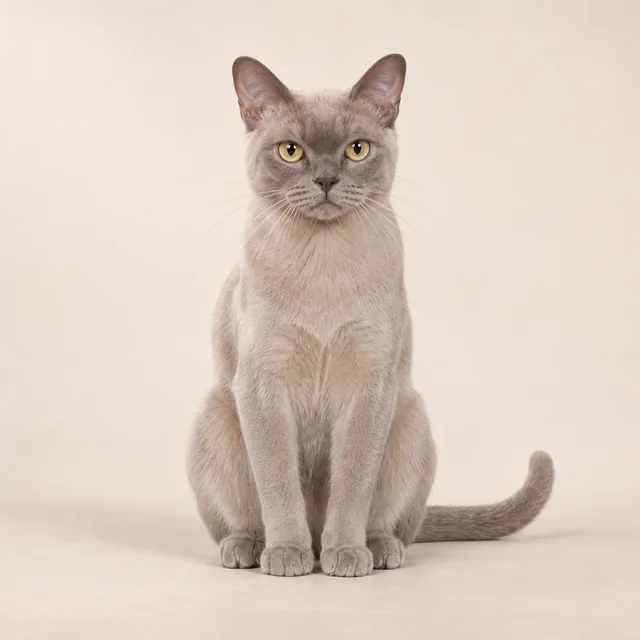
One registry accepts four solid colors: sable, champagne, blue and platinum. The other allows all colors in the solid and tortoiseshell divisions, in the sepia category.
Personality
Burmese are curious, clever and friendly.
They adore their people. They thrive on attention but can amuse themselves when needed. They do not pick one special person. They share affection with everyone nearby. Most think it is their job to run the house.
Source:CFA
With their people
Burmese are extremely people oriented. They will follow you from room to room. At bedtime, many like to sleep on your bed if allowed.
Source:CFA
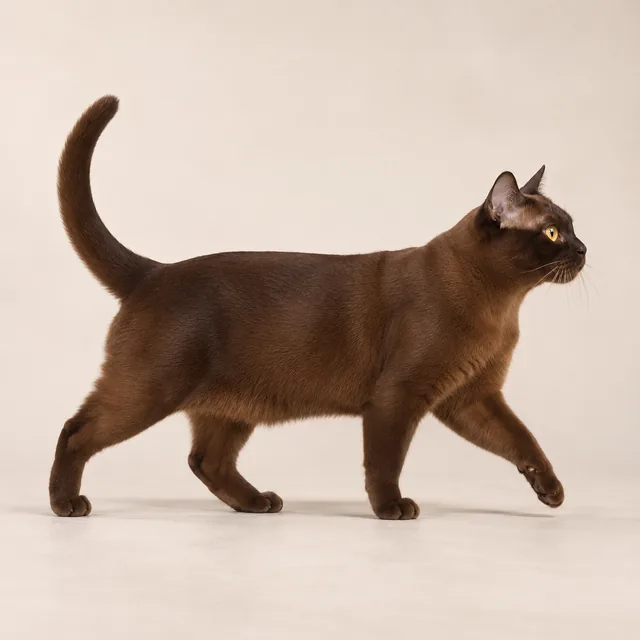
Living with a Burmese
Care
Health
Burmese, like all cats, are at risk for hypertrophic cardiomyopathy (HCM), the most common heart disease.
Burmese once had more cases of feline infectious peritonitis (FIP) than average. Careful breeding has largely removed that problem. Older cats may be prone to diabetes, but the research is not conclusive.
Health questions to ask
Asking about any diabetes in the breeder's lines is recommended. As your cat ages, keep up regular checkups and watch carbohydrate intake.
Source:CFA
CFA health notes
The Burmese is a relatively healthy natural breed. FIP, once more common in Burmese, now occurs no more often than in other breeds. Diabetes risk in older cats is possible but not proven.
Source:CFA
This is what CFA and TICA say about the breed. It is not a health promise for any kitten. TrueKitten verifies breeder identities and documents, but that does not guarantee a kitten's health. Ask the breeder for test results and talk to your vet.
History
Burmese occur naturally on the Malay Peninsula.
Most of today's Burmese trace back to one cat, Wong Mau. She was brought to America in 1930. She was bred to Siamese and had three types of kittens. The solid brown kittens bred true. They were first registered in 1936. The breed reached championship status in 1959. Dilute colors appeared over time and, after much debate, were accepted.
Source:CFA
For breeders
Details from the CFA and TICA show standards. Cat show judges use them. They do not rate a kitten as a pet.
What the show standards ask for
- Head: rounded with no flat planes; full face.
- Muzzle: short, broad and well-developed, keeping the rounded contours; rounded, short, broad.
- Profile: visible nose break; visible break (BU).
- Ears: medium, set well apart, broad at the base, rounded tips, tilting slightly forward.
- Eyes: large, set far apart, rounded aperture; large, round, wide set. Yellow to gold; gold.
- Body: medium, muscular, compact, with an ample rounded chest and level back; musculature alone scores 12 points.
- Legs and paws: well proportioned; round paws. Tail straight, medium length; tapering to a rounded tip.
- Coat: fine, glossy, satin-like, short and very close-lying; little to no undercoat with a glossy sheen.
- Color: sable, champagne, blue or platinum at some shows; all colors, solid and tortoiseshell, at others.
Points show how much each part counts when a judge scores a cat at a show. They add up to 100.
| Part | Points |
|---|---|
| HEAD, EARS and EYESRoundness of head 7, Breadth between eyes and Full face 6, Proper profile (includes Chin) 6, Ear set, placement, and size 6, Eye placement and shape 5 | 30 |
| BODY, LEGS, FEET, and TAILTorso 15, Muscle tone 5, Legs and Feet 5, Tail 5 | 30 |
| COATShortness 4, Texture 4, Close lying 2 | 10 |
| COLORBody color 25, Eye color 5 | 30 |
Source:CFA
| Part | Points |
|---|---|
| HEAD | 38 |
| BODY | 35 |
| COAT/COLOR/PATTERN | 27 |
Source:TICA
CFA allowed outcrosses
Tonkinese through December 31, 2031; imported Southeast Asian Cats; sable Bombay through December 31, 2031 (reference text, not an official part of the show standard)
Source:CFA
TICA allowances
Section heading: "Allowances: None." Elsewhere the standard allows paler eye color in older cats, coat allowance for kittens and cats up to 2 years, and (non-sable colors) slightly darker extremities.
Source:TICA
CFA penalties
Distinct barring on the front or rear outer legs (trace barring permitted in kittens and young adults); elongated muzzle with severe narrowing giving a wedge-shaped head; green eyes; abnormal tail.
Source:CFA
TICA penalties
(BU) Ranginess, fine boning; long, whippy tail; flat plane to forehead; flared ears; pointed ears; tufts; almond-shaped eyes; oriental slant to the eyes.
Source:TICA
CFA disqualifications
Kinked tail; lockets or spots; blue eyes; crossed eyes; incorrect nose leather or paw pad color; malocclusion causing severe underbite or overbite, protruding teeth, or a wry face or jaw; distinct barring on the torso; any color other than sable, champagne, blue and platinum.
Source:CFA
TICA disqualifications
Withhold all awards (BU): green eyes; extreme exotic type of profile; extremely protruding eyes and/or protruding chin; thick or open-lying coat; lockets. Disqualify: improper bite; any sign of definite challenge in temperament; plus the mandatory Show Rules Article Sixteen disqualifications listed in the standard (e.g. biting, intent to deceive, missing testicles in adult whole males, tail missing, extra toes, crossed eyes, total blindness, markedly smaller size, sternum depression).
Source:TICA
TICA standard version
Revised 2-Sep-2022 (Updated 12-Oct-2022); Burmese/Bombay Breed Group, 05/01/2023
Source:TICA
Common questions
A mature male may reach or exceed 12 pounds. Females are usually smaller. No full weight range is published.
Life expectancy is 12+ years. Burmese can live very long lives with proper care.
Burmese are extremely people oriented. They will follow you from room to room. At bedtime, many like to sleep on your bed if allowed.
Burmese are known for being good with children.
They typically like, or at least tolerate, the family dog.
Burmese are low-maintenance. The coat sheds minimally. Brush it every week with a rubber brush. This removes dead hair and keeps the coat glossy.
Burmese are generally soft-spoken, but they will let you know if something is wrong. The Burmese and Bombay are talkative and vocal, and happy to express their opinions.
Burmese, like all cats, are at risk for hypertrophic cardiomyopathy (HCM), the most common heart disease. Burmese once had more cases of feline infectious peritonitis (FIP) than average. Careful breeding has largely removed that problem. Older cats may be prone to diabetes, but the research is not conclusive.
Burmese are fully grown at 18 months.
One registry accepts four solid colors: sable, champagne, blue and platinum. The other allows all colors in the solid and tortoiseshell divisions, in the sepia category.
Questions to ask a breeder
- Has diabetes occurred in your breeding lines?
- What heart screening, if any, have the parents had?
- Can I see health records for both parents?
- Which registry are the kittens registered with, and in which color?
- What grooming or bath products do you use on this coat?
Sources
Every fact on this page comes from the two cat registries, CFA and TICA.
Last updated