
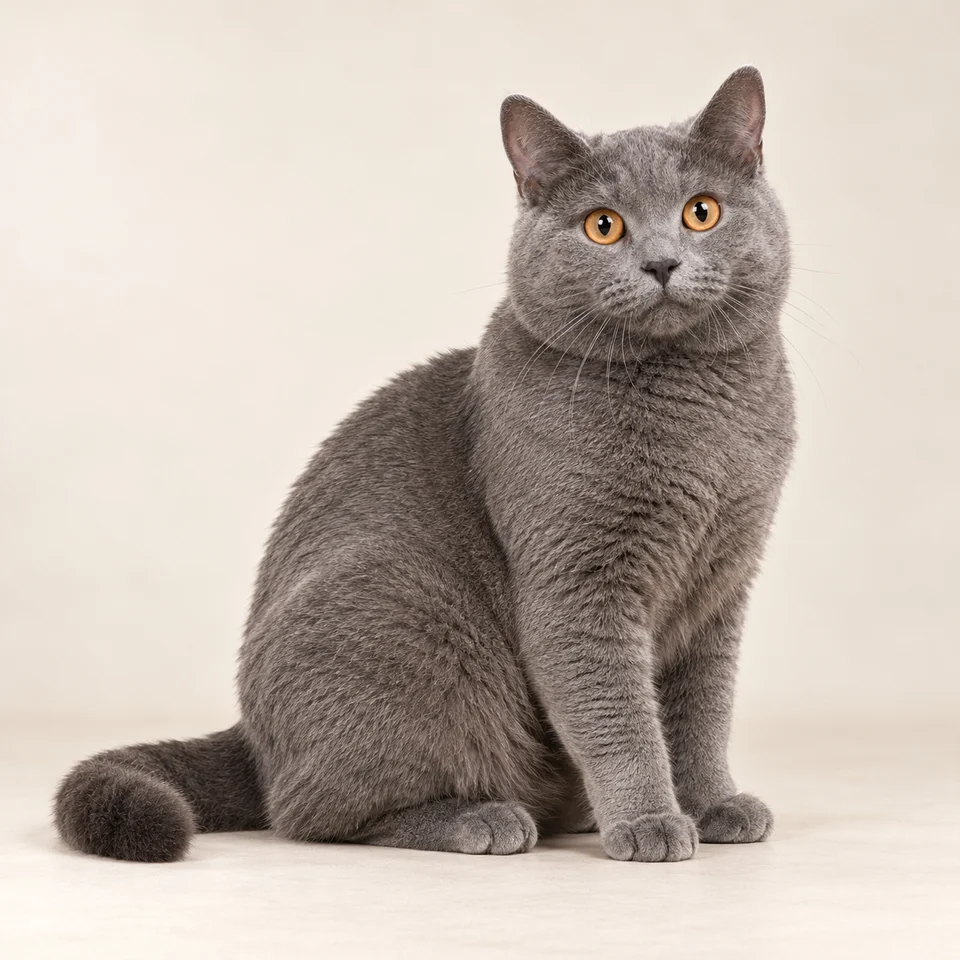
The Chartreux is a sturdy blue cat from France.
A legend links it to French monasteries. It is quieter than most breeds and has a calm, cheerful dignity. It is still playful and will join in interactive games. It is loyal, loving and adaptable.
Source:CFA
Quick facts
- Where it beganCFA
- France
- When it beganCFA
- Blue cats of France appear in literature from the 16th century; selective breeding in France began in the 1920s.
- SizeCFA
- Medium (females) to large (males); amply built
- Coat lengthCFA
- Shorthair
- Coat feelCFA
- Medium-short and slightly woolly; breaks like sheepskin at the neck and flanks; somewhat water-resistant
- WeightCFATICA
- The breed page lists 12–16 pounds. The show standard says mature males weigh 10–14 pounds and mature females at least 6–9 pounds. Males may weigh as much as 14 pounds, and females may be much smaller.
- LifespanTICA
- Life expectancy is 8 to 13+ years.
- Fully grownCFA
- Chartreux take three to five years to mature. Males are slower to mature than females.
Appearance
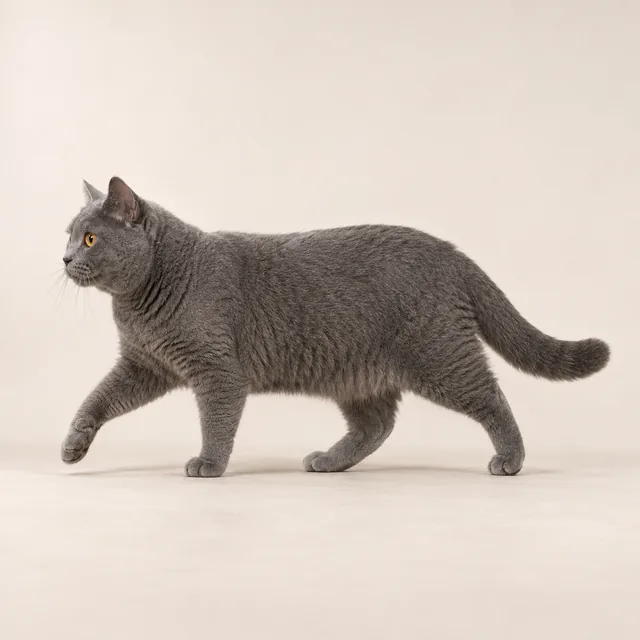
The breed has a broad-shouldered, powerful body on fairly fine-boned legs.
The broad, rounded head tapers to a narrow muzzle. Whisker pads give a hint of a smile. Ears are medium and set high. The round eyes range from gold to copper. The dense, woolly coat is blue.
Source:CFA
Body
Robust, medium-long body with broad shoulders and deep chest; dense muscle; comparatively short, fine-boned legs
Source:CFA
Colors and patterns
Blue only. Any shade of blue-gray from ash to slate is accepted, with tips lightly brushed with silver. A bright, even blue is preferred.
Source:CFA
Eye colors
Copper to gold; a clear, deep, brilliant orange is preferred. Green eyes are a show disqualification.
Source:CFA
Personality
Chartreux are intelligent, with lightning-fast reflexes.
They form close, loving bonds with their owners, yet are polite and not demanding. They are creatures of habit. They enjoy routines with their family.
Source:CFA
With their people
They often follow their owners from room to room. Treated with kindness and patience, they repay you with loyal affection.
Source:CFA
Voice
Many Chartreux have a tiny voice they rarely use, and some are mute. They still communicate with murmurs, chirps, their eyes and body language.
Source:CFA
Living with a Chartreux
Chartreux are not recommended for allergy sufferers, because of their abundant woolly undercoat.
Source:CFA
Care
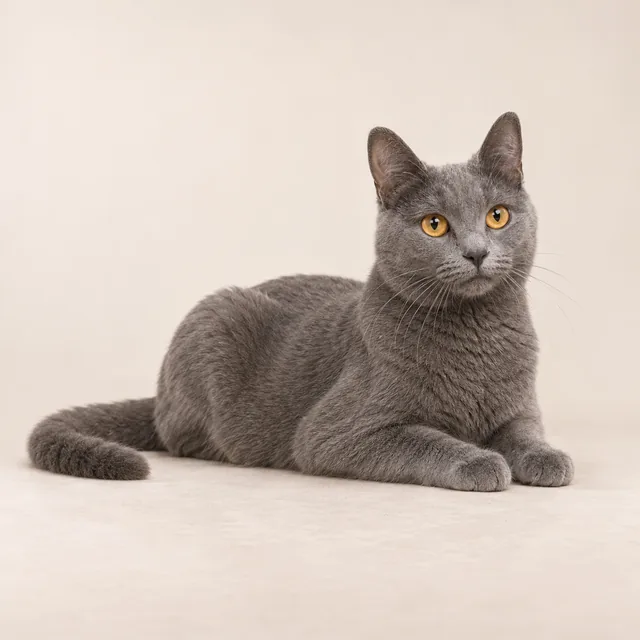
Chartreux shed by season, most in fall and spring.
Groom more often then. Occasional combing with a wide-spaced metal comb helps stop mats and hairballs. It also cuts down loose hair in your home.
Source:CFA
Baths
Most Chartreux do not need regular baths. If you plan a bath, ask your breeder first. The water-resistant coat is hard to wet fully.
Source:CFA
Nails, ears, eyes and teeth
Keep nails trimmed, ears cleaned and teeth brushed regularly with a vet-approved pet toothpaste.
Source:TICA
Food
Weight gain can be a problem for some mature Chartreux. Ask your breeder for diet advice if your cat struggles to keep a healthy body condition.
Source:CFA
Health
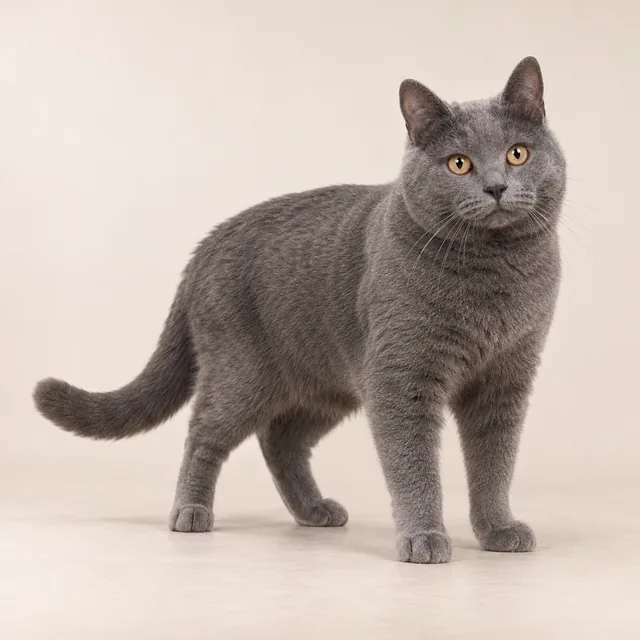
The Chartreux is generally healthy.
Weight gain can be a problem in some mature cats. Patellar luxation, an inherited condition that can affect mobility, has been seen in some Chartreux.
Source:CFA
CFA health notes
Generally healthy; weight gain in some mature cats; patellar luxation seen in some cats, screenable by a vet; mildly affected cats are unlikely to develop mobility issues but should not be bred.
Source:CFA
This is what CFA says about the breed. It is not a health promise for any kitten. TrueKitten verifies breeder identities and documents, but that does not guarantee a kitten's health. Ask the breeder for test results and talk to your vet.
History
Blue cats of France appear in writing as early as the 16th century.
The name was once linked to Carthusian monks. It may instead come from a Spanish wool known to traders. Selective breeding in France began in the 1920s, using natural colonies of French blue cats. Chartreux first came to North America in 1970. Breeders have kept them largely unchanged since then.
Source:CFA
Did you know?
- A legend claims Chartreux took a vow of silence like the monks they lived with. It is a charming myth.
- Some Chartreux walk on a leash or fetch toys.
- North American breeders name each year's kittens with one letter, skipping K, Q, W, X, Y and Z.
- The coat is somewhat water-resistant.
Source:CFA
For breeders
Details from the CFA and TICA show standards. Cat show judges use them. They do not rate a kitten as a pet.
What the show standards ask for
- General: sturdy French shorthair; husky, robust "primitive" type, neither cobby nor classic; supple and agile.
- Head: rounded and broad but not a sphere; powerful jaw; full cheeks; larger jowls in mature males.
- Nose and muzzle: straight nose, medium length, slight stop at eye level; muzzle small, narrow and tapered; sweet, smiling expression.
- Ears: medium, set high, very erect.
- Eyes: rounded and open; copper to gold, brilliant orange preferred.
- Body: medium-long, broad shoulders, deep chest; strong boning; females medium, males large.
- Legs and feet: comparatively short, fine-boned, straight and sturdy; round medium feet.
- Tail: moderate length, heavy at base, tapering to an oval tip.
- Coat and color: medium-short, slightly woolly, resilient undercoat; any shade of blue-gray, tips brushed with silver.
Source:CFA
Points show how much each part counts when a judge scores a cat at a show. They add up to 100.
| Part | Points |
|---|---|
| HEADShape and size 6, Profile/nose 5, Muzzle 5, Ear shape and size 5, Ear placement 5, Eye shape and size 5, Neck 4 | 35 |
| BODYShape and size 8, Legs and feet 8, Boning 5, Musculature 5, Tail 4 | 30 |
| COATTexture 15, Length 5 | 20 |
| COLORCoat color 10, Eye color 5 | 15 |
Source:CFA
| Part | Points |
|---|---|
| HEAD | 39 |
| BODY | 32 |
| COAT/COLOR | 29 |
Source:TICA
CFA allowances
Coat texture, coat color and eye color affected by sex, age and natural factors should not be penalized; silkier, thinner coat permitted on females and cats under two; ghost barring in kittens and tail rings in juveniles under two allowed.
Source:CFA
CFA penalties
Severe nose break; snubbed or upturned nose; broad, heavy muzzle; palpable tail defect; eyes too close together giving an angry look.
Source:CFA
CFA disqualifications
White locket; visible tail kink; green eyes; any signs of lameness in the hindquarters.
Source:CFA
CFA breeding notes
Cats with mild patellar luxation should not be used for breeding. U.S. breeders work to keep a diverse gene pool and often exchange cats worldwide. North American breeders follow the French naming tradition: each year's kittens get names starting with one letter, using only 20 letters.
Source:CFA
Common questions
The breed page lists 12–16 pounds. The show standard says mature males weigh 10–14 pounds and mature females at least 6–9 pounds. Males may weigh as much as 14 pounds, and females may be much smaller.
Life expectancy is 8 to 13+ years.
Chartreux take three to five years to mature. Males are slower to mature than females.
Many Chartreux have a tiny voice they rarely use, and some are mute. They still communicate with murmurs, chirps, their eyes and body language.
Chartreux are known for dog-like behavior. Some enjoy leash walks or fetching toys. Many learn to respond to their names.
Chartreux shed by season, most in fall and spring. Groom more often then. Occasional combing with a wide-spaced metal comb helps stop mats and hairballs. It also cuts down loose hair in your home.
The Chartreux is generally healthy. Weight gain can be a problem in some mature cats. Patellar luxation, an inherited condition that can affect mobility, has been seen in some Chartreux.
Blue only. Any shade of blue-gray from ash to slate is accepted, with tips lightly brushed with silver. A bright, even blue is preferred.
Questions to ask a breeder
- Have the kitten and parents been checked by a vet for patellar luxation?
- Can I see health records for both parents?
- What do you feed, and how do you keep adults at a healthy weight?
- What letter-year name does this kitten carry?
- How do you groom the coat during seasonal shedding?
Sources
Every fact on this page comes from the two cat registries, CFA and TICA.
Last updated