
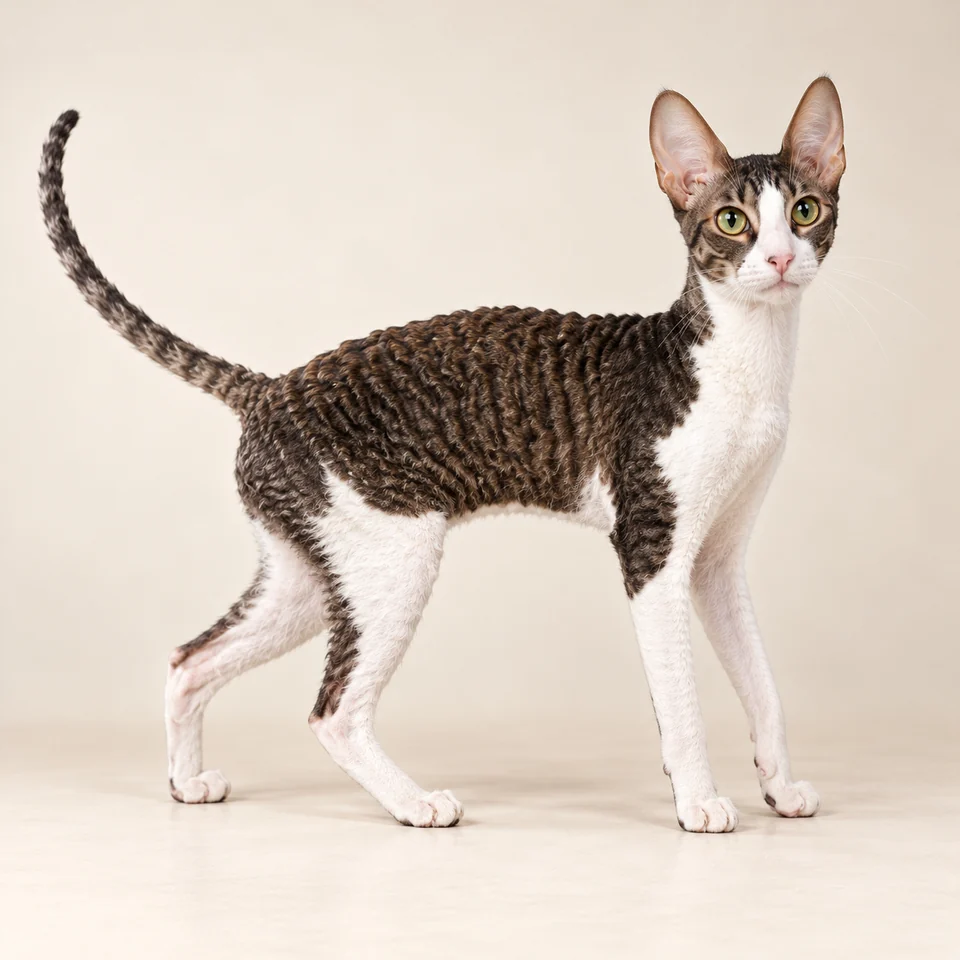
The Cornish Rex is like a greyhound with a clown's playful personality, dressed in curls.
Its coat has tight marcel waves and no guard hairs. That makes it very soft and silky. The coat is simple to care for and sheds very little. These cats are active and alert. They want to share every part of your life.
Source:CFA
Quick facts
- Where it beganCFA
- Cornwall, England
- When it beganCFA
- 1950
- SizeCFA
- Small to medium; males proportionately larger but never coarse
- Coat lengthCFA
- Shorthair (curly)
- Coat feelCFA
- Short, extremely soft and silky, with no guard hairs; a tight, uniform marcel wave lying close to the body.
- WeightCFATICA
- Females weigh 5–7 lb on average and males 8–10 lb. The cat is surprisingly heavy, and males are proportionately larger.
- LifespanTICA
- Life expectancy is 9–13+ years.
- CFA statusCFA
- Championship (achieved two years after 1962 registration)
Appearance
The Cornish Rex is lean and statuesque with an arched back.
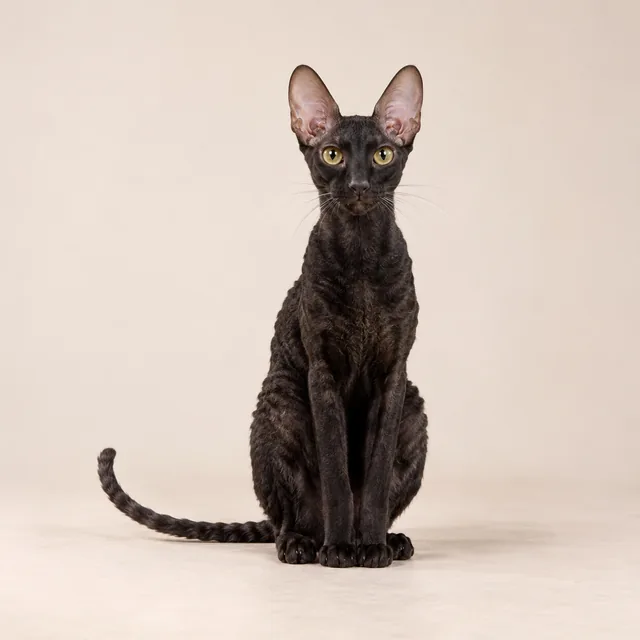
It has an egg-shaped head and large, high-set ears. The eyes are huge and luminous, and the Roman nose is prominent. The short coat lies close to the body in tight waves. It should feel dense and soft, not just curly.
Source:CFA
Body
Long, slender torso (not tubular) with a deep but not broad chest; naturally arched back; tucked-up waistline; muscular hips and thighs; very long, slender legs; fine, delicate bone.
Source:CFA
Colors and patterns
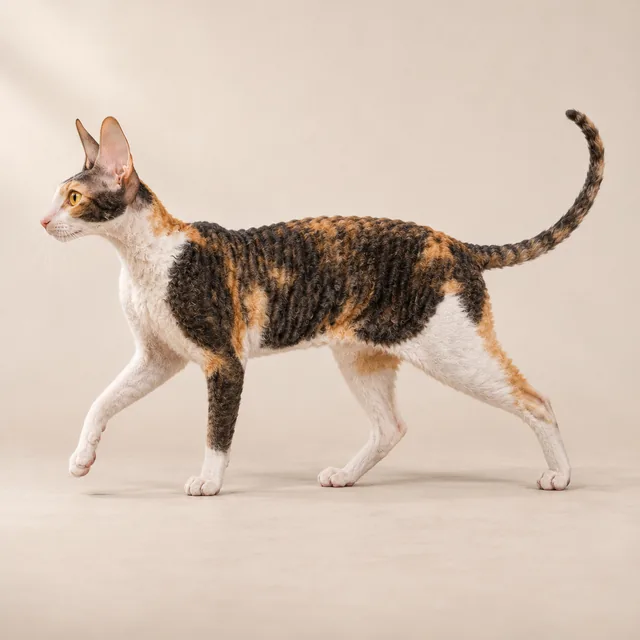
Many colors and patterns are accepted: solids, chinchilla and shaded silver, smokes, tabbies (classic, mackerel, spotted, ticked, patched), tortoiseshells, calicos and bi-colors, pointed and lynx point colors, plus ORC (Other Rex Colors) for any other color or pattern.
Source:CFA
Eye colors
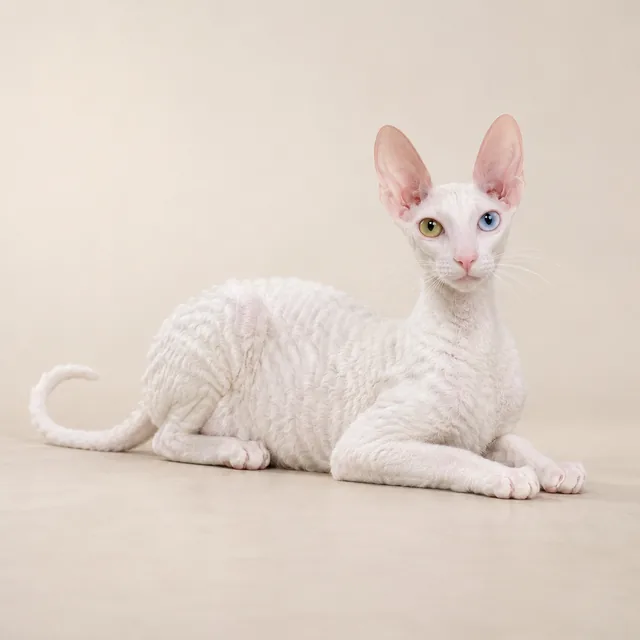
Eye color should be clear, intense and appropriate to coat color. Most colors call for gold eyes; whites may have deep blue, brilliant gold or odd eyes; chinchilla and shaded silvers have green or blue-green eyes.
Source:CFA
Personality
Today's "Corneys" are extremely intelligent, adaptable and adventurous.
They love to travel. They are also devoted to their people. The Cornish Rex is intelligent, alert and generally likes to be handled.
Source:CFA
With their people
Cornish Rex are often called "Velcro kitties." They need physical contact with their special person.
Source:CFA
Voice
Cornish Rex will join a conversation. But they are not given to needless or loud vocalizing.
Source:CFA
Living with a Cornish Rex
Cornish Rex are always looking for new things to play with.
Care
Regular combing is not needed because of the coat type.
They are true "wash-and-wear" cats.
Source:CFA
Baths
A bath may be needed now and then, because some cats get greasy over time. A good shampoo and a thorough towel dry are enough. Never use a blow dryer, because it will ruin the curls.
Source:CFA
Skin care
The lack of guard hairs makes the coat fragile. The coat may not protect the cat enough from the sun. Cats can get sunburned.
Source:CFA
Heat and cold
Cornish Rex are easily chilled in cold weather. You may want to give yours a sweater is recommended.
Source:CFA
Nails, ears, eyes and teeth
Pay attention to the ears. They may build up wax faster than in other breeds. Clean them often with a cotton ball or Q-tip.
Source:CFA
Health
The Cornish Rex is a sturdy, vigorous breed with no inherited health issues.
The fragile coat may not protect against the sun. They chill easily in cold weather.
Source:CFA
CFA health notes
"Breed Future": a sturdy, vigorous breed with no inherited health issues; the coat lacks guard hairs, is fragile, and may not give enough sun protection; easily chilled in cold weather.
Source:CFA
This is what CFA says about the breed. It is not a health promise for any kitten. TrueKitten verifies breeder identities and documents, but that does not guarantee a kitten's health. Ask the breeder for test results and talk to your vet.
History
The curly coat began as a mutation in Cornwall, England, in 1950.
A curly-coated cream male kitten was born to barn cats on Nina Ennismore's farm. She bred the kitten, Kallibunker, back to his mother. That produced two more curly-coated kittens. She had kept Rex rabbits, so she used the same name for the cats. Breedings with Burmese, Siamese and British Shorthairs showed the mutation was recessive. A California breeder bought a pair in 1956 to start the breed in the U.S. The breed was accepted for registration in 1962.
Source:CFA
Did you know?
- The breed is named after Rex rabbits, which its founder had kept.
- Cornish Rex have enormous appetites despite slim builds, and often eat vegetables and fruits.
- The show standard gives 40 of 100 points to the coat alone.
- Cornish Rex love to travel.
Source:CFA
For breeders
Details from the CFA and TICA show standards. Cat show judges use them. They do not rate a kitten as a pet.
What the show standards ask for
- Distinguished by an extremely soft, wavy coat and racy type; all contours gently curved.
- Head: comparatively small and egg-shaped, about one-third longer than wide; definite whisker break.
- Two convex arcs; rounded forehead; smooth, mild nose break; Roman nose with a high, prominent bridge.
- Ears: large and full from the base, erect, set high on the head.
- Eyes: medium to large, oval, slanting slightly upward, a full eye's width apart.
- Body: small to medium; long, slender torso; naturally arched back; tucked-up waist; muscular hips and thighs.
- Legs and tail: very long, slender legs (stands high); dainty, slightly oval paws; long, slender, extremely flexible tail.
- Coat: short, extremely soft, silky, free of guard hairs; tight, uniform marcel wave from head to tail tip.
Source:CFA
Points show how much each part counts when a judge scores a cat at a show. They add up to 100.
| Part | Points |
|---|---|
| HEADSize and shape 5, Muzzle and Nose 5, Eyes 5, Ears 5, Profile 5 | 25 |
| BODYSize 3, Torso 10, Legs and Paws 5, Tail 5, Bone 5, Neck 2 | 30 |
| COATTexture 10, Length 5, Wave, extent of wave 20, Close lying 5 | 40 |
| COLOR | 5 |
Source:CFA
| Part | Points |
|---|---|
| Head | 29 |
| Body | 29 |
| Coat/Color/Pattern | 32 |
| Other | 10 |
Source:TICA
CFA colors and patterns
Solid colors (white, black, blue, red, cream, chocolate, lavender); chinchilla silver and shaded silver; smokes (incl. tortoiseshell, chocolate tortoiseshell, blue-cream and lavender-cream smoke); tabbies in classic, mackerel, spotted and ticked patterns (incl. patched tabbies) in silver, blue-silver, red, brown, blue, cream, cream silver, cameo, chocolate and lavender; parti-colors; calicos and bi-colors; pointed and lynx point colors; ORC (Other Rex Colors).
Source:CFA
CFA allowed outcrosses
None (reference information, not an official part of the show standard)
Source:CFA
CFA allowances
Cats with no more white than a locket and/or button(s) are judged in their basic color class with no penalty. Males proportionately larger (but never coarse).
Source:CFA
CFA disqualifications
Kinked or abnormal tail. Incorrect number of toes. Any coarse or guard hairs. Any signs of lameness in the hindquarters. Signs of poor health.
Source:CFA
CFA breeding notes
Allowable outcross breeds: none (reference information, not an official part of the show standard). Historically, breedings with Burmese, Siamese and British Shorthairs showed the mutation was recessive and built the foundation.
Source:CFA
TICA breeding notes
Permissible outcrosses: American Shorthair, British Shorthair, European Shorthair.
Source:TICA
Common questions
The coat is prone to only minimal shedding.
Regular combing is not needed because of the coat type. They are true "wash-and-wear" cats.
A bath may be needed now and then, because some cats get greasy over time. A good shampoo and a thorough towel dry are enough. Never use a blow dryer, because it will ruin the curls.
Cornish Rex are easily chilled in cold weather. You may want to give yours a sweater is recommended.
Females weigh 5–7 lb on average and males 8–10 lb. The cat is surprisingly heavy, and males are proportionately larger.
Life expectancy is 9–13+ years.
Cornish Rex antics amuse children and adults alike.
Dogs will find them ready playmates.
Cornish Rex are always looking for new things to play with. Some of those things may not be right for them. Child-proofing the house and keeping fragile objects behind closed doors are recommended.
Questions to ask a breeder
- How do you keep your cats warm in cold weather, and out of strong sun?
- How often do you clean ears and bathe your cats?
- What health checks have the parents had, and may I see the records?
- How does this kitten handle being picked up and held?
- Does this kitten live with children or dogs now?
Sources
Every fact on this page comes from the two cat registries, CFA and TICA.
Last updated