
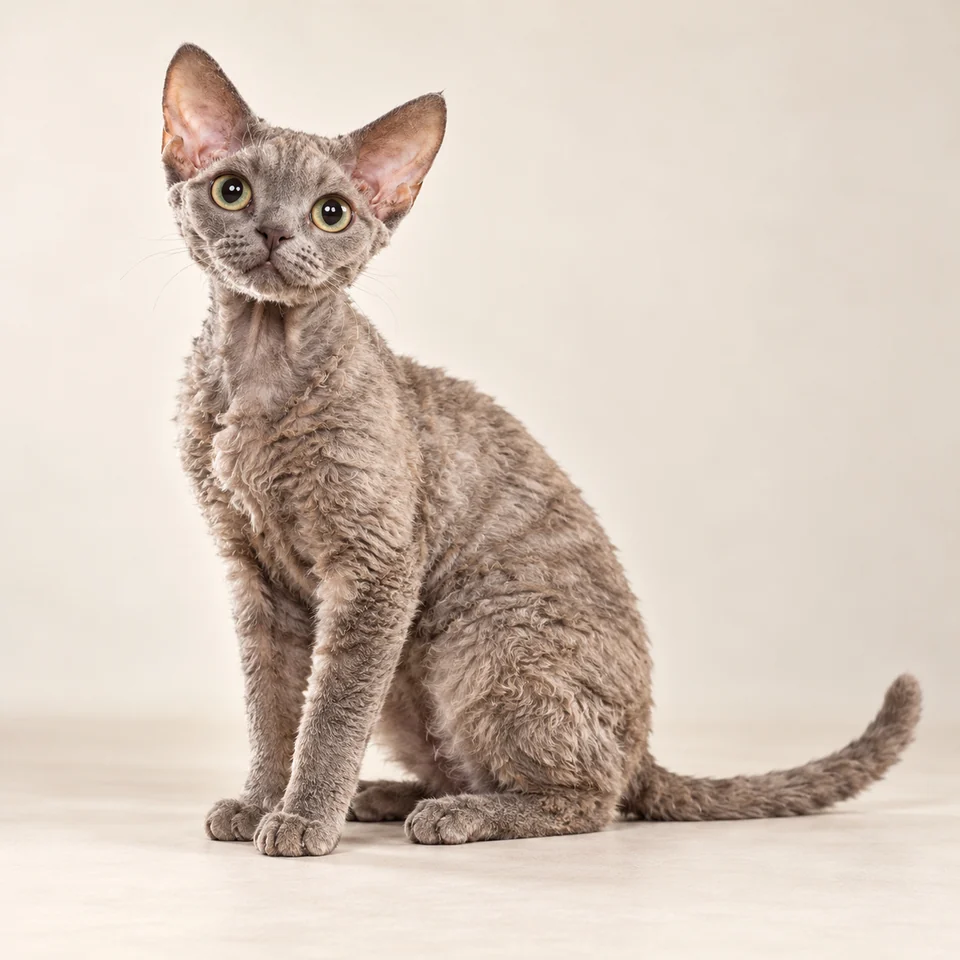
A Devon Rex looks like a cross between a cat and an elf.
Large eyes, a short muzzle and huge, low-set ears give it an elfin look. No other breed is bred for the mutation behind its wavy coat. Devons are cute, silly and fun. They are loyal and loving, and they dislike being left alone for long.
Source:CFA
Quick facts
- Where it beganCFA
- Devon, England
- When it beganCFA
- 1959
- SizeCFA
- Small to medium-sized, with surprising heft; medium fine frame
- Coat lengthCFA
- Shorthair (wavy)
- Coat feelCFA
- Soft, fine, full-bodied and rexed, with a rippled wave. The texture is tissue-soft. Devons have some very sparse, short, rexed guard hairs.
- WeightCFATICA
- The breed page lists females at 5–7 lb and males at 7–9 lb. Typical adult weights range from 6 to 9 lb, and males may be somewhat larger.
- LifespanTICA
- Life expectancy is 14–17+ years.
Appearance
The Devon Rex has large, expressive eyes and large ears set low on the sides of the head.
It has wide cheekbones and a mischievous look. The coat has gentle waves. Eyebrows and whiskers are curly but fragile and may break off. The chest is broad and the neck slender. The front legs are often held in a "bulldog" stance.
Source:CFA
Body
Hard, muscular, lithe body of medium length; broad chest; medium-fine boning; carried high on the legs, hind legs somewhat longer than the front.
Source:CFA
Colors and patterns
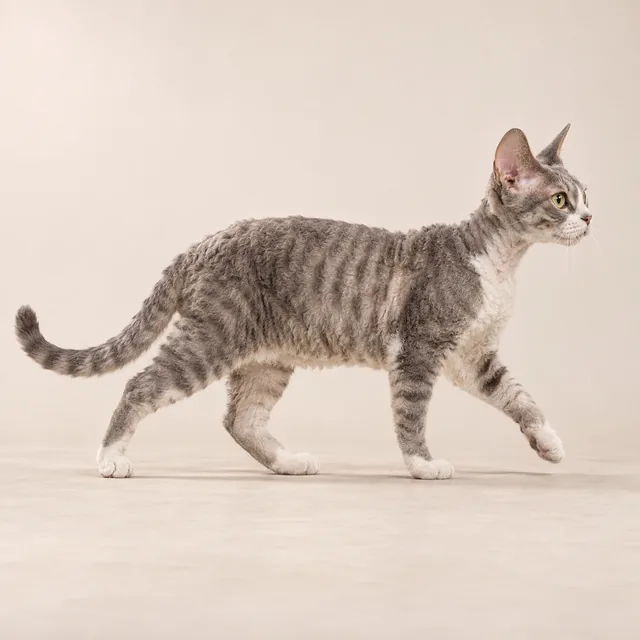
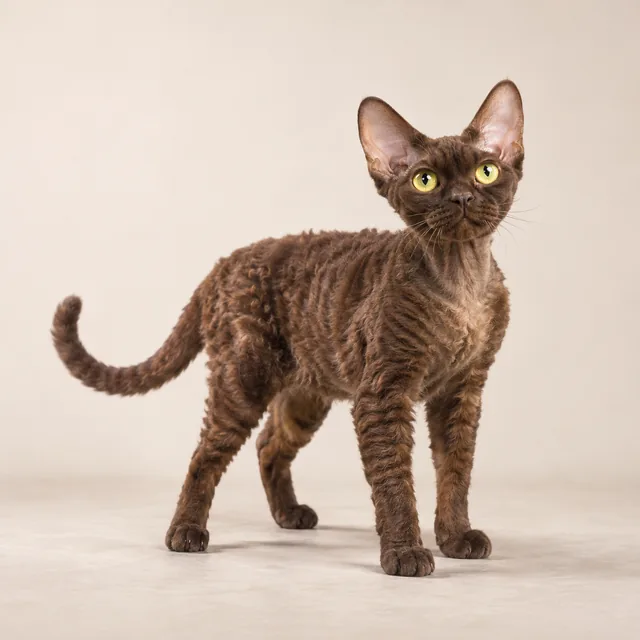
Any genetically possible color and pattern is allowed, in any combination. Devons offer one of the broadest ranges of colors and patterns of any breed.
Source:CFA
Eye colors
Any eye color is acceptable. Colorpoints generally have blue eyes and minks generally have aqua eyes.
Source:CFA
Personality
The Devon is "part court jester, part soulmate."
Devons try to be all things to all people. They are always eager to please. They are very intelligent cats. The Devon is alert and active, with a lively interest in its surroundings.
Source:CFA
With their people
Devons become deeply attached to their owners. They dislike being left alone for long periods. They follow their people everywhere in the house. They often want to "help" with whatever you are doing.
Source:CFA
Voice
Devons are talkative but not noisy. They use soft chirps, trills and peeps, along with happy purrs.
Source:CFA
Living with a Devon Rex
This breed suits someone who is comfortable being owned by a cat.
Care
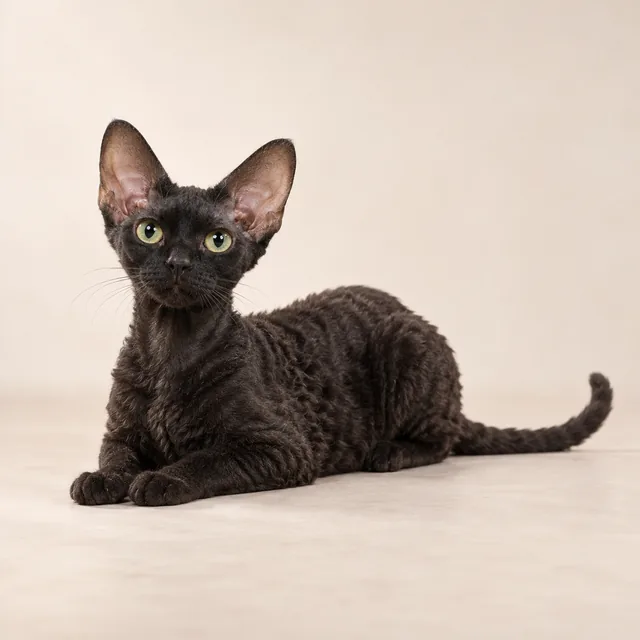
Devons are easy-care, wash-and-wear cats.
Their coat varies in density, texture and length. It can be somewhat fragile, which may leave bare or "sueded" spots now and then. Curly whiskers and eyebrows may break off.
Source:CFA
Nails, ears, eyes and teeth
Large ears tend to collect oily buildup. Clean them when they look dirty. Trim claws weekly.
Source:TICA
Health
Devons' varied genetic background means few health concerns would be expected.
But blood type B is common in the breed. If a type A male is bred to a type B female, the kittens can die unless they are hand-raised at first. Genetic testing for available markers, including Devon myopathy are recommended.
Screening
Genetic testing is essential for breeders because blood type B is common in the breed. All Devons should be genetically tested for all available genetic markers, including Devon myopathy. Parents should be scanned for HCM (hypertrophic cardiomyopathy).
CFA health notes
You would expect few health concerns, given the breed's varied genetic background. But blood type B is common in the breed. So genetic testing is essential for breeders. If an "A" male is bred to a "B" female, the kittens can die from blood type mismatch. This can happen unless the kittens are hand-raised at first.
Source:CFA
This is what CFA and TICA say about the breed. It is not a health promise for any kitten. TrueKitten verifies breeder identities and documents, but that does not guarantee a kitten's health. Ask the breeder for test results and talk to your vet.
History
In 1959 a curly-haired male kitten was born in a garden in Devon, England.
Beryl Cox gave him a home and named him Kirlee. At first, people thought he carried the Cornish Rex mutation. Test breedings proved this was wrong. Kirlee was bred to his own offspring to get more wavy-coated kittens. Later, his descendants were outcrossed with several other breeds.
Source:CFA
Did you know?
- A Devon may try to join you in the shower or fall into the bathtub with you.
- Devons have a robust appetite; fruit and vegetables may appeal to some as much as chicken or fish.
- Devon Rex were recently named the most popular shorthaired breed, based on registration statistics.
- Devons may be well tolerated by some people sensitive to cats, but stresses they are not hypoallergenic.
Source:CFA
For breeders
Details from the CFA and TICA show standards. Cat show judges use them. They do not rate a kitten as a pet.
What the show standards ask for
- Head: modified wedge outlined by three convex curves (outer ear edges, cheekbones, whisker pads); broad but slightly longer than broad; full cheeks.
- Strongly marked stop; forehead curving back to a flat skull; chin lines up vertically with nose.
- Ears: strikingly large, set very low and very wide at the base; with or without earmuffs or ear-tip tufts.
- Eyes: large, wide set, oval, sloping toward the outer edges of the ears; any eye color.
- Body: hard, muscular, lithe, medium length; broad chest; medium-fine boning; hind legs somewhat longer.
- Legs, paws and tail: long, slim legs; small oval paws; long, fine, tapering tail well covered with short fur.
- Coat: well covered, soft, fine, rexed; rippled wave most evident on body and tail; bare patches are a fault in kittens and a serious fault in adults.
- Points: head 40, body 25, coat and color 35.
Points show how much each part counts when a judge scores a cat at a show. They add up to 100.
CFA colors and patterns
Any genetically possible color and pattern and any combination. These include solids (incl. cinnamon and fawn), shaded, chinchilla and smoke, tabbies (classic, mackerel, spotted, ticked, patched), tortoiseshells, calicos and van patterns, bi-colors, pointed, mink and sepia patterns, and ODRC (Other Devon Rex Colors). Seal is used in place of black in pointed, mink and sepia. Classes: Solid, Tabby, Bi-color, ODRC.
Source:CFA
TICA allowed outcrosses
American Shorthair, British Shorthair, European Shorthair, Burmese, Bombay, Sphynx, Siamese
Source:TICA
CFA allowed outcrosses
American Shorthair or British Shorthair; kittens born on or after May 1, 2028 may have only Devon Rex parents (reference information, not an official part of the show standard).
Source:CFA
CFA allowances
Stud jowls in adult males. Larger size in males, if good proportions are kept. Ears with or without earmuffs and/or ear-tip tufts. Slightly less coat density on top of head, neck, chest and abdomen; down on underparts is not bareness; sparse hair on the temples is not a fault. Any eye color.
Source:CFA
CFA penalties
Heads that are long and/or narrow, or taper like a "V"; flared ears; round heads or a mixed-breed look; extremely short muzzle; misaligned bite; small or high-set ears; short or bare tail; straight coat; bare patches.
Source:CFA
CFA disqualifications
Extensive baldness; excessively long and/or shaggy coat; long hair on the tail; kinked or abnormal tail; incorrect number of toes; crossed eyes; weak hind legs; any evidence of illness or poor health.
Source:CFA
CFA breeding notes
Allowable outcross breeds: American Shorthair or British Shorthair. Kittens born on or after May 1, 2028 may have only Devon Rex parents. (Reference information, not an official part of the show standard.) Genetic testing is essential for breeders because blood type B is common in the breed.
Source:CFA
TICA breeding notes
Outcrosses for the Devon Rex group are American Shorthair, British Shorthair, European Shorthair, Burmese, Bombay, Sphynx and Siamese. Genetic testing for all available markers including Devon myopathy, and HCM scans for parents are recommended.
Source:TICA
Common questions
All cats shed, but Devons shed less than most.
Devons are easy-care, wash-and-wear cats. Their coat varies in density, texture and length. It can be somewhat fragile, which may leave bare or "sueded" spots now and then. Curly whiskers and eyebrows may break off.
Genetic testing is essential for breeders because blood type B is common in the breed. All Devons should be genetically tested for all available genetic markers, including Devon myopathy. Parents should be scanned for HCM (hypertrophic cardiomyopathy).
The breed page lists females at 5–7 lb and males at 7–9 lb. Typical adult weights range from 6 to 9 lb, and males may be somewhat larger.
Life expectancy is 14–17+ years.
Devons become deeply attached to their owners. They dislike being left alone for long periods. They follow their people everywhere in the house. They often want to "help" with whatever you are doing.
Devons get along very well with children. They calmly put up with dress-up or tea-party games.
Devons are talkative but not noisy. They use soft chirps, trills and peeps, along with happy purrs.
Questions to ask a breeder
- What are the blood types of the parents, and how do you manage type A and type B pairings?
- Have the parents been tested for Devon myopathy and other available genetic markers? May I see the results?
- Have the parents been scanned for hypertrophic cardiomyopathy (HCM)?
- How long is this kitten usually left alone, and does it live with other pets?
- Has this kitten had any bare patches or broken whiskers, and how do you care for its coat?
Sources
Every fact on this page comes from the two cat registries, CFA and TICA.
Last updated