
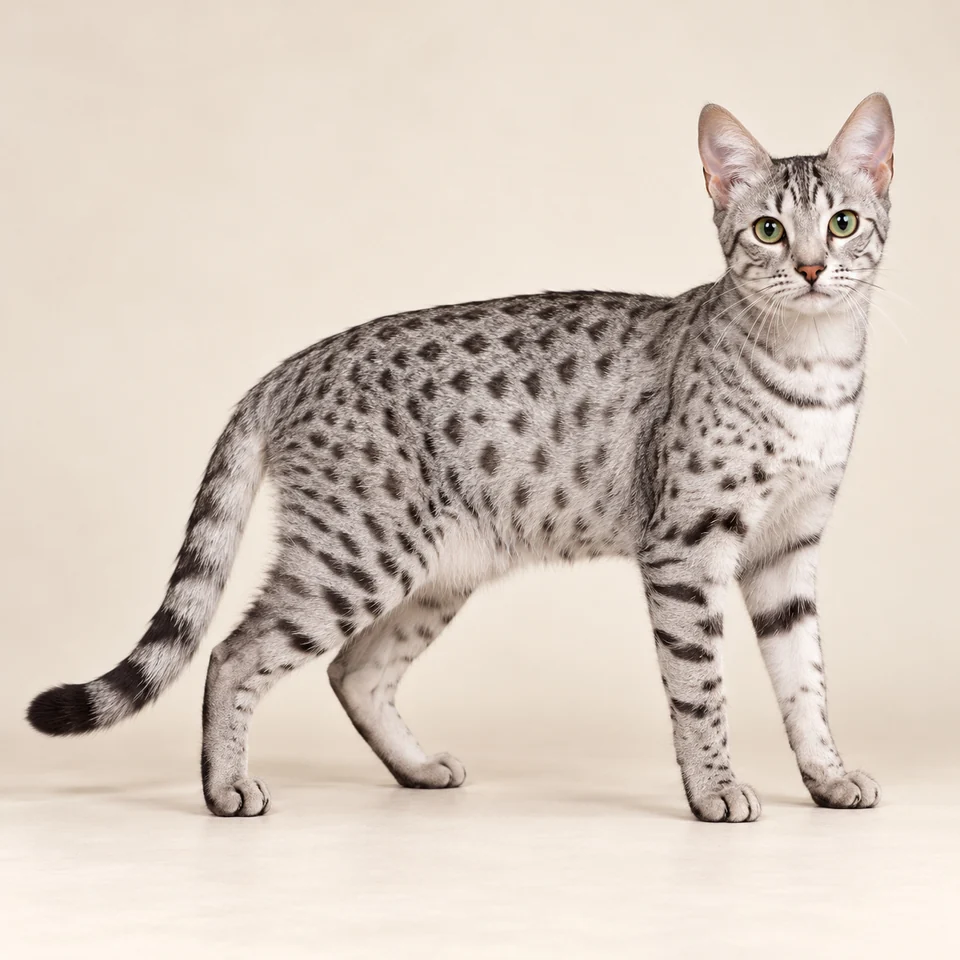
The Egyptian Mau is the only natural breed of spotted cat.
Its spots are scattered at random and vary in size and shape. Spotted cats like it appear in Egyptian art as far back as 1550 B.C. Maus are exceptionally intelligent. They are intensely devoted to their owners.
Source:CFA
Quick facts
- Where it beganCFA
- Egypt (ancient Egyptian art shows similar spotted cats); the modern breed came to the U.S. from Rome with Nathalie Troubetskoy in 1956.
- When it beganCFA
- Ancient: papyri and frescoes as far back as 1550 B.C. show similar spotted cats. Three Maus came to the United States with Nathalie Troubetskoy in 1956.
- Coat lengthCFA
- Shorthair
- Coat feelCFA
- Medium-length hair with a lustrous sheen. Smoke: silky and fine. Silver and bronze: dense and resilient, with two or more bands of ticking.
- LifespanTICA
- Life expectancy is 10-15+ years.
- Fully grownCFA
- The show standard allows for eye color change as kittens grow. Some green should show by eight months of age. Full green eye color should come by one and a half years.
- CFA statusCFA
- Championship (since 1977)
Appearance
Egyptian Maus are sleek and muscular.
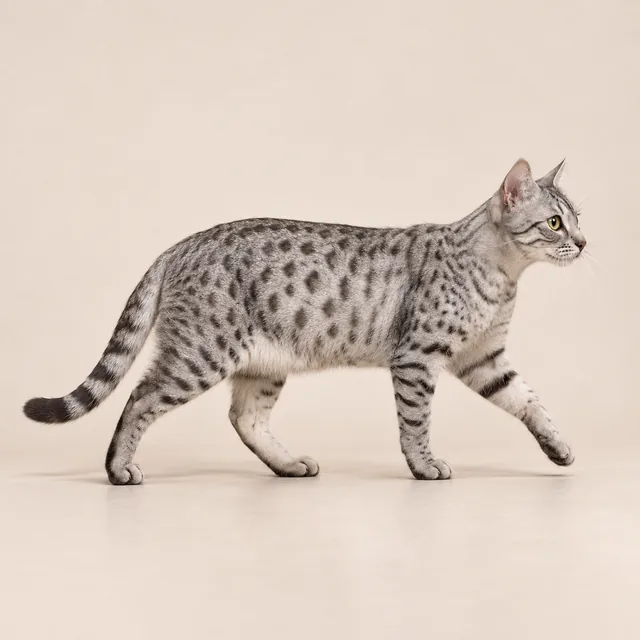
A loose skin flap runs from the flank to the hind leg. It helps them twist and jump freely. High shoulder blades and longer hind legs give a cheetah-like gait. Their gooseberry-green eyes are framed by "mascara" lines. These markings give a typical "worried" look. The coat has a lustrous sheen.
Source:CFA
Body
Medium long, graceful, muscular body; loose skin flap from flank to hind-leg knee; hind legs proportionately longer, giving a tip-toe look; small, dainty, slightly oval feet.
Source:CFA
Colors and patterns
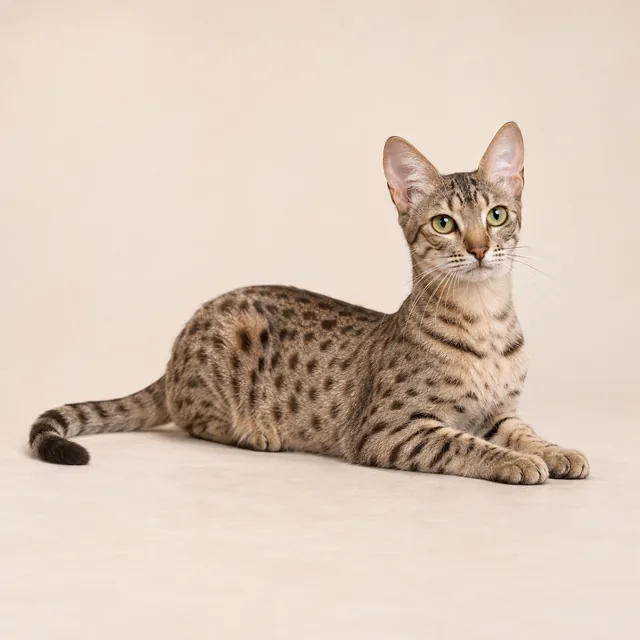
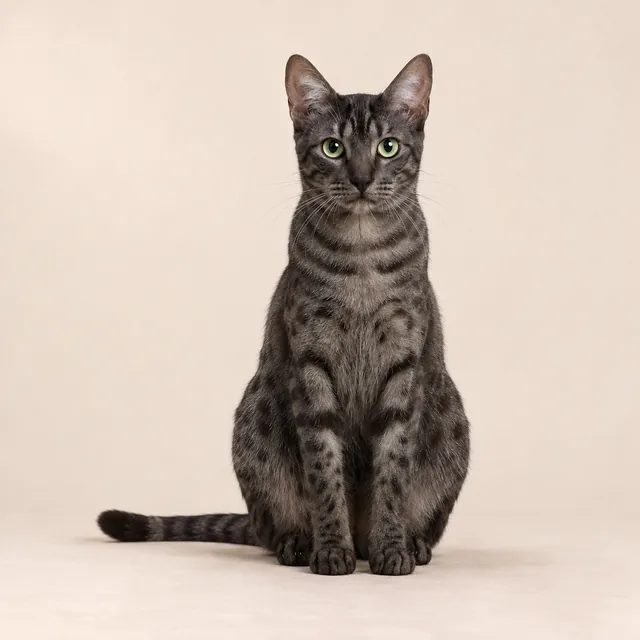
Spotted only. Three colors are shown: silver, bronze and smoke. Solid black and dilute colors may occur; they can be registered but not shown.
Source:CFA
Eye colors
"Gooseberry green". Allowance for changing eye color: some green by eight months and full green by one and a half years; greener eyes preferred at all ages. Blue eyes disqualify. Greener eyes are preferred at all ages.
About this variety
Silver and bronze Maus have dense, resilient coats with several bands of ticking. Smoke Maus have a finer, silky coat. Solid black and dilute kittens may occur; they can be registered but not shown.
Source:CFA
Personality
Maus are exceptionally intelligent and devoted.
They have very keen senses of smell, hearing and sight. They also pick up on their owners' moods. They are strong-willed. They have definite ideas about who can handle them and when. With "their" people, they are affectionate, loyal, outgoing and fearless. Maus are shy, sensitive cats. Sudden loud noises easily upset them. They are intensely loyal and passionate about their families. Yet they are also happy just being a cat.
With their people
Maus expect to be treated as full members of the household. They take part in every part of your life. They are shoulder riders, refrigerator vultures and furry alarm clocks. The breed has a special affinity with its people.
Being held
Maus have definite ideas about who can handle them and when. They may be cautious or reserved with strangers. Early socialization is essential.
Voice
Maus are quiet cats with low, melodious voices. They like to "talk" with you. They may chirp or chatter to greet you.
Source:CFA
Living with an Egyptian Mau
Maus make wonderful family pets with "their" people.
They may be cautious or reserved with strangers.
Source:CFA
With children
The Mau is a devoted family companion. Maus get along well with playful children, as long as the children can keep up with the Mau's energy.
Source:TICA
With other pets
Maus get along well with other cat-friendly pets that can keep up with the Mau's energy.
Source:TICA
Activity
Maus are active, alert and agile. They love interactive games. They may train you to play fetch. Many enjoy walks on a harness and leash.
Source:CFA
Training
Maus may "train you" to play fetch. They enjoy going for walks on a harness and leash.
Source:CFA
Care
Weekly combing to control shedding and prevent hairballs are recommended.
It takes only a few minutes and keeps the coat shiny. Brush the coat weekly to keep it shiny and healthy.
Baths
Regular bathing is not needed unless you show your cat. An occasional bath can add to the coat's beauty. Ask your breeder about products first. Human shampoos may not be safe for cats.
Source:CFA
Nails, ears, eyes and teeth
Regular nail trims, usually weekly are recommended. To clean the ears if they look dirty.
Source:TICA
Health
The Egyptian Mau is a healthy, natural breed that can live a long life with proper care.
Some conditions can be inherited. Pyruvate kinase deficiency can cause anemia. Urolithiasis causes stones in the kidneys and urinary tract and may occur. The Mau is generally a healthy breed. Named conditions are urolithiasis, pyruvate kinase deficiency (PK-Def) and leukodystrophy.
Screening
Breeders have tested for some heritable conditions, such as pyruvate kinase deficiency. Genetic tests do not yet exist for all of them. Asking your breeder about any history of health issues in the lines is recommended.
Source:CFA
CFA health notes
The Egyptian Mau is a healthy, natural breed that can live long with proper care. Breeders test for some heritable conditions, such as pyruvate kinase deficiency. This can cause anemia. Urolithiasis (stones in the kidneys and urinary tract) may occur. Breeders often share information to help remove carriers. But testing is not available for all conditions.
Source:CFA
This is what CFA and TICA say about the breed. It is not a health promise for any kitten. TrueKitten verifies breeder identities and documents, but that does not guarantee a kitten's health. Ask the breeder for test results and talk to your vet.
History
"Mau" meant cat or sun in ancient Egypt.
Papyri and frescoes from as early as 1550 B.C. show spotted cats like today's Maus. Cats thought to descend from ancient Egyptian cats were kept by Egypt's nobility and diplomats. One reached Nathalie Troubetskoy, a Russian princess living in Rome. She started a breeding program. In 1956 she moved to the United States with three Maus. The breed was accepted for registration in 1970 and for championship in 1977.
Source:CFA
Did you know?
- In ancient Egypt, the word "Mau" meant cat or sun.
- The Egyptian Mau is one of the oldest known breeds of cat.
- A loose skin flap from flank to hind leg helps Maus twist and jump.
- Maus often turn up with a soft purr just when you feel down.
Source:CFA
For breeders
Details from the CFA and TICA show standards. Cat show judges use them. They do not rate a kitten as a pet.
What the show standards ask for
- The only natural domesticated breed of spotted cat; active, colorful, medium size, well-developed muscles.
- Head: slightly rounded wedge without flat planes, medium length, not full-cheeked; gentle rise from nose bridge to forehead.
- Ears: medium to large, alert, moderately pointed, broad at base; inner ear almost transparent shell pink; may be tufted.
- Eyes: large, alert, almond-shaped with a slight slant; gooseberry green.
- Body: medium long and graceful; loose skin flap from flank to hind-leg knee; balance valued over size.
- Legs: hind legs proportionately longer, giving a tip-toe stance; small, dainty, slightly oval feet.
- Tail: medium long, thick at base, slight taper; heavily banded with a dark tip.
- Pattern: random, distinct spots of varied size and shape; forehead "M"; mascara lines on cheeks; broken necklaces; "vest button" spots on the belly.
- Show rules: Traditional category; Tabby and Silver/Smoke divisions; spotted pattern only in bronze, black silver and black smoke; no outcrosses; greener eyes preferred at all ages.
Points show how much each part counts when a judge scores a cat at a show. They add up to 100.
TICA colors
Spotted pattern only: bronze spotted tabby, black silver spotted tabby and black smoke only.
Source:TICA
CFA colors and patterns
Mau (spotted) pattern only, in Silver, Bronze and Smoke. Color classes: Silver, Bronze, Smoke.
Source:CFA
CFA allowed outcrosses
None (reference information, not an official part of the show standard)
Source:CFA
CFA allowances
Jowls in adult males. Muscular necks and shoulders in adult males. Changing eye color (some green by eight months, full green by one and a half years). Ears may be tufted.
Source:CFA
CFA penalties
Short or round head. Pointed muzzle. Small, round or oriental eyes. Cobby or oriental body. Short or whip tail. No broken necklaces. Pencillings in the torso spotting. Solid stripes on the underside instead of "vest button" spots. No green in eye color at 8 months or over, and amber cast in eye color over 1 year 6 months. Poor condition.
Source:CFA
CFA disqualifications
Lack of spots. Blue eyes. Lack of green in eye color over 1 year 6 months. Mottled or pink paw pads. Kinked or abnormal tail. Incorrect number of toes. White locket or button distinct from other acceptable white areas.
Source:CFA
CFA breeding notes
Allowable outcross breeds: none (reference information, not an official part of the show standard). Solid black and dilute colors may occur and can be registered but not shown.
Source:CFA
TICA standard version
Revised 05/01/08 (Corr: 01/29/10) Egyptian Mau Breed Standard, 05/01/2008
Source:TICA
Common questions
Spotted only. Three colors are shown: silver, bronze and smoke. Solid black and dilute colors may occur; they can be registered but not shown.
Weekly combing to control shedding and prevent hairballs are recommended. It takes only a few minutes and keeps the coat shiny. Brush the coat weekly to keep it shiny and healthy.
Regular bathing is not needed unless you show your cat. An occasional bath can add to the coat's beauty. Ask your breeder about products first. Human shampoos may not be safe for cats.
The Egyptian Mau is a healthy, natural breed that can live a long life with proper care. Some conditions can be inherited. Pyruvate kinase deficiency can cause anemia. Urolithiasis causes stones in the kidneys and urinary tract and may occur. The Mau is generally a healthy breed. Named conditions are urolithiasis, pyruvate kinase deficiency (PK-Def) and leukodystrophy.
Maus have definite ideas about who can handle them and when. They may be cautious or reserved with strangers. Early socialization is essential.
Maus are active, alert and agile. They love interactive games. They may train you to play fetch. Many enjoy walks on a harness and leash.
Maus are quiet cats with low, melodious voices. They like to "talk" with you. They may chirp or chatter to greet you.
The show standard allows for eye color change as kittens grow. Some green should show by eight months of age. Full green eye color should come by one and a half years.
Life expectancy is 10-15+ years.
The Mau is a devoted family companion. Maus get along well with playful children, as long as the children can keep up with the Mau's energy.
Questions to ask a breeder
- Have the parents been tested for pyruvate kinase deficiency, and may I see the results?
- Has there been any history of urinary or kidney stones (urolithiasis) in your lines?
- What health issues, if any, have appeared in this kitten's lines?
- What color is this kitten (silver, bronze or smoke), and is it eligible for showing?
- How does this kitten react to strangers and to being handled?
Sources
Every fact on this page comes from the two cat registries, CFA and TICA.
Last updated