
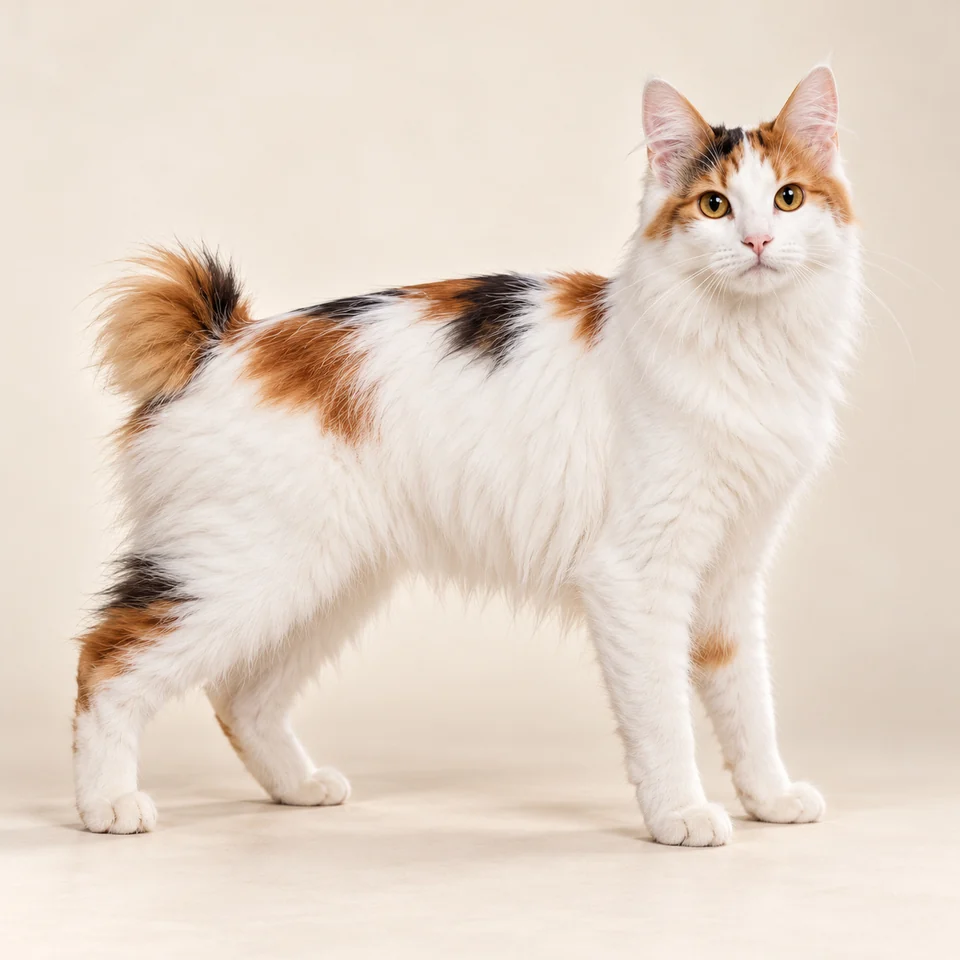
The Japanese Bobtail Longhair is known for its short, pom-pom tail.
Every bobtail is as unique as a fingerprint. The short tail comes from a dominant gene; it is not cropped. These cats are active, smart and affectionate. They were once the pampered darlings of Japanese nobles.
Source:CFA
Quick facts
- Where it beganCFA
- Japan (they are thought to have come from Korea as early as the sixth century)
- When it beganCFATICA
- Shown in Japanese art from the Middle Ages; thought to have come from Korea as early as the sixth century. Records and paintings go back at least 1,000 years.
- SizeCFA
- Medium
- Coat lengthCFA
- Longhair
- Coat feelCFA
- Medium-long to long, soft and silky; frontal ruff, ear and toe tufts desirable.
- WeightCFATICA
- Females weigh 5–7 lb and males weigh 8–10 lb. Males are proportionately larger than females.
- LifespanTICA
- The Japanese Bobtail lives 9 to 13+ years. The Longhair page gives no figure.
- CFA statusCFA
- Championship (longhair since 1993)
Appearance
Japanese Bobtails are medium-sized and slender, with long legs.
The head is a near-equilateral triangle with high cheekbones. The ears are large and upright. The large oval eyes are set at a slant. The tail is short, with curves, angles or kinks. The hair fans out like a pom-pom. The tail bone should extend no more than three inches.
Source:CFA
Colors and patterns
Many colors are accepted, and no color or pattern is preferred. The classic look is bicolor or mi-ke (tricolor, or calico). Solids, tabbies, smokes and pointed colors are also accepted.
Source:CFA
About this variety
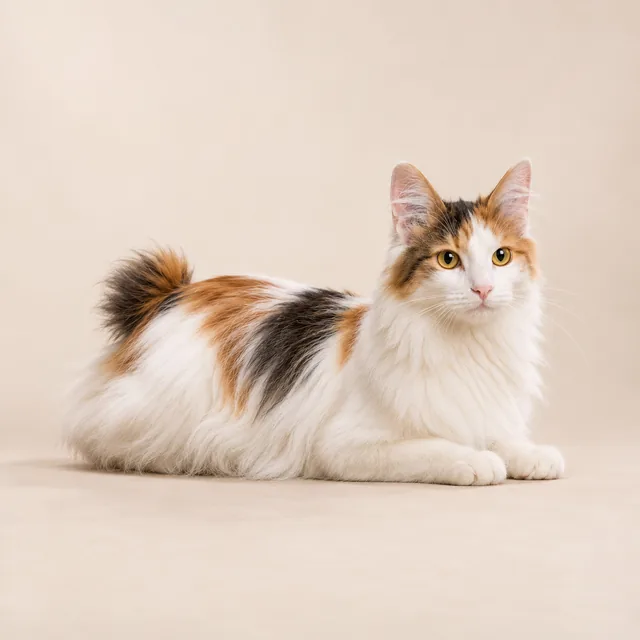
The longhair coat is medium-long to long and silky. It may be shorter over the shoulders and longer toward the rump. The tail and rear "britches" have longer hair. A chest ruff and ear and toe tufts are desirable. Longhairs gained championship status in 1993. A second registry recognized them for competition in March 1991.
Personality
Japanese Bobtails are inquisitive, intelligent problem-solvers.
They are playful and agile. They have a high activity level and a short attention span. They need a fair amount of attention. They will ask for it if they do not get enough.
Source:CFA
Lap time
They are very active and should not be thought of as lap cats. One may sit in your lap and purr, "but probably not for long."
Being held
The tail is sensitive and should always be handled with care. Some tails are stiff and some are flexible.
Source:CFA
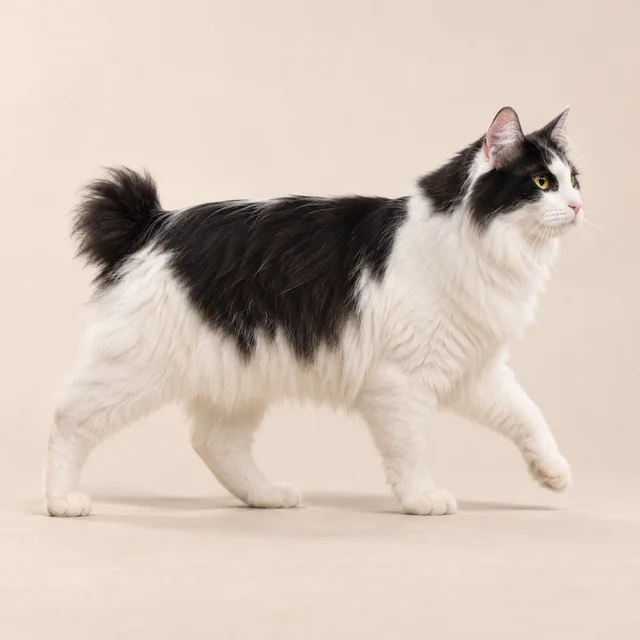
Living with a Japanese Bobtail Longhair
They get along well with children of all ages.
With other pets
They get along well with dogs. Other cats may need extra time to get used to a cat that seems to lack a tail.
Activity
They are often in motion. Their strong back legs let them jump very high, especially for a toy. They excel at Feline Agility.
Source:CFA
Care
Longhairs need combing more often than shorthairs, with a fine, long-tooth comb.
Their coats do not tangle or mat. Twice-weekly brushing or combing is enough most of the time. They shed in fall and spring, so brush more then.
Baths
Be ready to give an occasional bath. Longhairs should be blow-dried to keep their windblown look.
Source:CFA
Health
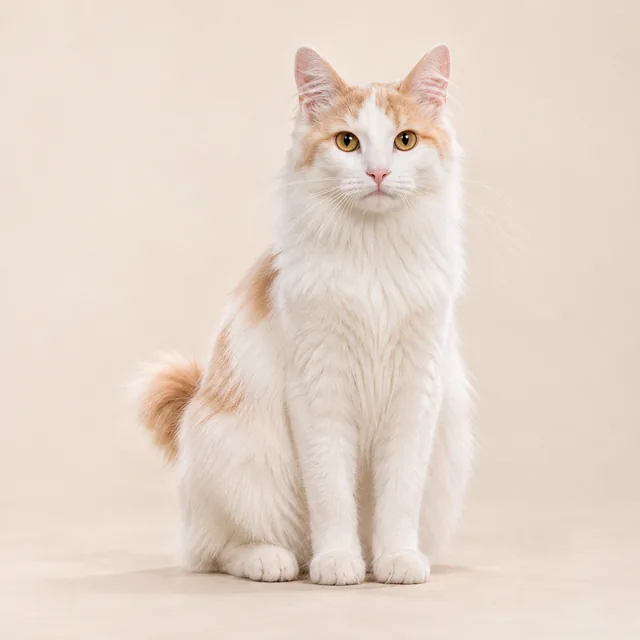
There are no known problems linked to the breed's tail.
This is what CFA says about the breed. It is not a health promise for any kitten. TrueKitten verifies breeder identities and documents, but that does not guarantee a kitten's health. Ask the breeder for test results and talk to your vet.
History
Bobtails appear in Japanese scrolls, prints and carvings from the Middle Ages.
They may have come from Korea as early as the sixth century. Only the court could own them until 1602. Then an edict sent all cats into the streets to fight rodents that threatened the silk industry. The first Japanese Bobtails came to the United States in 1968. Breeder Judy Crawford sent the first cats to Elizabeth Freret. One registry gave shorthairs championship in 1976 and longhairs in 1993. The other recognized shorthairs in 1979 and longhairs in 1991.
Recognition dates
- 1976CFA Shorthair championship status
- 1993CFA Longhair championship status
- 1979TICA Shorthair recognized for competition (June)
- 1991TICA Longhair recognized for competition (March)
For breeders
Details from the CFA and TICA show standards. Cat show judges use them. They do not rate a kitten as a pet.
What the show standards ask for
- Head: long, finely chiseled, almost an equilateral triangle; high cheekbones, noticeable whisker break; long nose with a gentle dip at or below eye level.
- Ears: large, upright, expressive, set wide apart at right angles to the head.
- Eyes: large, oval, set at a pronounced slant in profile; should not bulge.
- Body: medium; torso long, lean, elegant, not tubular; no cobbiness.
- Legs: long, slender, high; hind legs longer but angulated so the torso stays nearly level. Paws oval.
- Tail: clearly visible; one or more curves, angles or kinks; bone no longer than three inches; pom-pom appearance from the base.
- Coat: shorthair medium, soft, silky; longhair medium-long to long; no noticeable undercoat.
- Overall balance, elegance and refinement are the essence of the breed.
Source:CFA
Points show how much each part counts when a judge scores a cat at a show. They add up to 100.
CFA colors and patterns
No color or pattern preferred. Solid colors (white, black, chocolate, red, blue, lilac, cream); bicolors incl. tabby/patterned and smoke with white; mi-ke (tricolor) and other mi-ke colors; parti-colors (tortoiseshell, chocolate tortoiseshell, blue-cream, lilac-cream); tabby/patterned, patched tabby, smoke; colorpoint and colorpoint-and-white incl. lynx; any other color or pattern genetically possible in the breed.
Source:CFA
CFA allowances
- Jowls in the stud cat.
- Cats with no more white than a locket and/or button are judged in their basic color class with no penalty for the locket/button.
Source:CFA
CFA disqualifications
- Tail bone absent, or extending more than 3 inches from the body.
- Tail lacking pom-pom or fluffy appearance.
- Delayed bobtail effect (an inch or two of normal tail before the pom-pom).
Source:CFA
CFA breeding notes
The breed is somewhat rare, so gene-pool diversity matters. U.S. breeders have always been able to import Japanese street cats. Genetic testing helps head off problems.
Source:CFA
Common questions
The Japanese Bobtail Longhair is known for its short, pom-pom tail. Every bobtail is as unique as a fingerprint. The short tail comes from a dominant gene; it is not cropped. These cats are active, smart and affectionate. They were once the pampered darlings of Japanese nobles.
Females weigh 5–7 lb and males weigh 8–10 lb. Males are proportionately larger than females.
The Japanese Bobtail lives 9 to 13+ years. The Longhair page gives no figure.
They are very active and should not be thought of as lap cats. One may sit in your lap and purr, "but probably not for long."
They get along well with children of all ages. They get along well with children.
They get along well with dogs. Other cats may need extra time to get used to a cat that seems to lack a tail.
Longhairs need combing more often than shorthairs, with a fine, long-tooth comb. Their coats do not tangle or mat. Twice-weekly brushing or combing is enough most of the time. They shed in fall and spring, so brush more then.
There are no known problems linked to the breed's tail. Bobtails are a sturdy, natural breed with no specific health concerns.
Many colors are accepted, and no color or pattern is preferred. The classic look is bicolor or mi-ke (tricolor, or calico). Solids, tabbies, smokes and pointed colors are also accepted.
Questions to ask a breeder
- How should I handle this kitten's tail?
- What genetic tests have the parents had?
- Is this kitten registered, and with which registry?
- How does this kitten act with dogs, cats and children?
- How much play and attention is this kitten used to?
- What grooming routine is this kitten used to, and when does it shed most?
Sources
Every fact on this page comes from the two cat registries, CFA and TICA.
Last updated