
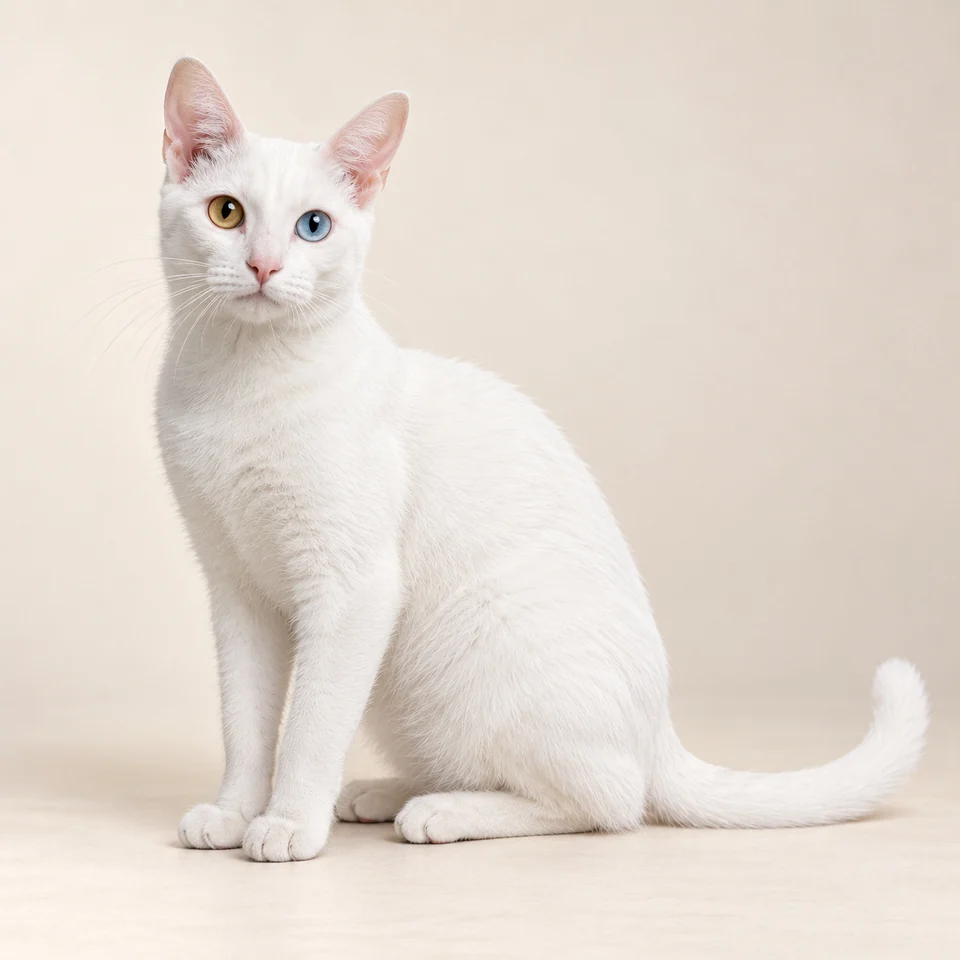
The Khaomanee (Khao Manee) is an old breed from Thailand.
It is a shorthaired white cat. A nonwhite kitten sometimes appears, but only white cats can be shown. The name means "White Gem" in Thai. Its bright eyes may be blue, green, yellow or odd-colored. It is curious and clever, with a sense of mischief.
Source:CFA
Quick facts
- When it beganCFATICA
- Referenced in the Tamra Maeo from the Ayutthaya period (1350–1767). The Khao-plort is described in the Tamra Maew at least 700 years ago; the Khaomanee name probably dates from about 100 years ago.
- Coat lengthCFA
- Shorthair
- Coat feelCFATICA
- Medium short, fine, slightly open, smooth; not coarse or fluffy. It is resilient and very natural, and it varies with temperature.
- WeightTICA
- Males should typically be 8 to 11 lb. Females should typically be 6 to 8 lb.
- LifespanTICA
- Life expectancy is 10 to 12 years.
- CFA statusCFA
- Provisional (registration since 2018). The standard's footer reads "Miscellanous Show Standard (2026)".
Appearance
The Khaomanee has a glistening white coat and large, bright eyes.
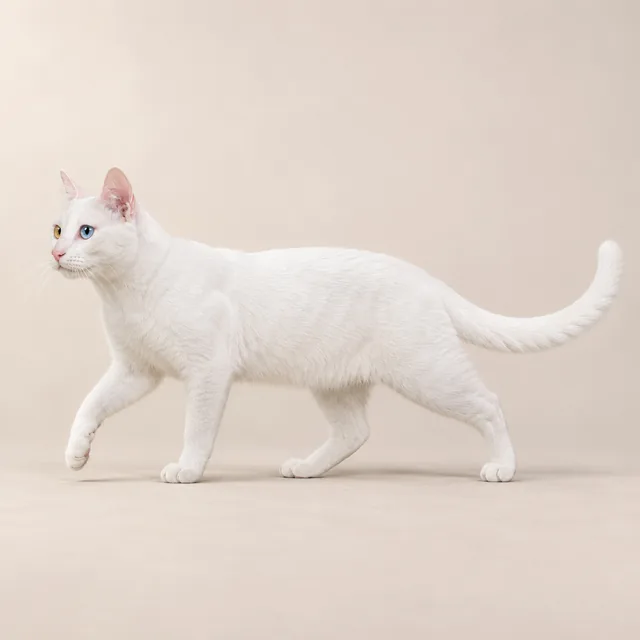
The body is medium and muscular. It should feel flexible and springy. The head is a modified wedge with high cheekbones. The nose and ear tips form an equilateral triangle. The tail is medium and may have small kinks.
Source:CFA
Body
Medium, very firmly muscled torso; agile, flexible and springy, not meaty, heavy or cobby.
Source:CFA
Colors and patterns
White only. The coat should be pure, glistening white. It should be a very even snowy white. A colored headcap may persist until 18 months.
Personality
Khao Manee are very smart, friendly and social.
They are curious about everything you do. They like to fetch and carry toys, or your socks. They are active, playful and curious. This is not a reserved, independent breed. They can be shy with strangers.
Living with a Khaomanee
Care
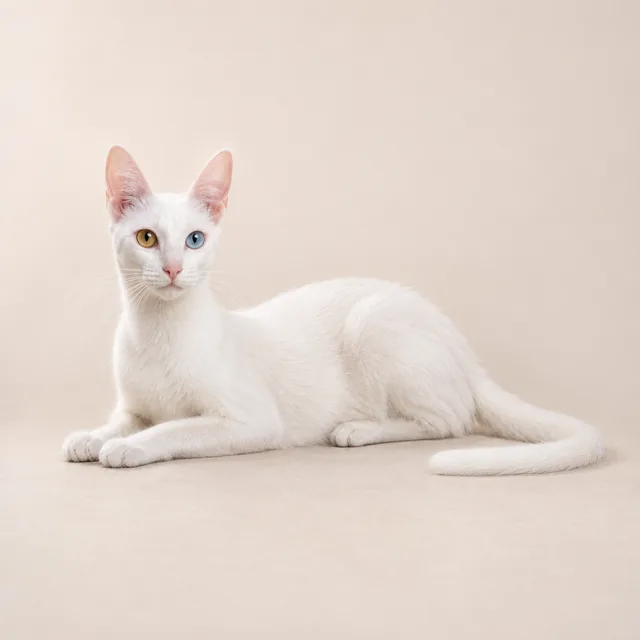
Regular brushing with a rubber brush to control shedding is recommended.
Source:CFA
Health
The Khao Manee is not known for specific health problems.
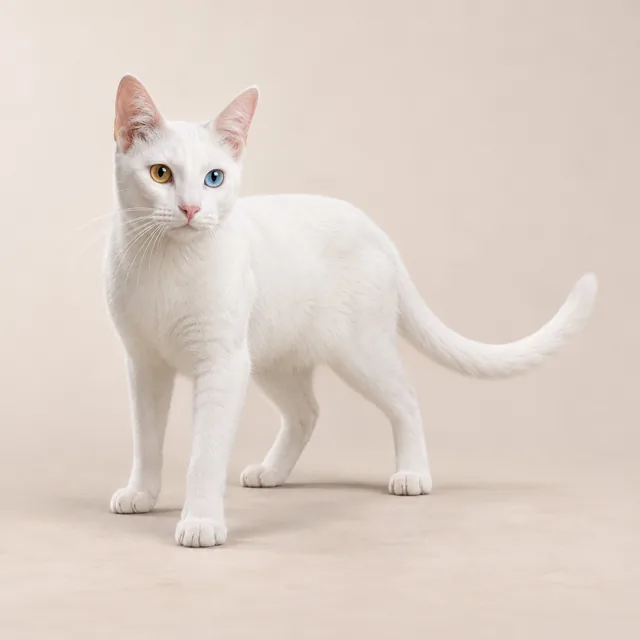
But white cats can be prone to deafness, especially blue-eyed cats. Odd-eyed cats may be deaf in one ear. Some pure white breeds are prone to deafness in one or both ears.
CFA health notes
Not known for specific health problems; white cats can be prone to deafness, especially blue-eyed cats; odd-eyed cats may be deaf in one ear.
Source:CFA
This is what CFA and TICA say about the breed. It is not a health promise for any kitten. TrueKitten verifies breeder identities and documents, but that does not guarantee a kitten's health. Ask the breeder for test results and talk to your vet.
History
The Khao Manee is an old Thai breed.
It appears as a "good luck" cat in the Tamra Maeo, a book of cat poems from the Ayutthaya period (1350–1767). Legend says Thai royalty kept it hidden from visitors. It stayed in Thailand until 1999. Then Colleen Freymouth brought the first one to the United States. The breed was accepted for registration in 2018. The name Khaomanee probably came into use about 100 years ago.
For breeders
Details from the CFA and TICA show standards. Cat show judges use them. They do not rate a kitten as a pet.
What the show standards ask for
- Head: modified wedge, medium width, moderate length; high cheekbones; nose tip and ear tips form an equilateral triangle (both).
- Ears: slightly large, wide at base, oval tips; point toward 11 and 1 o'clock; light furnishings allowed (both).
- Eyes: open almond to plump oval with a noticeable Asian slant, toward 10 and 2 o'clock; any color, clear and vivid.
- Profile: nearly straight with a slight downhill slope from brow to below the eyes; nose may be slightly convex.
- Body: medium torso, very firm muscle, agile and springy, not cobby; males more muscular.
- Legs: medium to slightly long; boning medium to slightly refined (females), slightly robust (males).
- Tail: medium, tapering; kinks near the tip are accepted.
- Coat/color: short, smooth, slightly open; pure white only.
Points show how much each part counts when a judge scores a cat at a show. They add up to 100.
| Part | Points |
|---|---|
| HeadShape 5, Profile 5, Ear set and placement 5, Muzzle and Chin 5 | 20 |
| EyesSize 5, Shape 5, Placement 5 | 15 |
| BodyBody 20, Legs and Feet 5, Tail 5 | 30 |
| CoatLength 5, Texture 10 | 15 |
| ColorBody color 10, Eye color 10 | 20 |
Source:CFA
| Part | Points |
|---|---|
| Head | 40 |
| Body | 40 |
| Coat/Color/Pattern | 20 |
Source:TICA
CFA colors and patterns
White only: pure, glistening white; nose leather, lips and paw pads pink. Eyes any shade of blue, yellow (incl. brown, copper, amber, hazel) or green; multiple colors between or within eyes appreciated.
Source:CFA
TICA allowed outcrosses
Cats born in Thailand, Malaysia, Burma or Viet Nam of very average, moderate body and head type; Thai-origin breeds with proof of Thai ancestry and moderate SE Asian conformation: Korat, and the experimental breed Maew Boran.
Source:TICA
CFA allowances
- Light ear furnishings.
- Headcap of color may persist until 18 months.
- Multiple colors or shades between eyes or within an eye.
- Some loose skin on the underbelly is permissible.
- Palpable kinks; visible kinks from the tip to the last third of the tail.
Source:CFA
TICA allowances
- Stud jowls in males; heavier chest and shoulder muscle in males.
- Colored spots limited to the head in kittens and young adults.
- Tail faults that do not significantly shorten the tail or distract from overall appearance.
Source:TICA
CFA penalties
- Fully round eyes with no Asian slant; small or dull eyes.
- Short, blunt muzzle or long, pointed muzzle.
- Straight profile.
- Narrow upper head or narrow space between ears; small, very large pointed, or low/high-set ears.
- Overly cobby or overly foreign body.
Source:CFA
TICA penalties
- Males resembling females (size, boning, muscle), or females resembling males.
- Round eyes; Oriental eyes.
- Short or blunt muzzle; very long or pointy muzzle.
- Narrow upper head or narrow ear spacing; small, very large, low- or high-set ears.
- Very straight profile.
- Tail fault that noticeably shortens the tail.
Source:TICA
CFA disqualifications
- Visible tail kink from base to two-thirds of the tail.
- Incorrect number of toes.
- Crossed eyes.
- Any color but white.
Source:CFA
TICA disqualifications
- Withhold all awards: Roman profile; pronounced stop; pronounced convex forehead; fluffy or stand-out coat; cobby body; obesity; colored markings or hair clumps over 18 months; paw pads/nose leather other than pink.
- Disqualify: crossed eyes; visible protrusion of the xiphoid process.
- Plus the Show Rules Article Sixteen general disqualifications.
Source:TICA
CFA breeding notes
Occasional non-white kittens appear because white masks recessive colors. They cannot be shown but can be bred, and breeders often use them to help reduce the likelihood of deaf kittens.
Source:CFA
TICA breeding notes
Breeders are asked to keep natural size differences between males and females and to avoid Western traits such as very round heads.
Source:TICA
Common questions
The Khaomanee (Khao Manee) is an old breed from Thailand. It is a shorthaired white cat. A nonwhite kitten sometimes appears, but only white cats can be shown. The name means "White Gem" in Thai. Its bright eyes may be blue, green, yellow or odd-colored. It is curious and clever, with a sense of mischief.
White only. The coat should be pure, glistening white. It should be a very even snowy white. A colored headcap may persist until 18 months.
Any shade of blue, green or yellow, or odd eyes (one of each). Both standards accept any eye color. Eyes must be clear and vivid. Odd eyes are the rarest and most prized.
The Khao Manee is not known for specific health problems. But white cats can be prone to deafness, especially blue-eyed cats. Odd-eyed cats may be deaf in one ear. Some pure white breeds are prone to deafness in one or both ears.
Males should typically be 8 to 11 lb. Females should typically be 6 to 8 lb.
Life expectancy is 10 to 12 years.
Owners call them lap lovers and shoulder riders. They love snuggling in laps.
Regular brushing with a rubber brush to control shedding is recommended.
The Khao Manee is an old Thai breed. It appears as a "good luck" cat in the Tamra Maeo, a book of cat poems from the Ayutthaya period (1350–1767). Legend says Thai royalty kept it hidden from visitors. It stayed in Thailand until 1999. Then Colleen Freymouth brought the first one to the United States. The breed was accepted for registration in 2018. The name Khaomanee probably came into use about 100 years ago.
Questions to ask a breeder
- Has this kitten's hearing been checked in both ears?
- What are the parents' eye colors, and has their hearing been checked?
- Does this kitten have a colored headcap now?
- Is this kitten registered, and with which registry?
- How does this kitten act with other pets and children?
- What brushing and bathing routine is this kitten used to?
Sources
Every fact on this page comes from the two cat registries, CFA and TICA.
Last updated