
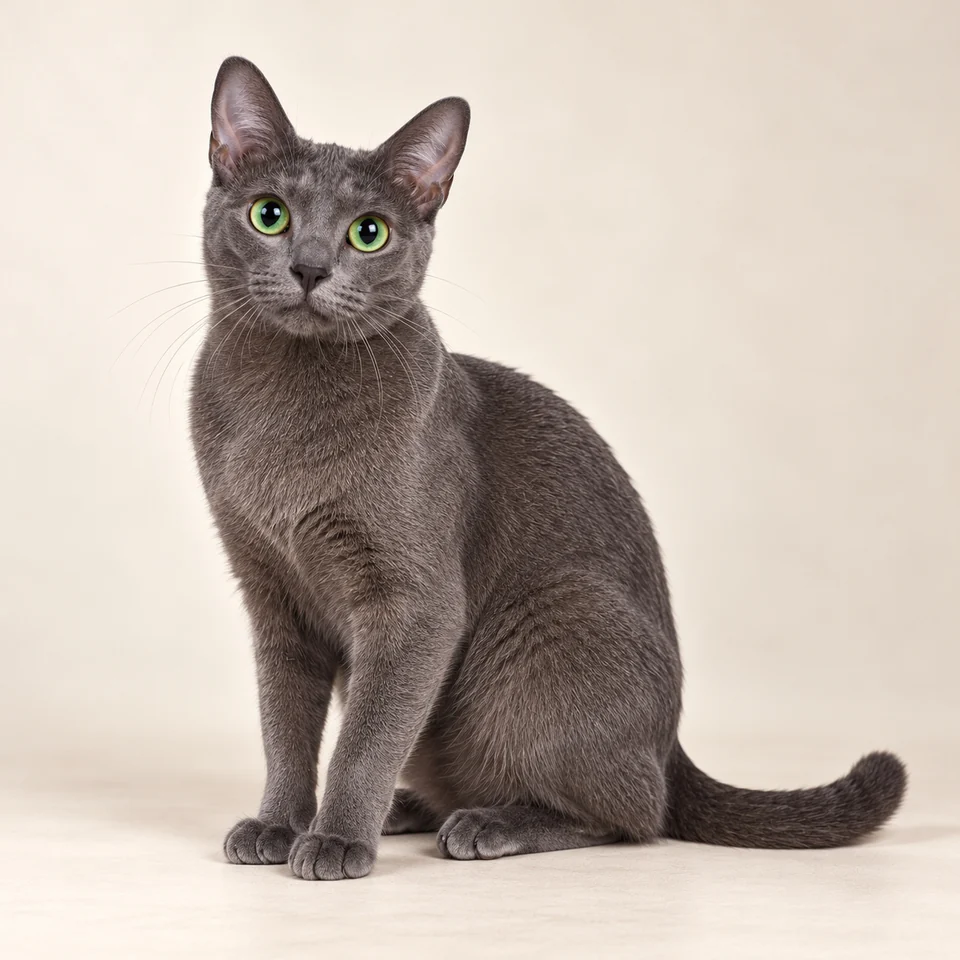
The Korat is an old breed from Thailand, where it is a "good luck" cat.
It has a silver-tipped blue coat and big green eyes. The head is shaped like a heart. Korats are loyal, trusting and very expressive. They are playful and like to "talk" with their people.
Source:CFA
Quick facts
- Where it beganCFA
- Thailand (first discovered in Amour Pimai, Korat province)
- When it beganCFA
- History dating back to the 1300s; earliest record in a book from the Ayudhya period (1350–1767).
- SizeCFA
- Medium
- Coat lengthCFA
- Shorthair
- Coat feelCFA
- Single coat; short, glossy and fine, lying close to the body. Over the spine the coat tends to break as the cat moves.
Appearance
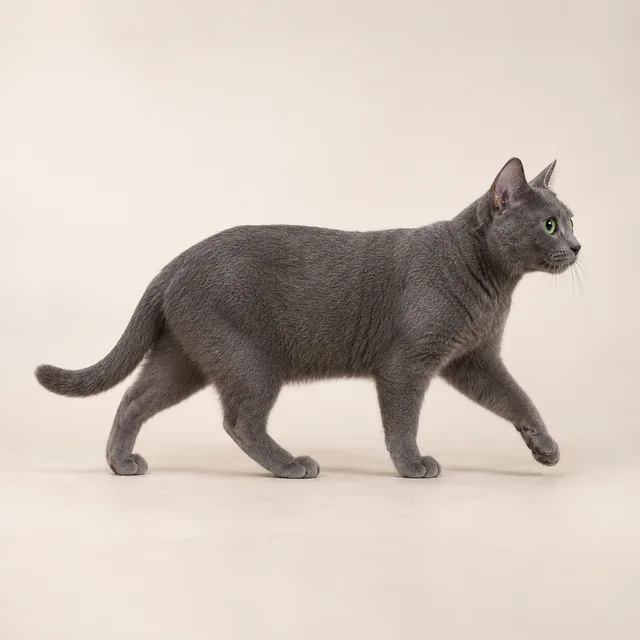
The Korat is medium-sized and muscular, and heavier than it looks.
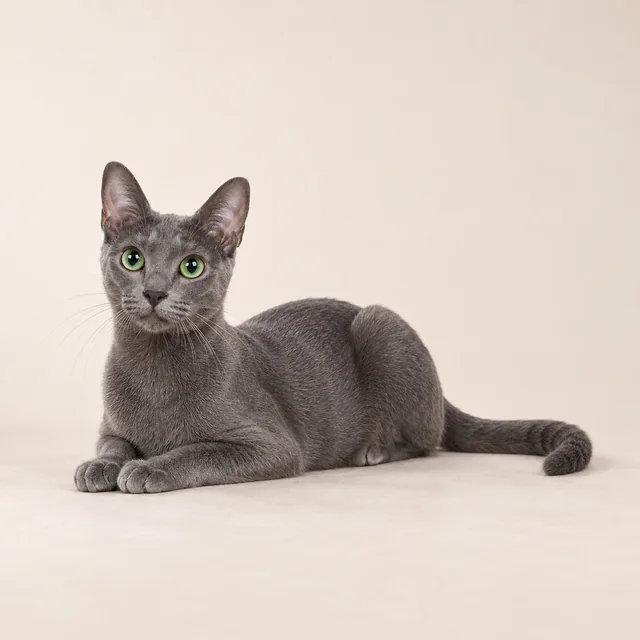
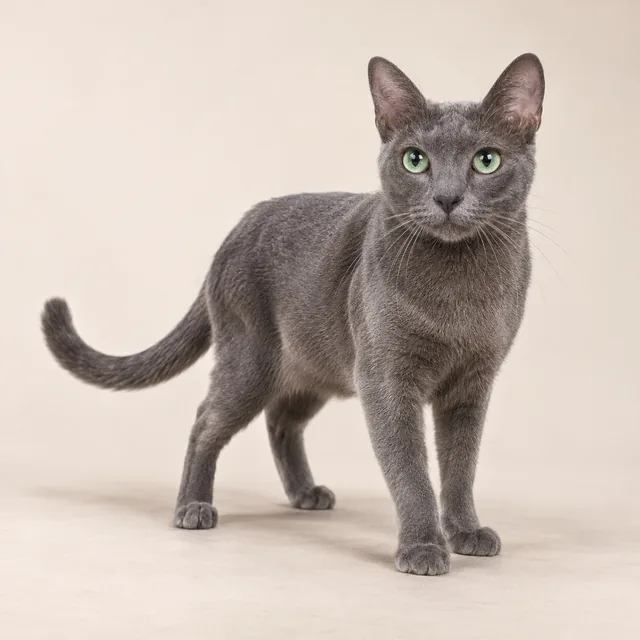
Its coat is short, glossy and silver-tipped blue. The large eyes are peridot green. Brow ridges, high cheekbones and a rounded muzzle make a heart-shaped head. The large ears have rounded tips.
Source:CFA
Body
Semi-cobby (neither compact nor svelte), broad-chested, muscular and supple, with unexpected weight; back carried in a curve.
Source:CFA
Colors and patterns
One color only: silver-tipped blue. The silver tips give a silver halo. Adults should have no shading or tabby markings.
Source:CFA
Eye colors
Luminous green preferred; amber cast acceptable. Kittens may have yellow, amber or amber-green eyes. Full color usually comes at two to four years.
Source:CFA
Personality
Korats are very smart.
They can learn tricks, but only if they agree to it. They crave stimulation. A Korat demands attention and sees itself as head of the family. Korats bond strongly with their owners and want to be part of everything.
Source:CFA
Living with a Korat
Korats generally get along with other household pets.
Care
Korats need little grooming.
Brushing weekly keeps the coat in good condition. Weekly brushing in summer and every other week in winter are recommended.
Nails, ears, eyes and teeth
As with all cats, owners should trim nails, brush teeth and keep ears clean.
Source:CFA
Health
Korats are a natural breed and typically relatively healthy.
The only known inherited disease is gangliosidosis (GM1 and GM2). A DNA test for carriers was developed in 1998. The disease is now almost completely eradicated.
Screening
Knowledgeable Korat breeders use only cats DNA-tested free of GM1 and GM2. Ask for the kitten's health papers to make sure vaccinations are done.
CFA health notes
A natural breed, typically relatively healthy; ask for health documentation showing vaccinations are complete.
Source:CFA
This is what CFA and TICA say about the breed. It is not a health promise for any kitten. TrueKitten verifies breeder identities and documents, but that does not guarantee a kitten's health. Ask the breeder for test results and talk to your vet.
History
The Korat was first found in Amour Pimai, in Korat province, Thailand.
Its earliest known record is a Thai book of cat poems from the Ayudhya period (1350–1767). The book shows 17 "good luck" cats, and the Korat is the best known. Korats were given as gifts to brides. Jean Johnson brought the first two Korats to the United States in 1959. Ten years later, Daphne Negus brought nine more from Thailand. In Thailand, the Korat is called the Si-Sawat cat.
For breeders
Details from the CFA and TICA show standards. Cat show judges use them. They do not rate a kitten as a pet.
What the show standards ask for
- Head: heart-shaped from the front, with breadth between and across the eyes; eyebrow ridges form the upper curves.
- Profile: slight stop between forehead and nose; lion-like downward curve just above the nose leather.
- Chin/jaw: strong and well developed, completing the heart shape.
- Ears: large, rounded tip, large flare at base, set high.
- Eyes: large, luminous, prominent; round when open, Asian slant when closed or partly closed; green preferred.
- Body: semi-cobby, broad-chested, muscular and supple with unexpected weight; back carried in a curve.
- Legs/tail: front legs slightly shorter than back; tail medium, heavier at base, non-visible kink permitted.
- Coat/color: single, short, glossy, close-lying; silver-tipped blue all over.
Source:CFA
Points show how much each part counts when a judge scores a cat at a show. They add up to 100.
| Part | Points |
|---|---|
| HeadBroad head 5, Profile 4, Breadth between eyes 4, Ear set and placement 4, Heartshape 5, Chin and Jaw 3 | 25 |
| EyesSize 5, Shape 5, Placement 5 | 15 |
| BodyBody 15, Legs and Feet 5, Tail 5 | 25 |
| CoatShort 4, Texture 3, Close lying 3 | 10 |
| ColorBody color 20, Eye Color 5 | 25 |
Source:CFA
| Part | Points |
|---|---|
| Head | 40 |
| Body | 30 |
| Coat/Color/Pattern | 30 |
Source:TICA
CFA colors and patterns
Silver-tipped blue only; nose leather and lips dark blue or lavender; paw pads dark blue to lavender with a pinkish tinge.
Source:CFA
CFA allowances
- Ghost tabby markings in kittens.
- Non-visible tail kink permitted.
- Kittens and adolescents may have yellow, amber or amber-green eyes.
Source:CFA
CFA penalties
Partial: the standard has no PENALIZE heading but lists "Undesirable" traits: pinch or narrowness between/across the eyes; nose too long or short; small or dull eyes; silver tipping only on head, legs and feet.
Source:CFA
CFA disqualifications
- Visible kink.
- Incorrect number of toes.
- White spot or locket.
- Any color but silver-tipped blue.
Source:CFA
TICA breeding notes
Knowledgeable breeders now use only cats DNA tested free of gangliosidosis (GM1/GM2).
Source:TICA
Common questions
The breed page lists females at 6–8 lb. For males, its "At a Glance" section says they are much larger and can be 10 lb or more. A later section of the same page says males weigh 8–10 lb. A mature male may weigh 10 lb or more, and females are usually smaller.
Life expectancy is 15 years or more.
Korats mature slowly. They do not reach full maturity until two to four years. Another page says it can take up to 5 years.
Korats are a natural breed and typically relatively healthy. The only known inherited disease is gangliosidosis (GM1 and GM2). A DNA test for carriers was developed in 1998. The disease is now almost completely eradicated.
Knowledgeable Korat breeders use only cats DNA-tested free of GM1 and GM2. Ask for the kitten's health papers to make sure vaccinations are done.
Korats need little grooming. Brushing weekly keeps the coat in good condition. Weekly brushing in summer and every other week in winter are recommended.
Korats generally get along with other household pets. When a new pet arrives, keep giving the Korat lots of attention. This helps prevent jealousy.
Korats make a wide range of noises. They will speak up if they want your attention.
The Korat was first found in Amour Pimai, in Korat province, Thailand. Its earliest known record is a Thai book of cat poems from the Ayudhya period (1350–1767). The book shows 17 "good luck" cats, and the Korat is the best known. Korats were given as gifts to brides. Jean Johnson brought the first two Korats to the United States in 1959. Ten years later, Daphne Negus brought nine more from Thailand. In Thailand, the Korat is called the Si-Sawat cat.
Questions to ask a breeder
- Have both parents been DNA tested for GM1 and GM2 gangliosidosis? May I see the results?
- May I see this kitten's health and vaccination records?
- What eye color do the parents have as adults?
- How does this kitten react to other pets?
- What toys and games is this kitten used to?
- Is this kitten registered, and with which registry?
Sources
Every fact on this page comes from the two cat registries, CFA and TICA.
Last updated