
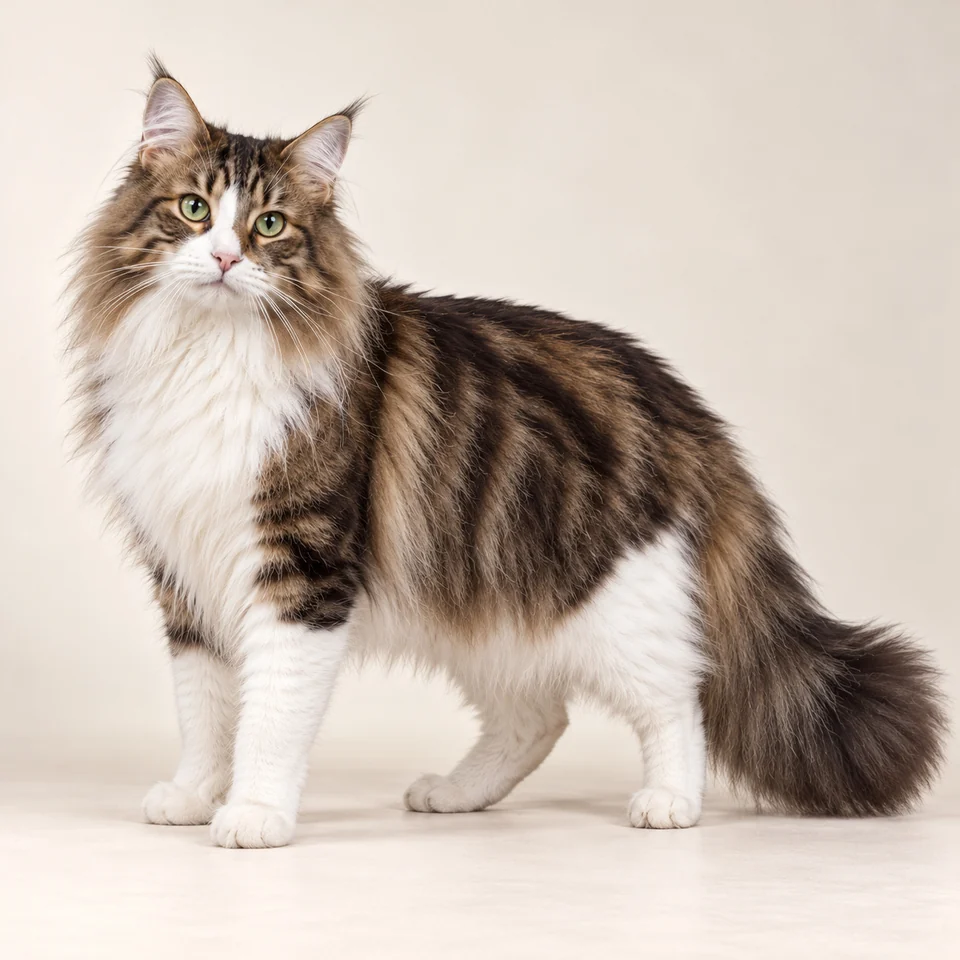
The Norwegian Forest Cat is a large, sturdy cat from Norway.
It has a thick double coat and a full ruff. Its triangular head and riveting gaze set it apart. It is the "Wegie." It is a gentle, friendly breed that loves being around people.
Quick facts
- Where it beganCFA
- Norway
- When it beganCFA
- The breed is thought to have emerged from the forest some 4,000 years ago; its exact origins are not clear. The first breed club formed in Norway in the mid-1970s.
- SizeCFA
- Large and sturdy. Males should be large and imposing; females may be more refined and smaller.
- Coat lengthCFA
- Longhair
- Coat feelCFA
- Long, glossy, smooth, water-resistant guard hairs over a dense undercoat. The overcoat is silky and water-repellant. Softer coats are permitted in shaded, solid and bicolor cats.
- WeightCFATICA
- A fully grown male weighs 12–16 lb and a female 9–12 lb. The breed page lists adult females at 8–12 lb and adult males at 12–18 lb. A breed seminar says males typically weigh 12–15 lb and females 8–11 lb.
- LifespanTICA
- Life expectancy is 13 or more years.
- Fully grownCFATICA
- This is a slow-maturing breed. It can take up to five years to reach full growth. Full maturity may take up to five years.
- CFA statusCFA
- Championship (since 1993)
- TICA statusTICA
- Championship (since 1984)
Appearance
An adult is large and sturdy.
It has a thick double coat with a silky, water-repellant top coat and a ruff on the neck and chest. The head forms an equilateral triangle with a straight profile. The eyes are large and almond-shaped. The ears are heavily furnished, the paws are tufted, and the tail is long and bushy.
Source:CFA
Body
Solidly muscled, moderate in length, with substantial bone, a broad chest and considerable girth; hind legs longer than front legs.
Source:CFA
Colors and patterns
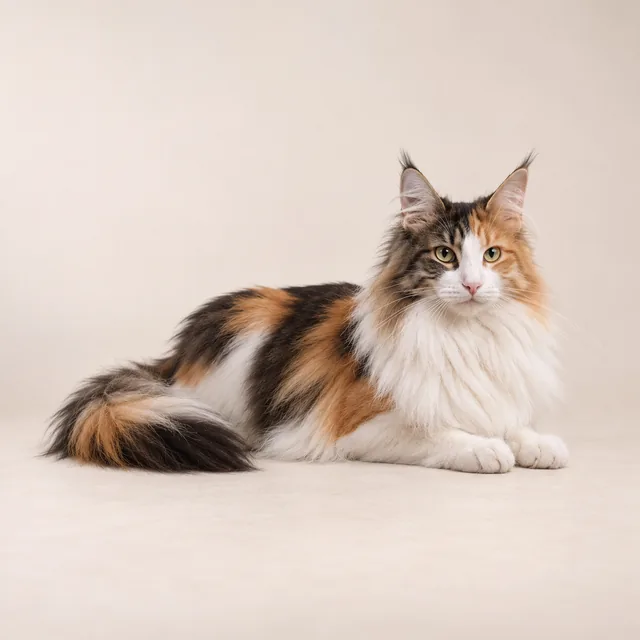
Almost every color and pattern is allowed. Colors showing hybridization are barred at some shows: chocolate, sable, lavender, lilac, cinnamon, fawn and pointed (Himalayan-type) markings, or these with white. Listed colors are solids, amber and light amber, tortoiseshells, silvers and goldens, smokes, tabbies (classic, mackerel, patched, spotted, ticked), and bi-colors and calicos including vans.
Source:CFA
Personality
This is an independent, intelligent breed.
They are moderately active, sensitive, friendly and adaptable. They like to be part of the family's daily life. They are gentle and friendly, and they love being around people.
With their people
They are not clingy. But they will look for company if left alone too long. They stay near you and may help with what you are doing, until they think of something else to do.
Source:CFA
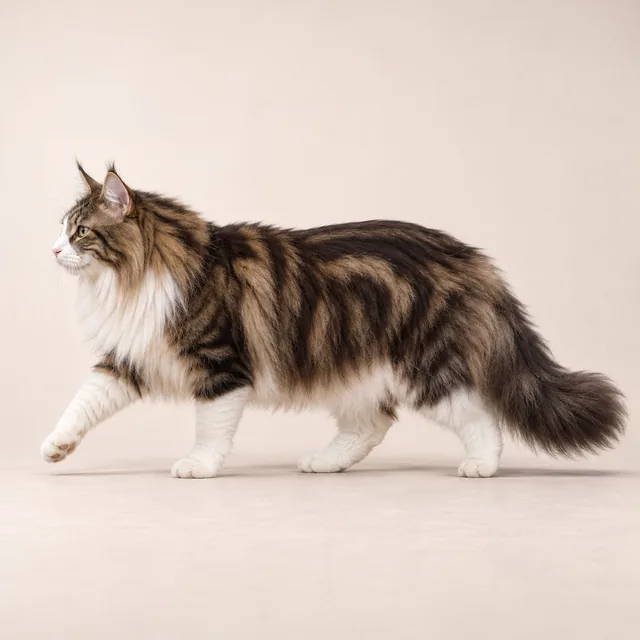
Living with a Norwegian Forest
They get along well with other cats, dogs and children.
Their calm temperament makes them a good choice for families with children and other pets.
With children
They get along well with children. They are a good choice for families with children.
With other pets
They get along well with other cats and dogs. They are a good choice for families with other pets.
Care
The double coat does not need a lot of maintenance.
Regular combing with a stainless-steel comb helps with tangles. A weekly combing is usually enough. Spring needs more care, when the winter coat is shed. Some coat textures mat more easily and need more upkeep.
Shedding
The winter coat gives way to a lighter warm-weather coat in spring, when more grooming is needed. A little extra combing in the spring is recommended.
Undercoat
Dense undercoat; it reaches full development in winter, so the coat may be fuller in winter than in summer.
Source:CFA
Baths
If you plan to bathe your cat, ask your breeder about products and methods. The water-repellent coat takes a long time to get wet and even longer to dry.
Source:CFA
Health
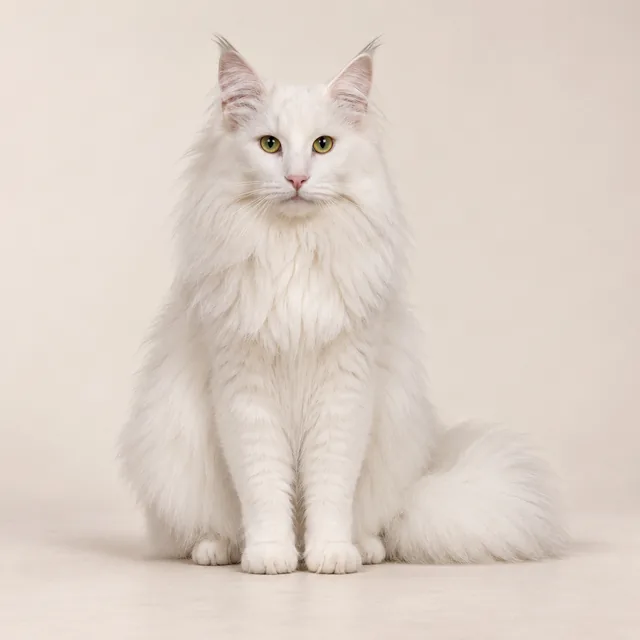
Problems that have affected the breed include hypertrophic cardiomyopathy (HCM), PK deficiency and glycogen storage disease type IV (GSD-IV).
Screening
Breeders now routinely test for HCM and glycogen storage disease. They are working to remove carrier cats from the gene pool.
Source:CFA
Health questions to ask
Talk to breeders about what testing they have done on their breeding cats. Not to hesitate to ask for copies of the test results.
Source:TICA
CFA health notes
Some hereditary health issues, HCM and glycogen storage disease, have occurred in the breed. Breeders now routinely test for them and work to remove carriers.
Source:CFA
This is what CFA and TICA say about the breed. It is not a health promise for any kitten. TrueKitten verifies breeder identities and documents, but that does not guarantee a kitten's health. Ask the breeder for test results and talk to your vet.
History
The breed's exact origins are not clear.
It is thought to have come out of the forest some 4,000 years ago and become a farm cat that hunted rodents. Norse myth says two giant "Skogkatts" pulled the chariot of the goddess Freya. Vikings may have brought Forest Cats on their ships. The breed was nearly lost through mixing with shorthair strays. King Olaf named it the official cat of Norway in the 1970s. The first breeding pair came to the U.S. in 1979. Championship status first came in 1984, a first for a North American registry. A second registry followed in 1993.
Recognition dates
- 1984TICA Championship status (first North American registry to grant it)
- 1993CFA Championship status
Did you know?
- Norse myth says two giant "Skogkatts" drew the chariot of the goddess Freya.
- Vikings may have brought Forest Cats to North America in the late 900s AD.
- King Olaf named it the official cat of Norway in the 1970s.
- The water-repellent coat takes a long time to get wet and even longer to dry.
- Without a tall cat tree, a Wegie may pick the top of the kitchen cabinet as its favorite spot.
Source:CFA
For breeders
Details from the CFA and TICA show standards. Cat show judges use them. They do not rate a kitten as a pet.
What the show standards ask for
- Head: equilateral triangle, measured from the outside of the ear base to the point of the chin; short, heavily muscled neck.
- Profile: straight from brow ridge to nose tip with no break; flat forehead into a gently curved skull.
- Chin firm and in line with the front of the nose; muzzle part of the straight line toward the ear base, without pronounced whisker pads or pinch.
- Ears: medium to large, rounded at the tip, broad at the base, set as much on the side as on top of the head; heavily furnished; lynx tips desirable but not required.
- Eyes: large, almond-shaped, well-opened, set at a slight angle with the outer corner higher.
- Body: solidly muscled, moderate length, substantial bone, broad chest and considerable girth without being fat; males large and imposing.
- Legs: hind legs longer than front legs (rump higher than shoulders); large, round, firm paws with heavy tufting.
- Tail: long and bushy, ideally as long as the body from tail base to neck base.
- Coat: dense undercoat under long, glossy, smooth water-resistant guard hairs; three-part bib (collar, mutton chops, frontal ruff); full britches. Coat type and quality matter more than color.
- Head an equilateral triangle; large, almond-shaped eyes on an oblique tilt; ears large and wide at the base, arched forward as if listening.
Points show how much each part counts when a judge scores a cat at a show. They add up to 100.
CFA colors and patterns
Every color and pattern except those showing hybridization (chocolate, sable, lavender, lilac, cinnamon, fawn, point-restricted/Himalayan-type markings, or these with white). Sections: solid and particolor (incl. amber, light amber, amber tortoiseshell); silver and golden (chinchilla/shaded silver and golden, red chinchilla/shaded silver, chinchilla/shaded tortoiseshell); smoke (incl. amber and light amber smoke); tabby (all tabby colors in classic, mackerel, patched, spotted, ticked); calico and bi-color, including vans; any other NFC colors. Buttons and lockets allowed without penalty.
Source:CFA
CFA allowed outcrosses
None (class-number reference, not an official part of the show standard)
Source:CFA
CFA allowances
No separate allowance section. Within the standard: softer coats are permitted in shaded, solid and bicolor cats; the coat may be fuller in winter; buttons and lockets carry no penalty.
Source:CFA
TICA allowances
- Buttons, spots and lockets allowed in all colors.
- Length of coat and density of undercoat vary with the seasons.
- Allow for size difference between males and females.
- Very slow maturing of this breed should be taken into account.
- Mature males may have broader heads than females.
Source:TICA
TICA penalties
- Too small and finely built cats.
- Round or square head; profile with a break (stop).
- Round eyes.
- Ears too small or narrow at the base.
- Legs that are short, thin, not in proportion to the body, or cowhocked.
- Short tail.
- Partial list; see the show standard for the rest.
Source:TICA
CFA disqualifications
Disqualify: severe break in nose; square muzzle; whisker pinch; long rectangular body; cobby body; incorrect number of toes; crossed eyes; kinked or abnormal tail; delicate bone structure; malocclusion (undershot or overshot chin); evidence of hybridization resulting in chocolate, sable, lavender, lilac, cinnamon, fawn or point-restricted markings, or these with white.
Source:CFA
TICA disqualifications
Partial: depression of the sternum or an unusually small rib cage diameter; any sign of definite challenge (temperament). The standard also points to the Show Rules' mandatory disqualifications.
Source:TICA
CFA breeding notes
The breed was almost lost through interbreeding with shorthair strays. In the mid-1970s, Norway's first breed club began a breeding program. It used carefully selected non-pedigreed cats that a panel of judges certified for registration.
Source:CFA
Common questions
A fully grown male weighs 12–16 lb and a female 9–12 lb. The breed page lists adult females at 8–12 lb and adult males at 12–18 lb. A breed seminar says males typically weigh 12–15 lb and females 8–11 lb.
This is a slow-maturing breed. It can take up to five years to reach full growth. Full maturity may take up to five years.
Life expectancy is 13 or more years.
They can be lap cats, but it will always be their decision when to get on or off.
They get along well with other cats, dogs and children. Their calm temperament makes them a good choice for families with children and other pets.
The double coat does not need a lot of maintenance. Regular combing with a stainless-steel comb helps with tangles. A weekly combing is usually enough. Spring needs more care, when the winter coat is shed. Some coat textures mat more easily and need more upkeep.
They are moderately active, with random bursts of energy. They can amuse themselves with toys, running, hiding and pouncing. They like high places. Give them tall scratching posts or cat trees. They love to climb and recommends a scratching post with seats they can climb.
Problems that have affected the breed include hypertrophic cardiomyopathy (HCM), PK deficiency and glycogen storage disease type IV (GSD-IV).
Questions to ask a breeder
- Which tests have the parents had for HCM, and when were their last heart scans?
- Have the parents been DNA-tested for PK deficiency and glycogen storage disease type IV? May I have copies of the results?
- How big are the parents, and how old are they?
- What is this kitten's coat texture, and how often do you comb it?
- Does the kitten have a tall cat tree or climbing space now?
Sources
Every fact on this page comes from the two cat registries, CFA and TICA.
Last updated