
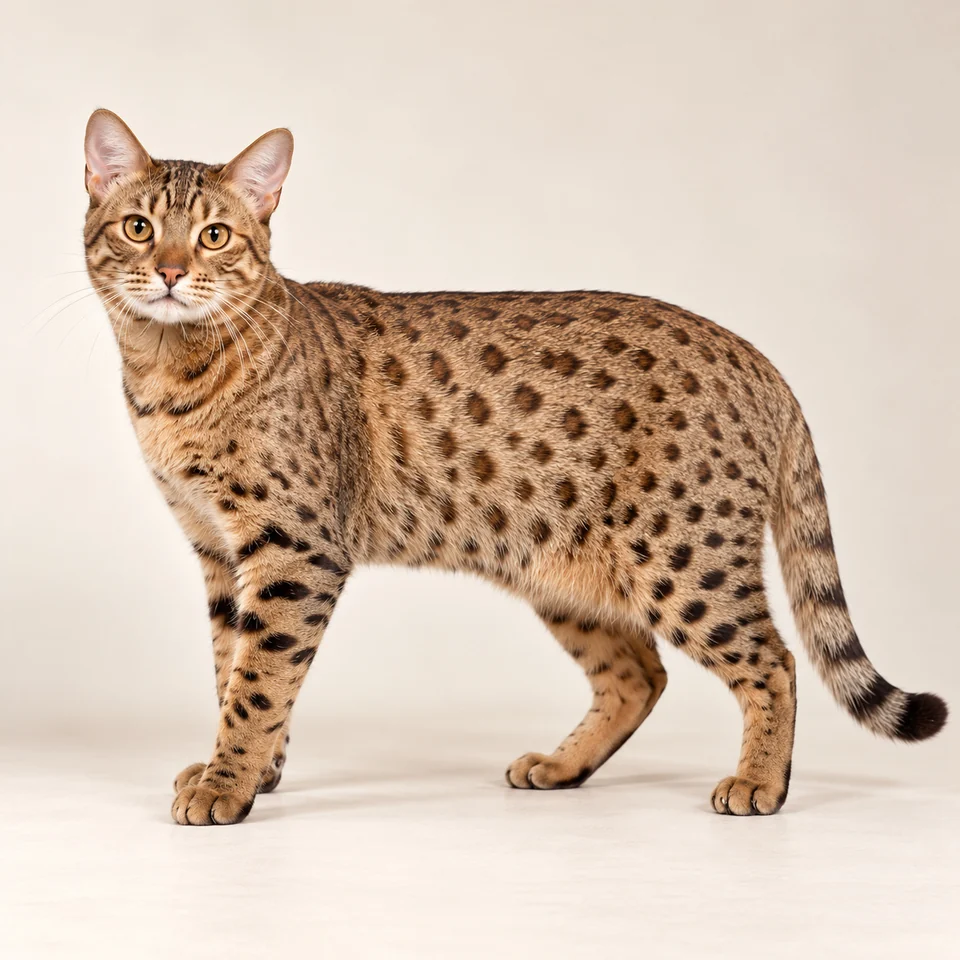
The Ocicat is a spotted cat with a wild look.
It is a 100% domestic hybrid. It was bred to look like the spotted wildcats of Central and South America. Ocicats are confident and outgoing. They are friendly to everyone, even strangers.
Quick facts
- Coat lengthCFA
- Shorthair
- Coat feelCFATICA
- Short, smooth and satiny, with a lustrous sheen and no woolliness. It is fine, thick, tight and close-lying.
- WeightCFATICA
- Average weights are 10 to 12 lb for males and 8 to 10 lb for females. Another figure is about 9 to 14 lb for males and 6 to 9 lb for females. Ocicats feel heavy for their size, and females are usually smaller than males.
- CFA statusCFA
- Championship (since 1987)
Appearance
Ocicats are strong, muscular cats.
They feel heavy for their size. Their large spots are shaped like thumbprints. Show cats have a bull's-eye pattern on each side. That is a spot ringed by other spots. The head is a modified wedge with a broad muzzle.
Source:CFA
Body
Solid, hard, rather long body with depth and fullness, never coarse. The torso is moderate and semi-foreign, with substantial muscle.
Colors and patterns
Spotted only. One registry accepts 12 colors in 8 color classes, such as tawny, chocolate, cinnamon and silver versions. The other allows eumelanistic colors only. Neither allows red, cream or torbie Ocicats.
Personality
Ocicats are often called dog-like.
They are devoted to their owners but not clingy or demanding. The Ocicat may look wild but is absolutely devoted to its family. They often show dog-like behavior in their desire to play fetch. They are outgoing and friendly to everyone, including strangers.
With their people
Ocicats are not happy left alone for long periods. The same about their social nature. They value people but do not crave attention all the time.
Voice
An Ocicat may meow now and then to get your attention. They will not be annoying about it.
Source:CFA
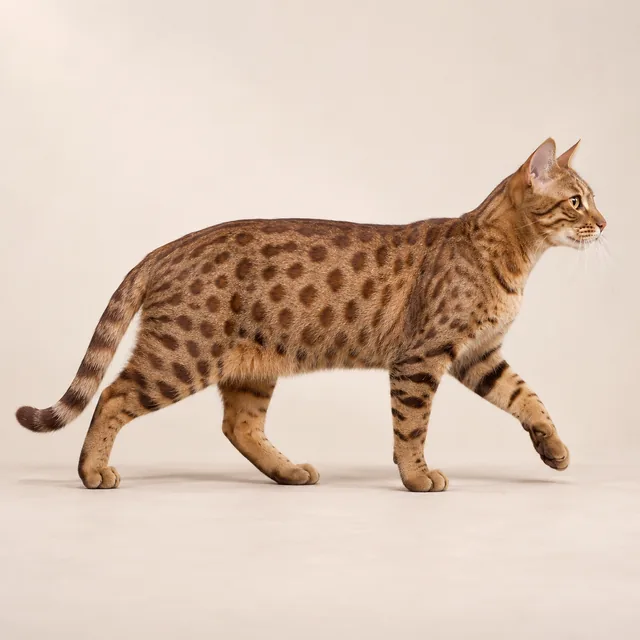
Living with an Ocicat
Ocicats do best in homes with other animals or someone who works from home.
They fit well into almost any type of household.
Source:CFA
Activity
Ocicats are energetic but not overly active. Their activity level is lower than an Abyssinian's or Siamese's. Their love of toys can turn possessive. Try to take a toy, and they may play tug-of-war.
Training
Ocicats respond well to training. Many will fetch and walk on a leash. Many learn voice commands and household rules. They also make excellent travelers.
Source:CFA
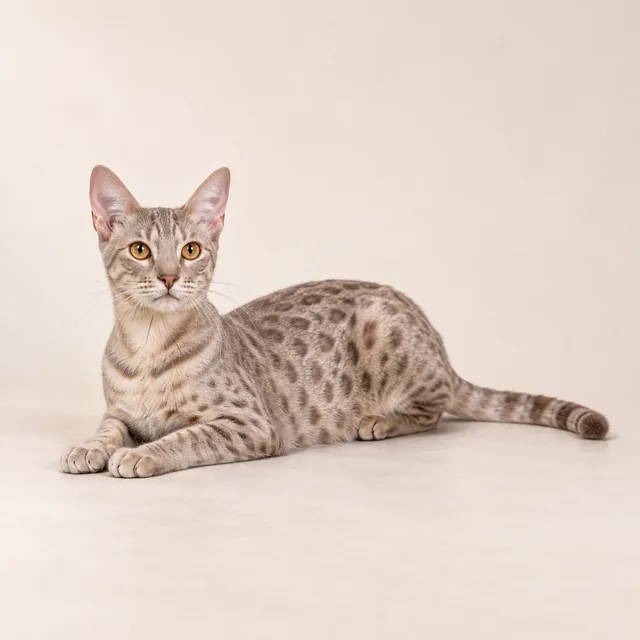
Care
Ocicats need only minimal grooming.
Some owners use a rubber brush now and then to remove dead hair. For very light shedders, a chamois cloth is enough. There are two views. One is to run a rubber brush over the coat weekly. The other is that brushing is not necessary, but it is a good way to bond.
Nails, ears, eyes and teeth
Brush their teeth and clip their nails regularly, as with any cat. To ask your vet for instructions.
Source:TICA
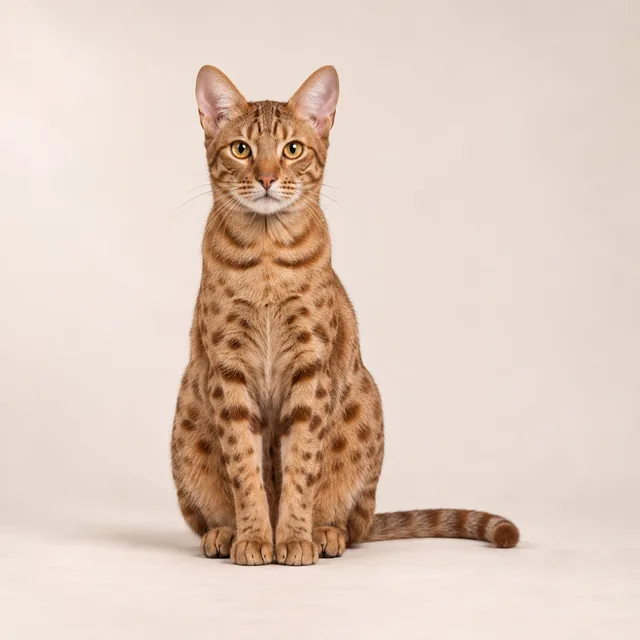
Health
Some conditions from the parent breeds may still occur.
One is hypertrophic cardiomyopathy (HCM), the most common feline heart condition. Another is amyloidosis, which can affect the kidneys or liver. Progressive retinal atrophy (PRA), which causes blindness, is now a minor concern. It can be managed through genetic testing.
Source:CFA
Screening
Breeders generally share genetic testing information. PRA can be managed through genetic testing.
Source:CFA
Health questions to ask
Asking your breeder about any history of these conditions in the line is recommended.
Source:CFA
CFA health notes
"Breed Future": breeders generally share genetic testing information. Hypertrophic cardiomyopathy and amyloidosis may still occur. Progressive retinal atrophy is now a minor concern because of genetic testing.
Source:CFA
This is what CFA says about the breed. It is not a health promise for any kitten. TrueKitten verifies breeder identities and documents, but that does not guarantee a kitten's health. Ask the breeder for test results and talk to your vet.
History
The first Ocicat, Tonga, was born in 1964.
He came from an attempt to cross an Abyssinian with a Siamese. The breeder was Virginia Daly. The spotted kitten reminded the breeder's daughter of an ocelot, so he was named Ocicat. Other breeders repeated the cross. They also added an American Shorthair to broaden the gene pool. The Ocicat was accepted for registration in 1966. It reached championship status in 1987.
Did you know?
- The name comes from the ocelot. The first kitten reminded the breeder's daughter of one.
- Ocicats look wild but are 100% domestic.
- The spotted pattern comes in 12 colors.
- Many Ocicats make excellent travelers.
Source:CFA
For breeders
Details from the CFA and TICA show standards. Cat show judges use them. They do not rate a kitten as a pet.
What the show standards ask for
- Head: modified wedge with a slight curve from muzzle to cheek; broad, well-defined muzzle with a suggestion of squareness.
- Ears: moderately large, set to corner the head; ear tufts / lynx tips are a bonus.
- Eyes: large, almond shaped, angled slightly upward; any color except blue.
- Body: solid, hard, rather long, medium to large; a moderate, semi-foreign torso.
- Legs: medium-long, well-muscled, in good proportion to the body; feet oval and compact.
- Tail: fairly long, medium-slim, slight taper, dark tip.
- Coat: short, smooth, satiny and close-lying; fine, thick, tight, close-lying.
- Pattern: thumbprint spots, bull's-eye-style spot ringed by spots on the sides; elongated mackerel-style spots are penalized (both).
Points show how much each part counts when a judge scores a cat at a show. They add up to 100.
CFA colors and patterns
Spotted pattern in 12 colors: tawny (brown spotted tabby), chocolate, cinnamon, blue, lavender, fawn, ebony silver, chocolate silver, cinnamon silver, blue silver, lavender silver, fawn silver. Non-spotted or non-agouti Ocicats (classic or ticked tabby, solid, smoke) fall in the AOV class.
Source:CFA
CFA allowed outcrosses
Abyssinian, for litters born before 12/31/2030 (reference information, not an official part of the show standard).
Source:CFA
CFA allowances
Jowls on mature males. (Contrast section also notes pale colors will show less contrast than darker ones.)
Source:CFA
TICA allowances
Stud jowls in adult males; pale colors will show less contrast than darker ones.
Source:TICA
CFA penalties
Faint or blurred spotting (remembering pale colors show less contrast); elongated spots following a mackerel pattern.
Source:CFA
CFA disqualifications
White locket or spotting, or white anywhere other than around eyes, nostrils, chin and upper throat (except white agouti ground in silvered colors); kinked or otherwise deformed tail; blue eyes; incorrect number of toes; long hair; reds, creams or torbies.
Source:CFA
TICA disqualifications
Withhold all awards (WW): white locket or spotting, or white anywhere other than around eyes, nostrils, chin and upper throat; any cat displaying phaeomelanistic color. Plus the general Show Rules (Article Sixteen) disqualifications printed on every standard (e.g. biting, intent to deceive, incorrect toe count, tail faults, total blindness).
Source:TICA
Common questions
The Ocicat is a spotted cat with a wild look. It is a 100% domestic hybrid. It was bred to look like the spotted wildcats of Central and South America. Ocicats are confident and outgoing. They are friendly to everyone, even strangers.
Ocicats are often called dog-like. They are devoted to their owners but not clingy or demanding. The Ocicat may look wild but is absolutely devoted to its family. They often show dog-like behavior in their desire to play fetch. They are outgoing and friendly to everyone, including strangers.
Ocicats are not happy left alone for long periods. The same about their social nature. They value people but do not crave attention all the time.
Ocicats respond well to training. Many will fetch and walk on a leash. Many learn voice commands and household rules. They also make excellent travelers.
Ocicats need only minimal grooming. Some owners use a rubber brush now and then to remove dead hair. For very light shedders, a chamois cloth is enough. There are two views. One is to run a rubber brush over the coat weekly. The other is that brushing is not necessary, but it is a good way to bond.
Average weights are 10 to 12 lb for males and 8 to 10 lb for females. Another figure is about 9 to 14 lb for males and 6 to 9 lb for females. Ocicats feel heavy for their size, and females are usually smaller than males.
Some conditions from the parent breeds may still occur. One is hypertrophic cardiomyopathy (HCM), the most common feline heart condition. Another is amyloidosis, which can affect the kidneys or liver. Progressive retinal atrophy (PRA), which causes blindness, is now a minor concern. It can be managed through genetic testing.
Spotted only. One registry accepts 12 colors in 8 color classes, such as tawny, chocolate, cinnamon and silver versions. The other allows eumelanistic colors only. Neither allows red, cream or torbie Ocicats.
The first Ocicat, Tonga, was born in 1964. He came from an attempt to cross an Abyssinian with a Siamese. The breeder was Virginia Daly. The spotted kitten reminded the breeder's daughter of an ocelot, so he was named Ocicat. Other breeders repeated the cross. They also added an American Shorthair to broaden the gene pool. The Ocicat was accepted for registration in 1966. It reached championship status in 1987.
Questions to ask a breeder
- Is there any history of hypertrophic cardiomyopathy (HCM) in this kitten's line?
- Is there any history of amyloidosis in this kitten's line?
- What genetic testing have the parents had, including for PRA, and can I see the results?
- How is the kitten used to being left alone, and with other pets?
- What food is the kitten eating now?
- Can I see the registration papers for the kitten and parents?
Sources
Every fact on this page comes from the two cat registries, CFA and TICA.
Last updated