
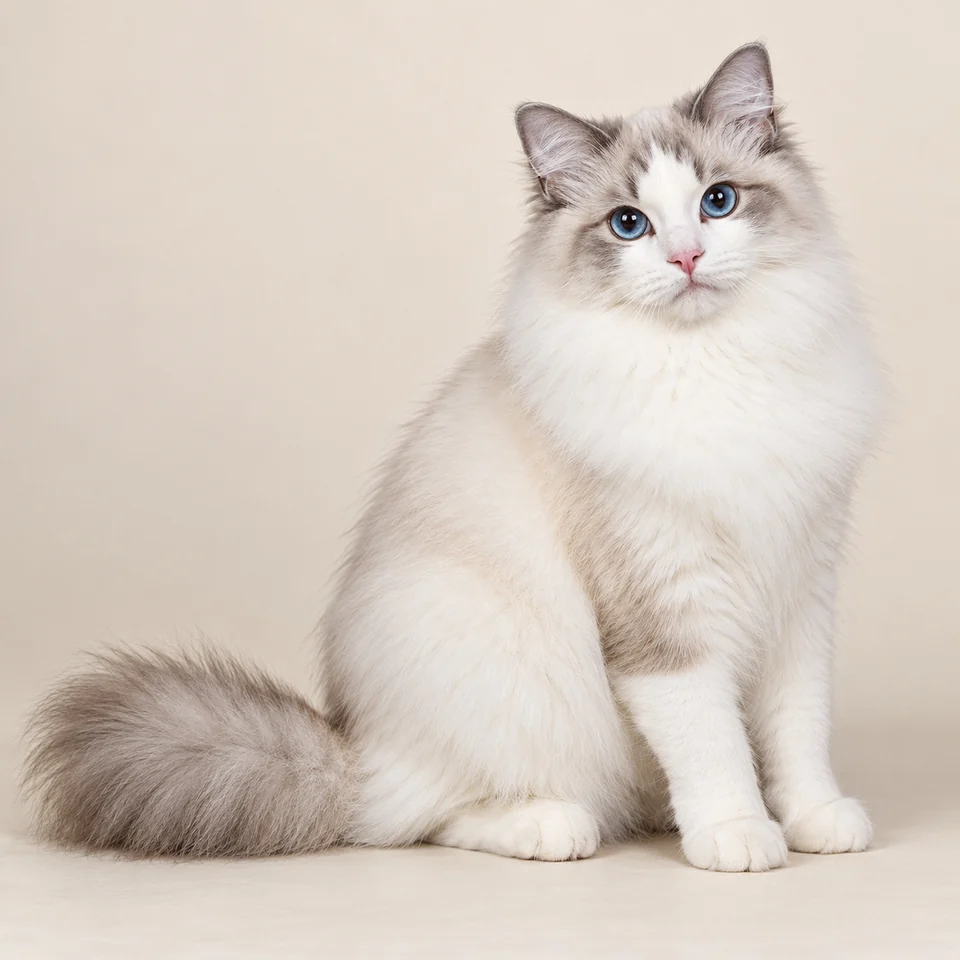
The Ragdoll is one of the larger cat breeds.
It has vivid blue eyes and a soft, semi-long coat. Every Ragdoll is pointed, with a body lighter than its head, legs and tail. Ragdolls are laid-back, gentle and affectionate. They are loving without being demanding.
Source:CFA
Quick facts
- Where it beganCFA
- Riverside, California, USA
- When it beganCFA
- 1960s
- Coat feelCFATICA
- Soft and silky, made mostly of guard hairs; flows with the body. Silky soft, not wooly or cottony.
- WeightCFATICA
- A mature male often reaches or exceeds 20 pounds. Females are usually smaller. The breed page lists males at 15-20 pounds. "Females can weigh up to 10-15 pounds."
- LifespanTICA
- Many Ragdolls live to their mid- or high teens. Life expectancy depends on things like genetics and care.
- Fully grownCFATICA
- Ragdolls are slow to mature. Full size and weight can take four years. Full coat color comes at two to three years. Full color is not reached until three.
- CFA statusCFA
- Championship (since 2000)
Appearance
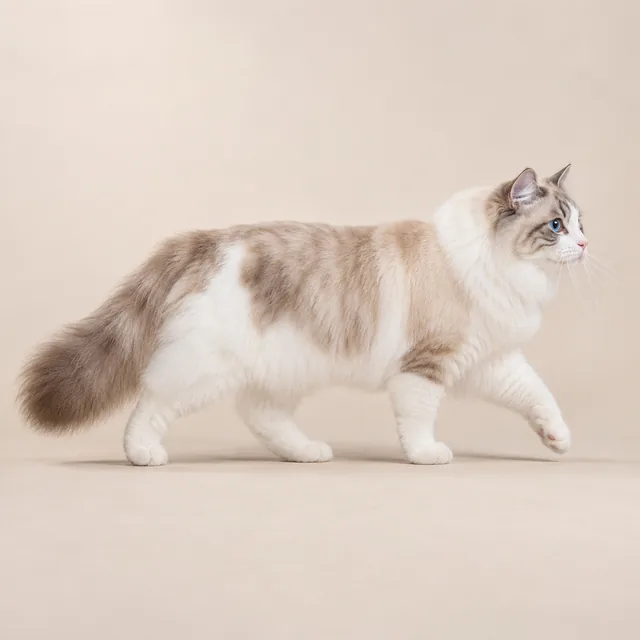
The breed has a broad chest, a long, muscular body and sturdy bones.
The head is a large, modified wedge with a slightly curved profile. The eyes are vivid blue ovals. The semi-long coat is mostly guard hairs, so it feels soft and silky. Three of the four Ragdoll patterns add white accents to the pointed markings.
Source:CFA
Body
Large, long and rectangular, broad and solid, with heavy boning; firm and muscular; moderate lower stomach pad acceptable
Colors and patterns
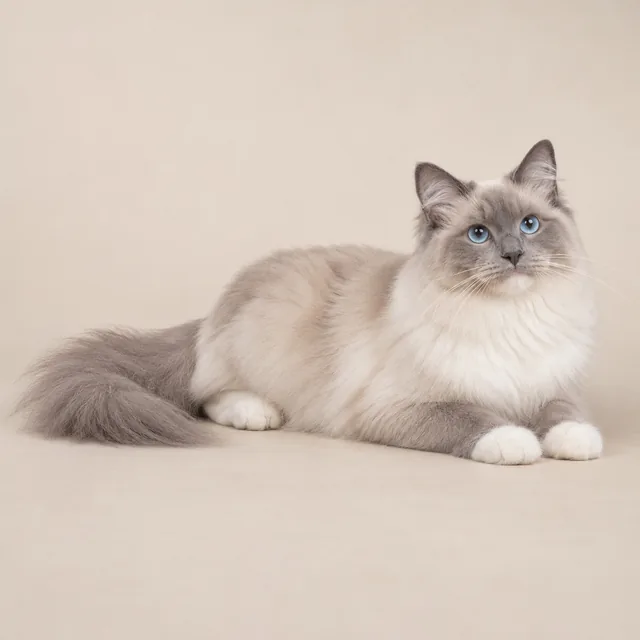
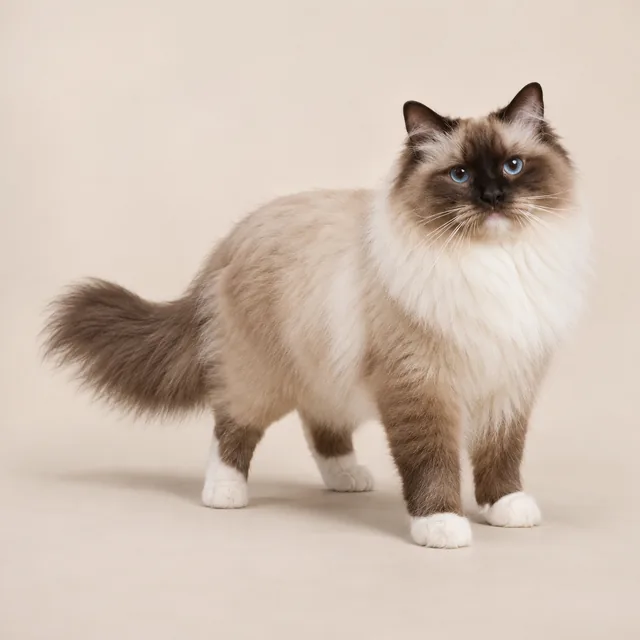
All Ragdolls are pointed: the body is lighter than the head, legs and tail. There are four patterns: colorpoint, mitted, bicolor and van. The six point colors are seal, blue, chocolate, lilac, red and cream, in solid, lynx and tortie. Some shows accept all pointed colors, in solid, tortie and tabby point, plus mitted and bicolor white patterns.
Personality
Ragdolls are gentle, calm and sociable.
They are loving without being demanding. It is rare for a Ragdoll to be aggressive or temperamental. The breed has a sweet personality.
With their people
A Ragdoll will often greet you at the door and stay close by. Many sleep with their owners. Some owners say Ragdolls are attuned to their feelings.
Source:CFA
Living with a Ragdoll
Ragdolls adapt easily to most homes and do not need much space.
They make excellent pets for children and get along well with other animals. Because they are so trusting, introduce them carefully to cats or dogs you already have.
Source:CFA
With children
Ragdolls make excellent pets for children. Ragdolls get along well with children. They may be carried around the house in a child's arms.
With other pets
They get along well with other animals. Introduce them with extra care to existing cats or dogs, who may be less gentle. They get along with other pets, including dogs.
Activity
Ragdolls are moderately active. They enjoy play sessions but do not insist on them. Some owners call them kittens that never quite grow up.
Source:CFA
Care
Grooming takes little time.
Comb at least once or twice a week with a steel comb. This removes loose hair and tangles. Ragdolls shed, usually with the seasons. A stainless steel or "Greyhound" comb, used once a week or more is recommended.
Shedding
Ragdolls shed, usually with the change of seasons. With no thick, dense undercoat, shedding and matting are reduced. Watch for tangles under the armpits during shedding season.
Undercoat
The coat should not have a significant undercoat, with minimal woolly undercoat. A minimal undercoat gives the coat body, but the coat still falls smoothly.
Baths
Ask your breeder about products and techniques if you plan to bathe your cat. Ragdolls can be taught from an early age to tolerate, and even enjoy, bathing and blow-drying.
Food
Ragdolls love food and may be at risk for obesity. Watch portion sizes to keep a healthy weight.
Source:CFA
Health
One hereditary health issue, hypertrophic cardiomyopathy (HCM), has been found in the breed.
Screening
Breeders now routinely test for HCM. They are working to remove carrier cats from the gene pool. Ragdolls have a DNA test for HCM. Choosing a breeder who does an HCM DNA test on all cats they breed is recommended.
CFA health notes
HCM has been found in the breed, and breeders now routinely test for it. Ragdolls may be at risk for obesity, so monitor portion sizes.
Source:CFA
This is what CFA and TICA say about the breed. It is not a health promise for any kitten. TrueKitten verifies breeder identities and documents, but that does not guarantee a kitten's health. Ask the breeder for test results and talk to your vet.
History
Ann Baker developed the Ragdoll in the 1960s in Riverside, California.
She started with a chosen group of domestic longhairs. The foundation cat, Josephine, was a white domestic longhair carrying the colorpoint gene. Baker claimed Josephine went limp when held. That trait is not typical of most Ragdolls today, but it gave the breed its name. Ragdolls were accepted for registration in 1993 and for championship in 2000.
Source:CFA
For breeders
Details from the CFA and TICA show standards. Cat show judges use them. They do not rate a kitten as a pet.
What the show standards ask for
- General: large, well balanced, moderate type with no extremes; medium to large.
- Head: broad modified wedge (equilateral); flat plane between the ears.
- Profile: slightly curving, straight medium-length nose; straight nose to bridge, concave curve to brow, convex forehead. A Roman nose is penalized; any nose break can disqualify.
- Eyes: large ovals, vivid blue; large oval, blue for RD.
- Ears: medium, wide set, broad base, rounded tips, tilted forward.
- Body: large, long, rectangular, heavy boning, firm and muscular; stomach pad acceptable.
- Legs and paws: heavily boned, hind legs longer; paws large, round, tufted.
- Tail: long with full plume; equal to body length.
- Coat: moderately long, abundant guard hairs, minimal woolly undercoat, non-matting; semi-long, silky soft, minimal undercoat.
Points show how much each part counts when a judge scores a cat at a show. They add up to 100.
| Part | Points |
|---|---|
| HEADLarge, modified wedge that is equilateral in shape 20, Eyes large; vivid blue ovals 10, Ears medium, wide set, moderately flared 5, Profile slightly curving; nose straight, chin strong 5 | 40 |
| BODYMedium to large size and heavy boning 15, Long, rectangular body 10, Legs moderately long; tail long 5 | 30 |
| COATModerately long length, with abundant guard hairs, but minimal woolly undercoat 20, Color of body and points (5 for white markings and symmetry, 5 for body and point color) 10 | 30 |
Source:CFA
| Part | Points |
|---|---|
| HEAD | 40 |
| BODY | 35 |
| COAT/COLOR/PATTERN | 25 |
Source:TICA
TICA divisions
RD Solid Point Division; Tortie Point Division; Tabby Point Division; Solid Point/white, Tortie Point/white, Tabby Point/white Divisions (mitted and bicolor patterns ONLY)
Source:TICA
CFA colors and patterns
Patterns: colorpoint, mitted, bicolor, van. Point colors: seal, blue, chocolate, lilac, red, cream; each in solid, lynx (including tortie-lynx) and tortie forms (seal-tortie, chocolate-tortie, blue-cream, lilac-cream).
Source:CFA
CFA allowances
Partial: no allowances section. The standard allows jowls in adult males, slow maturation in young adults, shorter coats in unaltered adults and seasonal variations, darker body color in older cats, and faint ghost markings on mitted kittens.
Source:CFA
TICA allowances
Seasonal changes in coat length; shorter coats on unaltered adults and kittens; females may be smaller than males. Mitted and bicolor only: small spots of point color in white areas; spots of point color on paw pads or colored paw pads. Color clauses also allow darker body color in older cats and undeveloped color in young cats.
Source:TICA
CFA penalties
General: thick undercoat standing off the body; small or round eyes; very pale blue or near-black blue eyes; Roman nose; cobby body low on legs; short tail; non-directional lump on tail. Pattern penalties: bicolor "V" beyond outer edges of eyes or very asymmetrical, white on ears; van more than 20% body color.
Source:CFA
TICA penalties
Very small ears; any eye shape other than oval; Roman nose; straight profile; cobby body; short legs; short tail; wooly/cottony coat. Mitted: no white belly stripe; white on ears and/or tail. Bicolor: white beyond the outer edge of the eye; white on ears and/or tail.
Source:TICA
CFA disqualifications
General: any nose break; body and point colors other than those listed; eyes other than blue; directional tail kink; crossed eyes; extra toes. Pattern: bicolor "V" absent or dark-spotted, extensive dark area on a leg; van with no point color on head or tail; colorpoint with any locket or white spot; mitted without a white chin.
Source:CFA
TICA disqualifications
Withhold all awards: doming; RD: any eye color other than blue; pointed: any white. Mitted: lack of white chin. Bicolor: any dark markings inside the white "V", including the chin. Disqualify: crossed eyes; visible or severe tail faults; severe cow hocks; any sign of definite challenge in temperament; plus the Show Rules Article Sixteen mandatory disqualifications listed in the standard.
Source:TICA
Common questions
A mature male often reaches or exceeds 20 pounds. Females are usually smaller. The breed page lists males at 15-20 pounds. "Females can weigh up to 10-15 pounds."
Ragdolls are slow to mature. Full size and weight can take four years. Full coat color comes at two to three years. Full color is not reached until three.
Ragdolls adapt easily to most homes and do not need much space. They make excellent pets for children and get along well with other animals. Because they are so trusting, introduce them carefully to cats or dogs you already have.
Ann Baker developed the Ragdoll in the 1960s in Riverside, California. She started with a chosen group of domestic longhairs. The foundation cat, Josephine, was a white domestic longhair carrying the colorpoint gene. Baker claimed Josephine went limp when held. That trait is not typical of most Ragdolls today, but it gave the breed its name. Ragdolls were accepted for registration in 1993 and for championship in 2000.
Grooming takes little time. Comb at least once or twice a week with a steel comb. This removes loose hair and tangles. Ragdolls shed, usually with the seasons. A stainless steel or "Greyhound" comb, used once a week or more is recommended.
The coat should not have a significant undercoat, with minimal woolly undercoat. A minimal undercoat gives the coat body, but the coat still falls smoothly.
Ragdolls are not talkative. They may greet you with a soft mew now and then.
One hereditary health issue, hypertrophic cardiomyopathy (HCM), has been found in the breed. They may be at risk for obesity. Ragdolls have a DNA test for HCM, a heart disease.
All Ragdolls are pointed: the body is lighter than the head, legs and tail. There are four patterns: colorpoint, mitted, bicolor and van. The six point colors are seal, blue, chocolate, lilac, red and cream, in solid, lynx and tortie. Some shows accept all pointed colors, in solid, tortie and tabby point, plus mitted and bicolor white patterns.
Many Ragdolls live to their mid- or high teens. Life expectancy depends on things like genetics and care.
Questions to ask a breeder
- Have the parents been tested for hypertrophic cardiomyopathy (HCM), and can I see the results?
- Have both parents had the HCM DNA test, and what were the results?
- Can I see health records for both parents?
- Which pattern (colorpoint, mitted, bicolor or van) is this kitten?
- How much and what do you feed, and how do you watch portion sizes?
- How do you introduce kittens to other cats or dogs?
Sources
Every fact on this page comes from the two cat registries, CFA and TICA.
Last updated