
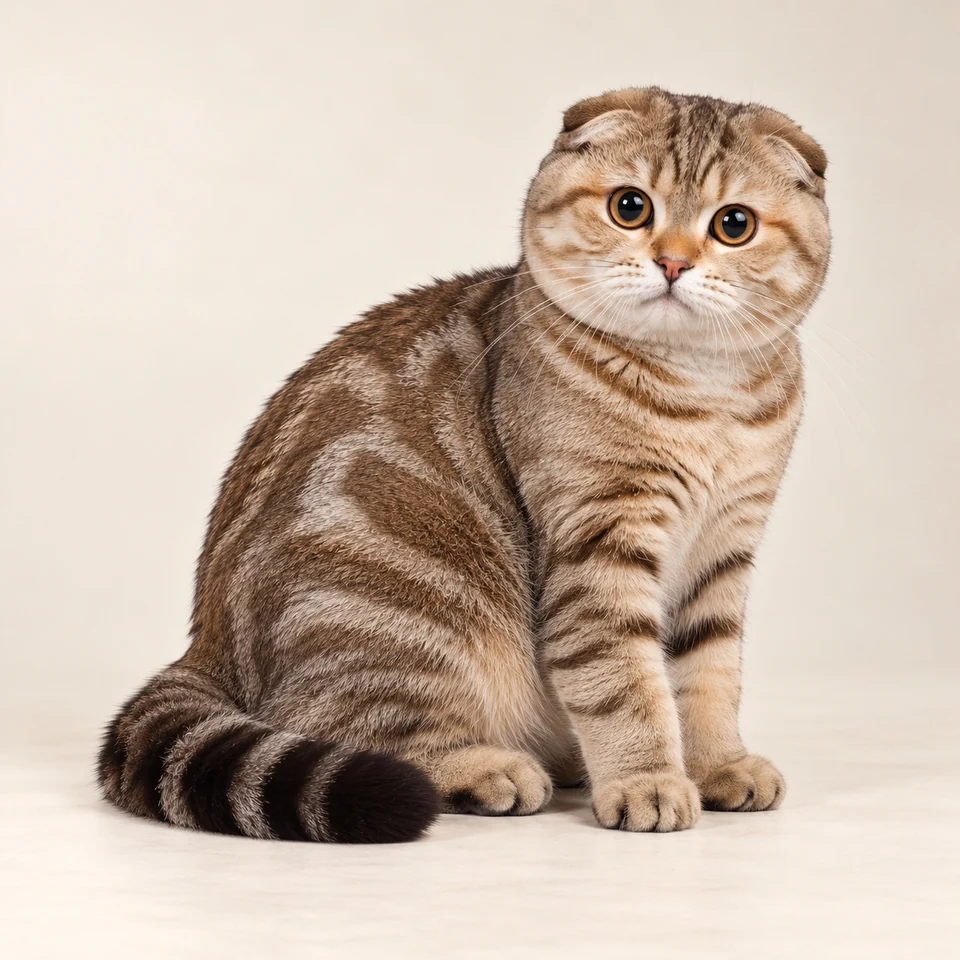
The Scottish Fold is known for ears that fold forward and down.
“Round” is the word most used to describe it. The round eyes give it a sweet, open look. The breed is loving and calm. There is a separate longhaired version, the Scottish Fold Longhair.
Quick facts
- Where it beganCFA
- Scotland (Tayside region farm)
- When it beganCFA
- 1961 (the first Scottish Fold, Susie, was spotted in 1961)
- Coat feelCFATICA
- Dense and plush. It is soft, short to medium-short, and standing away from the body. It should be plush, dense and resilient.
- LifespanTICA
- Life expectancy is 11 to 14+ years.
- CFA statusCFA
- Championship (shorthaired Fold, since 1978)
Appearance
The ears fold forward and down.
A small, tightly folded ear is preferred. The ears sit like a cap on a rounded head. The folded ears have no effect on the cat’s hearing. Eyes are large and round. The body is medium and rounded, with medium bone. The tail should be flexible and in proportion to the body. The short coat is dense and plush.
Colors and patterns
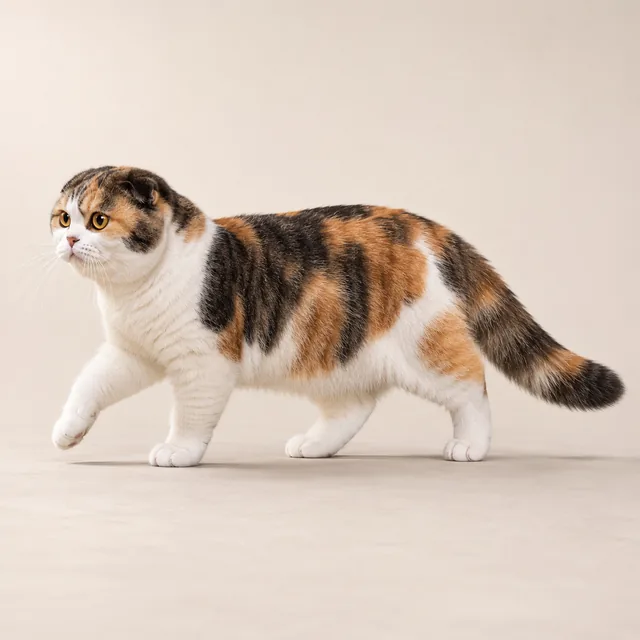
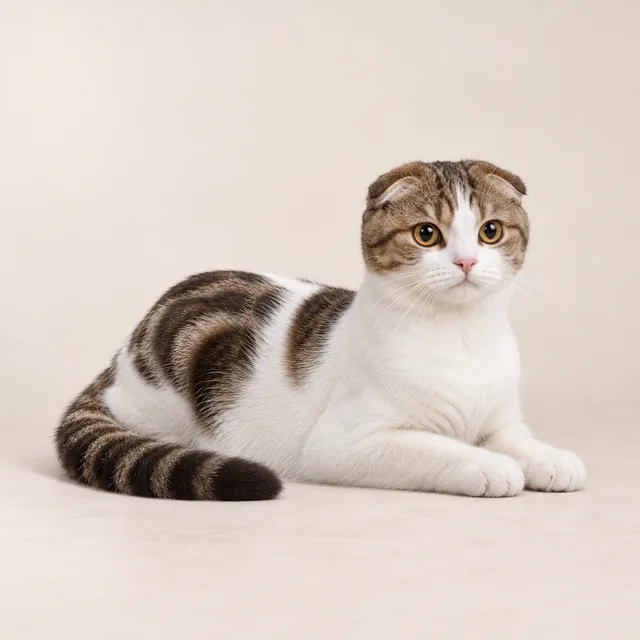
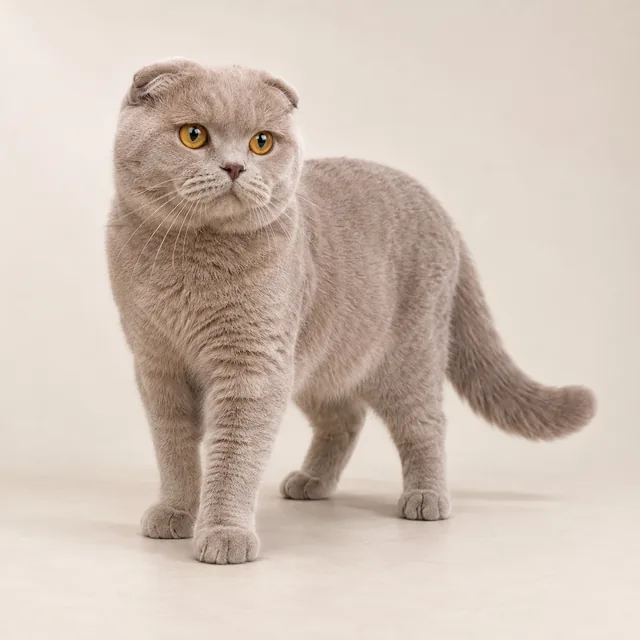
Any color and pattern. Any genetically possible color, pattern or combination is allowed.
Eye colors
Eye color matches the coat color. Blue or odd eyes are allowed in white, bi-color and van patterns.
Personality
Scottish Folds are comfortable, charming homebodies.
They enjoy people but do not crave attention. They are quiet but not placid. They have very even temperaments. The Scottish Fold is sweet-tempered and affectionate.
With their people
They are people-oriented and follow you around the house. They rarely get in the way. They do not do well left alone for long periods.
Source:CFA
Being held
The tail should be handled gently. Folds can develop stiffness that can cause pain if manhandled.
Source:TICA
Living with a Scottish Fold
They are homebodies who rarely get in the way of daily life.
They do not do well left alone for long periods.
Source:CFA
With other pets
Folds are sometimes reserved with other cats. Other cats may see their folded ears as a sign of hostility.
Source:CFA
Activity
They will readily play fetch. They will not start a game at three in the morning. Scottish Folds are not as active as other breeds.
Settling in
Folds can be reserved with strangers. Their affection blossoms with respectful, loving attention.
Source:CFA
Care
Scottish Folds need no special grooming.
A weekly combing keeps the coat in good condition.
Source:CFA
Baths
If you plan to bathe your cat, ask your breeder about the right products. Every coat is slightly different.
Source:CFA
Food
Scottish Folds tend to be good eaters and are not as active as other breeds. Special care should be taken with their nutrition so they do not become overweight.
Source:TICA
Health
“They do, however have a form of degenerative joint disease caused by the same thing that causes the ear to fold.
This can show up particularly in their tail, ankles, and feet.” “Folds also should be checked for hypertrophic cardiomyopathy and polycystic kidney disease.” Breeders pair fold-eared cats only with straight-eared cats “to minimize arthritic and bone conditions that may occur in this breed.”
Screening
Tail flexibility should be checked gently but often. Stiffness can be an early sign of other health problems. “They should be taken to the veterinarian immediately to check for arthritis if any stiffness is noticed or if they appear to be in pain when their tail is manipulated.” Folds should be checked for hypertrophic cardiomyopathy (HCM) and polycystic kidney disease (PKD).
CFA health notes
“A well-bred Scottish Fold will have a flexible tail and no problems with its gait.” Tail stiffness can be an early sign of other health problems.
Source:CFA
This is what CFA and TICA say about the breed. It is not a health promise for any kitten. TrueKitten verifies breeder identities and documents, but that does not guarantee a kitten's health. Ask the breeder for test results and talk to your vet.
History
In 1961, shepherd William Ross spotted the first Scottish Fold on a farm in Scotland's Tayside region.
She was a copper-eyed white female named Susie. Susie had only one litter. Her daughter Snooks became the foundation queen. Snooks was bred to a domestic male and then to a British Shorthair. Both litters had folded-ear kittens. The folded ears come from a dominant gene, considered a spontaneous mutation. Shorthaired Folds gained championship status in 1978 and longhaired Folds in 1992. Straight-eared cats were accepted in 2022.
Source:CFA
Recognition dates
- 1978CFA Championship status for shorthaired Folds
- 1992CFA Championship status for longhaired Folds; breed split into Shorthair and Longhair divisions
- 2022CFA Straight-eared cats accepted; breed now has four divisions
Source:CFA
Did you know?
- The folded ears have no effect on the cat’s hearing.
- Kittens’ ears do not begin to fold until three or four weeks of age, so expect a wait for a kitten.
- A curious Fold may sit up straight like a prairie dog when something new catches its eye.
- All bona fide Scottish Fold cats trace their pedigree to Susie.
Source:CFA
For breeders
Details from the CFA and TICA show standards. Cat show judges use them. They do not rate a kitten as a pet.
What the show standards ask for
- Overall: “round” is the word most used for this breed; the head should be round from any angle.
- Head: well rounded with a firm chin and jaw; prominent, jowly cheeks, more so in males.
- Ears (folded): fold forward and downward; small, tightly folded ear preferred; set like a cap to expose a rounded cranium; rounded tips.
- Eyes: wide open, large and round, with a sweet expression; color to match the coat.
- Nose/profile: a short, broad nose with a gentle curve and a brief stop. A definite nose break is a fault and can disqualify.
- Body: medium, rounded, even from shoulder to pelvic girdle; medium bone; no hint of lack of mobility from short, coarse legs.
- Tail: medium to long, flexible and tapering, in proportion; longer preferred. Tail is worth 20 points in both standards.
- Coat (shorthair): dense, plush, even and resilient; short to medium-short, standing away from the body; double coat preferred.
- Color: any color and pattern in both standards.
Points show how much each part counts when a judge scores a cat at a show. They add up to 100.
CFA colors and patterns
Any genetically possible color and pattern, and any combination of them. Buttons and lockets are allowed on any color or pattern.
Source:CFA
CFA allowed outcrosses
American Shorthair and British Shorthair ("In America, the outcross is the American and British Shorthair.")
Source:CFA
CFA allowances
No separate ALLOW section. Buttons and lockets are allowed on any color/pattern with no penalty. Longhair: short hair permissible on face and legs. Shorthair: coat texture may vary with color and regional/seasonal changes.
Source:CFA
TICA allowances
Seasonal changes in coat length and texture for the longhair fold. Lockets.
Source:TICA
CFA penalties
Penalize: brow ridge. Longhair: seriously penalize cottony coat, except in kittens. Body section: fault cats obviously lacking in type.
Source:CFA
TICA penalties
A heavy brow ridge (closes down the face and looks like scowling or frowning); forehead should be smooth; a definite nose break is a fault; any hint of lack of mobility due to short, coarse legs.
Source:TICA
CFA disqualifications
Kinked tail; foreshortened tail; tail lacking flexibility due to abnormally thick vertebrae; splayed toes; incorrect number of toes; any evidence of illness or poor health; palpable nose break.
Source:CFA
TICA disqualifications
Kinked tail; tail lacking in flexibility; foreshortened tail (when standing square, tail does not reach the table); any sign of definite challenge (temperament must be unchallenging); plus the Show Rules Article Sixteen mandatory disqualifications listed in the standard (e.g., biting, intent to deceive, missing tail or extra toes unless authorized, total blindness, markedly smaller size, sternum depression or unusually small rib cage). Withhold all awards: evidence of illness, poor health, emaciation.
Source:TICA
CFA breeding notes
“Responsible Fold breeders are careful to only breed fold-eared cats to straight-eared cats in order to minimize arthritic and bone conditions that may occur in this breed.” “DNA testing is also of paramount importance in order to confirm that each possible pairing is appropriate.”
Source:CFA
Common questions
This is a medium-sized cat of 7–10 pounds. Females may be slightly smaller.
Life expectancy is 11 to 14+ years.
Scottish Folds are comfortable, charming homebodies. They enjoy people but do not crave attention. They are quiet but not placid. They have very even temperaments. The Scottish Fold is sweet-tempered and affectionate.
They are usually patient with children.
Folds are sometimes reserved with other cats. Other cats may see their folded ears as a sign of hostility.
“They do, however have a form of degenerative joint disease caused by the same thing that causes the ear to fold. This can show up particularly in their tail, ankles, and feet.” “Folds also should be checked for hypertrophic cardiomyopathy and polycystic kidney disease.” Breeders pair fold-eared cats only with straight-eared cats “to minimize arthritic and bone conditions that may occur in this breed.”
Tail flexibility should be checked gently but often. Stiffness can be an early sign of other health problems. “They should be taken to the veterinarian immediately to check for arthritis if any stiffness is noticed or if they appear to be in pain when their tail is manipulated.” Folds should be checked for hypertrophic cardiomyopathy (HCM) and polycystic kidney disease (PKD).
Scottish Folds need no special grooming. A weekly combing keeps the coat in good condition.
Scottish Folds shed year-round, with heavier shedding in spring and fall.
In 1961, shepherd William Ross spotted the first Scottish Fold on a farm in Scotland's Tayside region. She was a copper-eyed white female named Susie. Susie had only one litter. Her daughter Snooks became the foundation queen. Snooks was bred to a domestic male and then to a British Shorthair. Both litters had folded-ear kittens. The folded ears come from a dominant gene, considered a spontaneous mutation. Shorthaired Folds gained championship status in 1978 and longhaired Folds in 1992. Straight-eared cats were accepted in 2022.
Questions to ask a breeder
- Do you breed fold-eared cats only to straight-eared cats?
- What DNA testing do you do before a pairing? May I see the results?
- Have this kitten's tail and gait been checked? Is the tail flexible?
- Have the parents been checked for HCM and PKD? May I see the results?
- When did this kitten's ears fold, and how long is your wait list?
- Has this kitten lived with other cats or dogs?
Sources
Every fact on this page comes from the two cat registries, CFA and TICA.
Last updated