
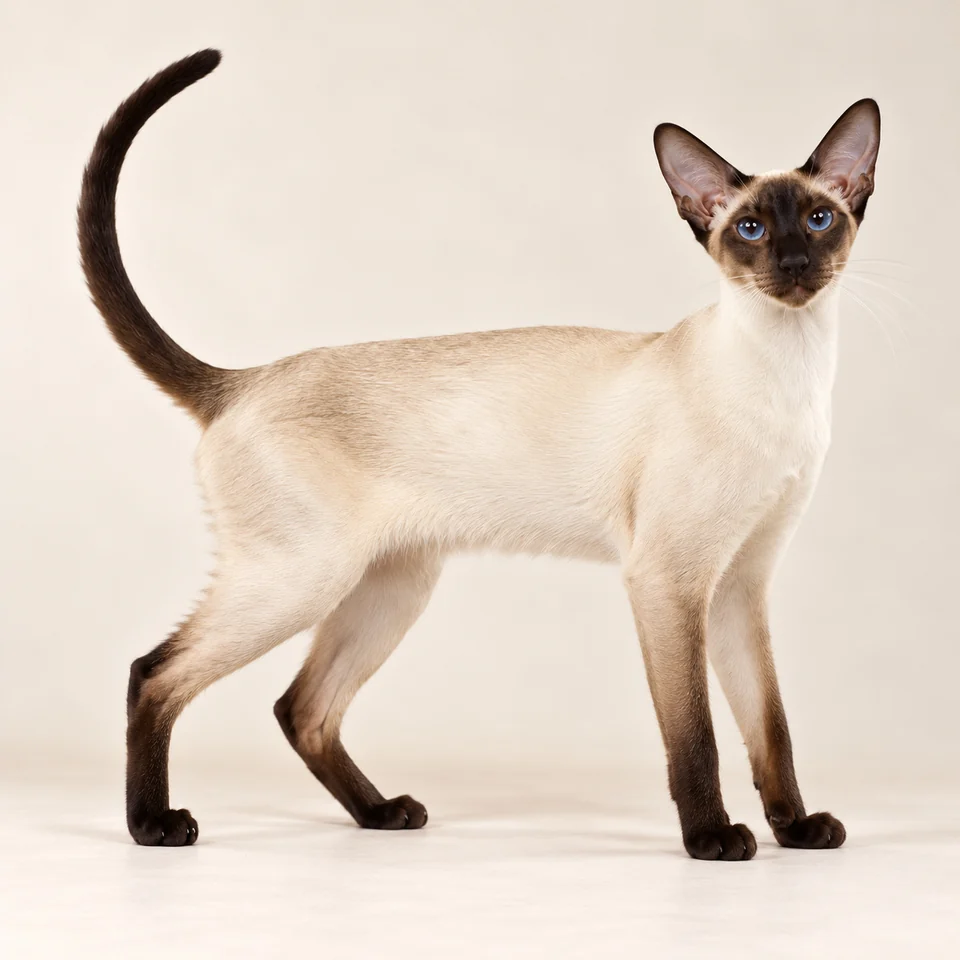
The Siamese is a slim, elegant cat with color on its points.
It inspired many other breeds. It is one of the great treasures of the cat fancy. Its dark points stand out against a pale body. It has striking sapphire blue eyes.
Source:CFA
Quick facts
- Where it beganCFA
- Thailand. The cats were first recorded in old Thai cat poems.
- When it beganCFA
- First documented in Thai cat poems from the Ayutthaya period (1350–1767). In the West, English fanciers promoted them in the late 1880s.
- Coat feelCFATICA
- Short, fine textured and glossy; lies close to the body. It is very short and tight.
- WeightTICA
- Adult females are small, about 5–8 lb. Adult males are medium, about 8–12 lb.
- LifespanTICA
- Life expectancy is 10+ years. The breed has been known to live 20+ years.
- CFA statusCFA
- Recognized since 1906
Appearance
Everything about the Siamese is long, except its short, fine coat.
It has a long neck, body, legs and tail. The head is a wedge shape. Large, broad-based ears complete the triangle. The eyes are bright blue and almond-shaped. Color shows on the face mask, ears, legs, feet and tail.
Source:CFA
Body
Long, svelte, tubular body; fine bones with firm muscles; hips never wider than shoulders
Colors and patterns
Pointed: darker color on the face mask, ears, legs, feet and tail, with a paler body. One registry accepts four colors: seal, chocolate, blue and lilac point. The other accepts all pointed colors for the Siamese.
Personality
The Siamese is vocal, affectionate and active.
It can be insistent. It is often considered the most intelligent of cats. It is very good at telling people what it wants. It uses body language and many different sounds.
Source:CFA
With their people
A Siamese needs closeness and human attention. It wants to be with you, on you, or involved in what you are doing. Be ready to give a lot of devotion. You will get it back many times over.
Source:CFA
Lap time
A Siamese looks for the warmest spot in the house. That may be a sunny spot on the floor. Most likely, it is your lap.
Source:CFA
Voice
The Siamese is known as a vocal breed. It has a large range of sounds. Expect loud protests if you need time alone.
Source:CFA
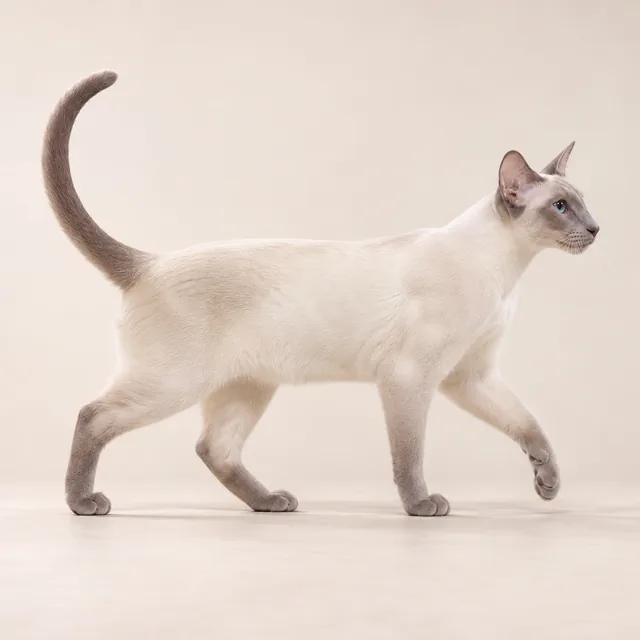
Living with a Siamese
The best companion for a Siamese is likely a human or another Siamese.
Many Siamese have formed close friendships with other pets.
Source:CFA
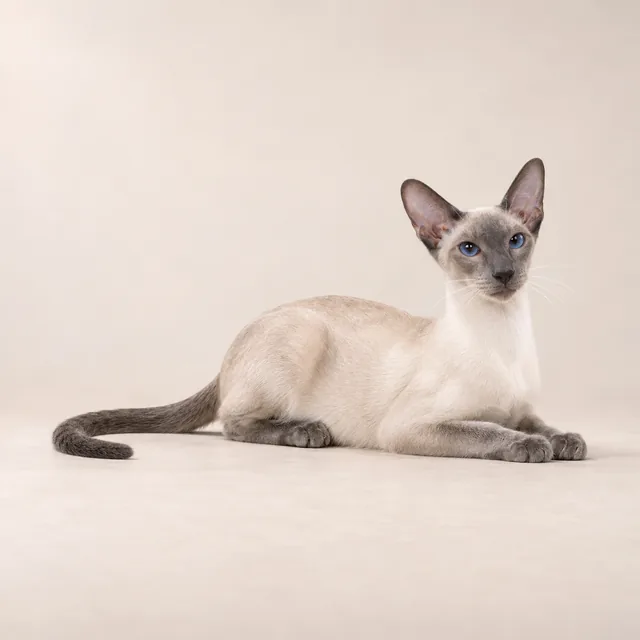
Care
Siamese do shed, so groom them regularly.
You need no special tools. Wet your hands and stroke the coat until your hands are dry. This removes dead hair. A rubber brush also works. The short coat needs little care. They tend to enjoy being combed weekly with a stainless steel comb.
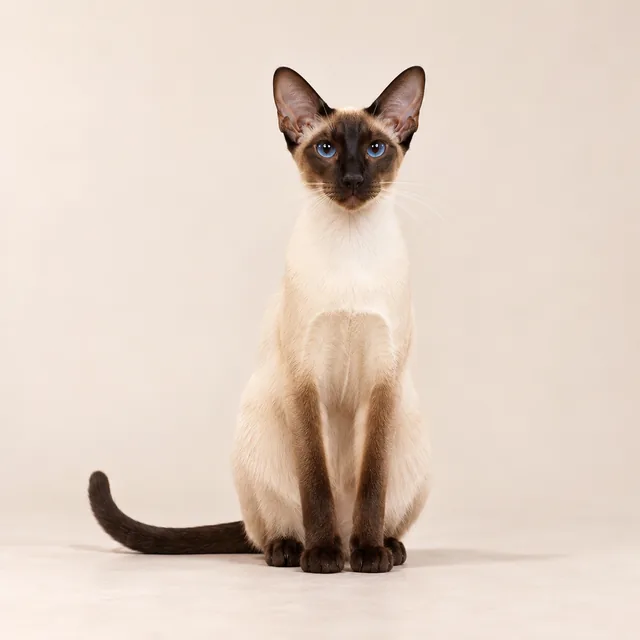
Health
Most Siamese are healthy.
Breeders are working on two issues that may occur. Progressive retinal atrophy (PRA) can cause blindness. Amyloidosis causes liver problems. Siamese tend to be sensitive to anesthesia. Tell the vet before any surgery.
Screening
PRA is a recessive gene that a genetic test can detect. Carriers can be removed from breeding or bred only to non-carriers. For amyloidosis, research is still ongoing to find the genes involved.
Source:CFA
Health questions to ask
It is best to ask if amyloidosis has occurred in your kitten’s family lines.
Source:CFA
CFA health notes
Most Siamese are healthy. Breeders are addressing PRA, which can cause blindness and can be found by genetic testing. They are also addressing amyloidosis, which causes liver problems. Its genes are still being researched.
Source:CFA
This is what CFA and TICA say about the breed. It is not a health promise for any kitten. TrueKitten verifies breeder identities and documents, but that does not guarantee a kitten's health. Ask the breeder for test results and talk to your vet.
History
These cats were first recorded in old Thai cat poems.
The poems date from the Ayutthaya period (1350–1767). In 1878, a Siamese named “Siam” was given to U.S. President Rutherford B. Hayes. Siamese were also shown at the Crystal Palace cat shows in England. The Siamese was one of the first breeds recognized in 1906. At first, seal point was the only color. Blue point was recognized in 1934, chocolate point in 1952 and lilac point in 1955.
Source:CFA
Recognition dates
- 1906CFA One of the first recognized breeds
- 1907CFA First Siamese Best-in-Show winner
- 1934CFA Blue point recognized
- 1952CFA Chocolate point recognized
- 1955CFA Lilac point recognized
Source:CFA
Did you know?
- The first Siamese in the United States was named “Siam.” It was a gift to President Rutherford B. Hayes in 1878.
- The first Siamese Best-in-Show winner came in 1907.
- Siamese generally darken with age.
- The Siamese inspired, or was the genetic source for, many other breeds.
Source:CFA
For breeders
Details from the CFA and TICA show standards. Cat show judges use them. They do not rate a kitten as a pet.
What the show standards ask for
- General: medium sized, svelte and refined, with long tapering lines; lithe but muscular. Svelte, graceful, refined, medium size.
- Head: long tapering wedge from nose to ear tips, no break at the whiskers.
- Profile: a long straight line, no bulge over eyes and no dip in nose. A slight change of angle over the eyes (two-planed) is allowed at some shows.
- Ears: strikingly large, pointed, wide at base, continuing the wedge; neither too high nor too flared.
- Eyes: almond shaped, medium size, slanted toward the nose, uncrossed; deep vivid blue.
- Body: medium size, long, svelte and tubular; fine bones, firm muscles; hips never wider than shoulders.
- Legs and paws: long, slim legs, hind legs higher than front; small oval paws, five toes in front and four behind.
- Tail: long, thin, whippy, tapering to a fine point.
- Coat: short, fine textured, glossy, lying close.
- Color: definite contrast between body and points; points dense, clearly defined and of the same shade.
Points show how much each part counts when a judge scores a cat at a show. They add up to 100.
| Part | Points |
|---|---|
| HeadLong, flat profile 6, Wedge, fine muzzle, size 5, Ears 4, Chin 3, Width between eyes 2 | 20 |
| EyesShape, size, slant, and placement 10 | 10 |
| BodyStructure and size, including neck 12, Muscle tone 10, Legs and feet 5, Tail 3 | 30 |
| Coat | 10 |
| ColorBody color 10, Point color (matching points of dense color, proper foot pads and nose leather) 10, Eye color 10 | 30 |
Source:CFA
| Part | Points |
|---|---|
| Head | 35 |
| Body | 35 |
| Coat/Color/Pattern | 30 |
Source:TICA
CFA allowances
No separate ALLOWANCES section. In-text allowances: jowls in the stud cat; darker body color in older cats, but definite contrast between body and points is still required.
Source:CFA
TICA allowances
Dip above the eyes (headache band) in kittens and young adults to 12 months; ghost barring in kittens and young adults to 12 months; SI/BA: incomplete point color and mask in kittens and young adults to 12 months. Also allow for jowls in males and proportionately larger size in males.
Source:TICA
CFA penalties
Improper (off-color or spotted) nose leather or paw pads; soft or mushy body; visible protrusion of the cartilage at the end of the sternum under normal handling.
Source:CFA
TICA penalties
Receding or excessively massive chin; Roman profile; Roman nose; miniature size; any evidence of poor condition; SI/BA: belly and/or flank spots, tabby markings on the torso of lynx points.
Source:TICA
CFA disqualifications
Any evidence of illness or poor health; weak hind legs; mouth breathing due to nasal obstruction or poor occlusion; emaciation; visible kink; eyes other than blue; white toes and/or feet; incorrect number of toes; malocclusion with undershot or overshot chin; longhair.
Source:CFA
TICA disqualifications
DQ: visible tail fault; crossed eyes; visible protrusion of the cartilage at the end of the sternum (xiphoid process); any sign of definite challenge in temperament. Withhold all awards: evidence of illness, poor health, emaciation; white lockets and buttons; white toes and feet (including paw pads) except in any color with white divisions; patches of white in the points except in "any color with white" points. Plus the standard Show Rules Article Sixteen mandatory disqualifications.
Source:TICA
CFA breeding notes
PRA carriers can be removed from the gene pool or bred only to non-carriers. Breeders have been proactive about watching their lines for relatives of cats with amyloidosis.
Source:CFA
TICA standard version
Siamese Breed Group Standard, 05/01/2009 (footer also reads "Revised 120109")
Source:TICA
Common questions
Adult females are small, about 5–8 lb. Adult males are medium, about 8–12 lb.
Life expectancy is 10+ years. The breed has been known to live 20+ years.
The Siamese is known as a vocal breed. It has a large range of sounds. Expect loud protests if you need time alone.
A Siamese needs closeness and human attention. It wants to be with you, on you, or involved in what you are doing. Be ready to give a lot of devotion. You will get it back many times over.
The best companion for a Siamese is likely a human or another Siamese. Many Siamese have formed close friendships with other pets.
Siamese do shed, so groom them regularly. You need no special tools. Wet your hands and stroke the coat until your hands are dry. This removes dead hair. A rubber brush also works. The short coat needs little care. They tend to enjoy being combed weekly with a stainless steel comb.
Most Siamese are healthy. Breeders are working on two issues that may occur. Progressive retinal atrophy (PRA) can cause blindness. Amyloidosis causes liver problems. Siamese tend to be sensitive to anesthesia. Tell the vet before any surgery.
Pointed: darker color on the face mask, ears, legs, feet and tail, with a paler body. One registry accepts four colors: seal, chocolate, blue and lilac point. The other accepts all pointed colors for the Siamese.
These cats were first recorded in old Thai cat poems. The poems date from the Ayutthaya period (1350–1767). In 1878, a Siamese named “Siam” was given to U.S. President Rutherford B. Hayes. Siamese were also shown at the Crystal Palace cat shows in England. The Siamese was one of the first breeds recognized in 1906. At first, seal point was the only color. Blue point was recognized in 1934, chocolate point in 1952 and lilac point in 1955.
Questions to ask a breeder
- Have the parents been tested for progressive retinal atrophy (PRA)? May I see the results?
- Has amyloidosis ever appeared in this kitten’s family lines?
- Has this kitten or its parents had anesthesia, and were there any problems?
- How much time does this kitten spend with people each day?
- Has this kitten lived with other cats or pets?
- Which registry is this kitten registered with, and in what color?
Sources
Every fact on this page comes from the two cat registries, CFA and TICA.
Last updated