
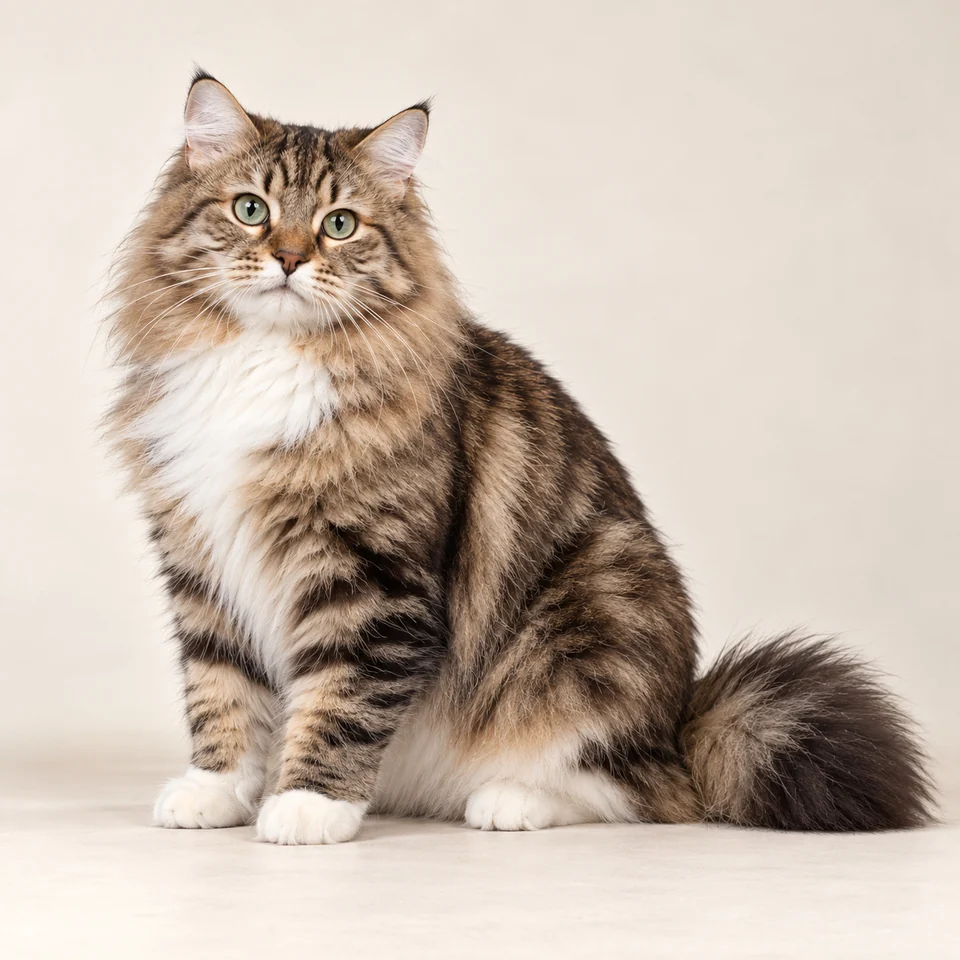
The Siberian is a native cat of Russia, built for harsh winters.
It is powerful and muscular, with a thick triple coat. The triple coat is often called its most distinctive feature. The breed has a sweet-faced look. Siberians mature slowly, taking up to five years.
Quick facts
- When it beganCFA
- Recorded history goes back to about the year 1000. First breeding Siberians reached the U.S. in 1990.
- Coat feelCFATICA
- A triple coat: soft, dense undercoat, awn hairs, and coarser guard hairs that make it dense and weatherproof. Texture varies from coarse to soft by color.
- WeightCFATICA
- A mature male can range from 12 to 18 pounds, and females from 8 to 12 pounds. Males are notably larger than females.
- LifespanTICA
- Life expectancy is 11 to 18+ years.
- Fully grownCFATICA
- Siberians mature slowly. Most reach full size by about three years. Maturing can take as long as 5 years.
- CFA statusCFA
- Championship (since 2007)
Appearance
The overall look is round, with circles rather than triangles.
The head is a broad, rounded wedge with a full, rounded muzzle. Ears are medium-large and rounded with a slight forward tilt. The body is barrel-shaped and muscular. Feet are big and round with toe tufts. The coat is semi-long to long. Adults should have a full collar ruff.
Body
Strong, muscular, barrel-shaped body with substantial boning and surprising heft for its size.
Colors and patterns
One registry accepts all colors and combinations, with or without white. The other accepts only dominant black-based colors (plus red); chocolate, lilac, cinnamon, fawn and caramel are not allowed. Both allow any amount of white.
Personality
Siberians are sociable, curious and easygoing.
They want to be near their owners and know what is going on. They are extremely intelligent but not overactive or intrusive. Owners call them “90% placid and 10% mischief.” They are lively, yet highly affectionate.
With their people
They want to be near their owners. They become very attuned to their owners' moods. This is why they are often sought as potential emotional support animals.
Source:CFA
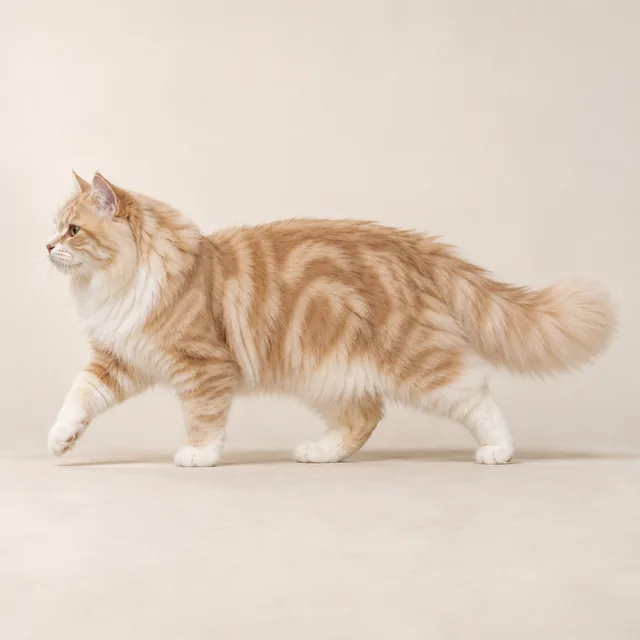
Living with a Siberian
These are gentle cats that enjoy playing and clowning with their families.
With children
They can be wonderful companions for children. Children hold a warm spot in their hearts.
Activity
Siberians love to investigate cabinets, cupboards and suitcases, but are not overactive. They are lively.
Training
They quickly learn the meaning of “no” — though they may treat it as “okay when no one is looking.”
Source:CFA
Care
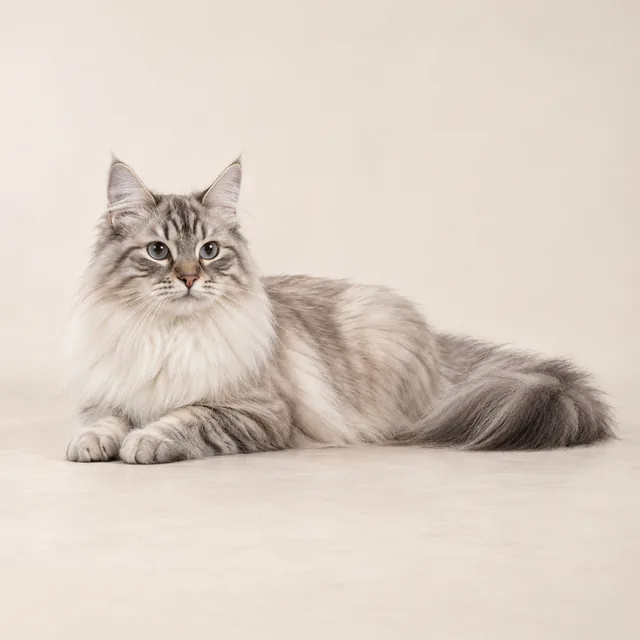
Siberian coats vary a lot.
Some need weekly grooming to prevent mats; others go weeks without. Feeling the underside, tail and britches several times a week for mats and tangles are recommended. Pull clumps apart gently with your fingers or the edge of a steel-toothed comb, then comb through.
Source:CFA
Shedding
Seasonal. The coat is noticeably thicker in colder months and shorter and less dense in summer. They shed their winter coat for a shorter, less dense one.
Undercoat
Yes. Plentiful, dense and resilient. It is tight in mature cats and thicker in cold weather.
Heat and cold
The coat is thicker in colder months and shorter in summer. The summer coat can be distinctly shorter and less dense.
Nails, ears, eyes and teeth
Keep nails trimmed, ears cleaned and teeth brushed regularly with a vet-approved pet toothpaste.
Source:TICA
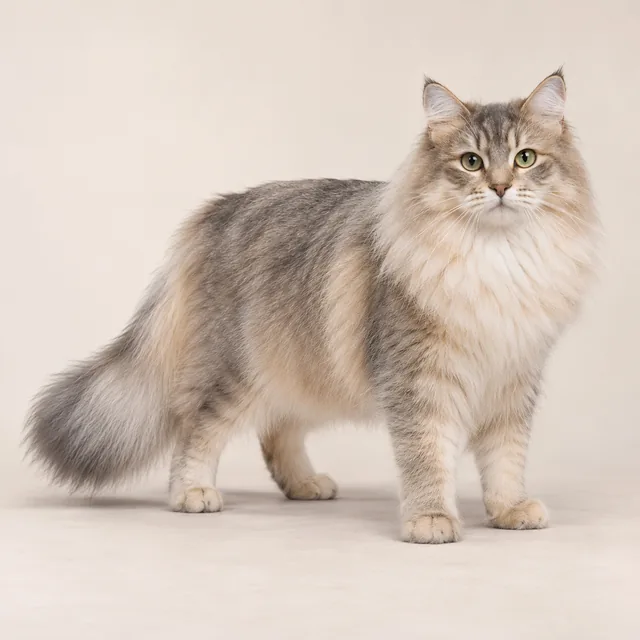
Health
Hereditary issues found in the breed are hypertrophic cardiomyopathy (HCM), polycystic kidney disease (PKD) and several other recessive conditions.
Screening
Siberians should be checked for hypertrophic cardiomyopathy. Breeders are typically scrupulous about genetic testing and choose breeding pairs carefully.
CFA health notes
Breeders “choose breeding pairs with extreme care in order to maintain a high level of diversity and minimize hereditary issues found in this breed.” These include HCM, PKD and several other recessive conditions.
Source:CFA
This is what CFA and TICA say about the breed. It is not a health promise for any kitten. TrueKitten verifies breeder identities and documents, but that does not guarantee a kitten's health. Ask the breeder for test results and talk to your vet.
History
The Siberian is the national cat of Russia.
Its recorded history there goes back to about the year 1000. Farmers and tradesmen kept them, and they worked as mousers. They also appear in Russian fairy tales. They became known outside Russia after cat shows began in England in the 1890s. The first breeding Siberians reached the U.S. in 1990, imported by Elizabeth Terrell. They were accepted for registration in 2000 and for championship in 2007.
Source:CFA
Did you know?
- Siberians earned their keep as “Ministers of Rodent Control.”
- Owners describe them as “90% placid and 10% mischief”.
- A newer color called “bimetallic” has both gold and silver areas in the same coat; it is linked to Corin silvers.
- They love to investigate cabinets, cupboards and suitcases.
For breeders
Details from the CFA and TICA show standards. Cat show judges use them. They do not rate a kitten as a pet.
What the show standards ask for
- Overall: roundness and circles, not rectangles and triangles; strength, presence, alertness and a sweet expression.
- Head: modified wedge of medium/large size with rounded contours; low-set, broad cheekbones.
- Muzzle: moderately short, full and rounded, with a gentle transition to the head.
- Ears: medium-large, rounded, broad at the base, slight forward tilt; ear/lynx tipping allowed.
- Eyes: medium to large, almost round to broad oval; set more than one eye's width apart.
- Body: barrel-shaped, firm and well muscled; medium to medium-long, with back slightly higher than shoulders.
- Legs/feet: substantial boning; hind legs slightly longer; big rounded feet with toe tufts.
- Tail: medium, somewhat shorter than the body, wide at base, tapering to a blunt tip, thickly furnished.
- Coat: triple coat (undercoat, awn and guard hairs), dense and weatherproof; texture alone is worth 15 points at some shows.
- Maturity: both standards make allowances for slow maturing (up to about 5 years).
Points show how much each part counts when a judge scores a cat at a show. They add up to 100.
TICA colors
Only dominant black-based (B/-) colors, including sex-linked red. Corin is permitted in the Tabby, Tabby and White, Silver/Smoke, and Silver/Smoke and White Divisions. Chocolate, lilac, cinnamon, fawn and caramel are not allowed. Permitted tabby patterns: mackerel, spotted, classic and shaded.
Source:TICA
CFA colors and patterns
All colors and combinations, with or without white; white allowed in any amount and area; buttons, spots and lockets allowed; tarnishing on silvers not penalized.
Source:CFA
CFA allowances
Slow-maturing breed: coat and physical structure considered when judging kittens and young adults; buttons, spots and lockets allowed; allow for warm weather coats; moderate stomach pad or famine pouch acceptable; allowances for females and young cats.
Source:CFA
TICA allowances
Slow maturing (average three to five years to full structure and coat): consideration for kittens and young adults and for seasonal variation in coat length and density. White buttons, spots and lockets allowed in all colors.
Source:TICA
CFA penalties
Straight profile; narrow or fox-like muzzle; long tail; delicate boning; non-muscular; long body; almond-shaped eyes; very long or very short legs; an adult with a long body or without good body weight.
Source:CFA
TICA penalties
Head: straight profile or very deep profile curve; narrow, pinched, long or foxy muzzle. Body: tail too long or too short, long body, long legs, narrow chest, unhealthy weight. Coat: exceptionally soft and fine guard hairs on adults; flat, draping, silky body coat; exaggerated undercoat; lacking triple coat.
Source:TICA
CFA disqualifications
Kinked tail; incorrect number of toes; crossed eyes; evidence of illness, poor health, emaciation. Temperament must be unchallenging.
Source:CFA
TICA disqualifications
Disqualify: visible tail fault; any sign of definite challenge; plus Show Rules Article Sixteen mandatory disqualifications (biting, intent to deceive, etc.). Withhold all awards: illness, poor health, emaciation; high-set cheekbones in grown adults; exaggerated stop or break; blue/odd eyes outside solid white or with-white Traditional cats; very slight or delicate boning, build and musculature; non-permissible colors; absence of guard hairs in adults.
Source:TICA
CFA breeding notes
Siberian breeders are typically scrupulous about genetic testing and pick breeding pairs to keep diversity high.
Source:CFA
Common questions
A mature male can range from 12 to 18 pounds, and females from 8 to 12 pounds. Males are notably larger than females.
Siberians mature slowly. Most reach full size by about three years. Maturing can take as long as 5 years.
Life expectancy is 11 to 18+ years.
Siberians are sociable, curious and easygoing. They want to be near their owners and know what is going on. They are extremely intelligent but not overactive or intrusive. Owners call them “90% placid and 10% mischief.” They are lively, yet highly affectionate.
They can be wonderful companions for children. Children hold a warm spot in their hearts.
They get along well with dogs and other animals.
Siberian coats vary a lot. Some need weekly grooming to prevent mats; others go weeks without. Feeling the underside, tail and britches several times a week for mats and tangles are recommended. Pull clumps apart gently with your fingers or the edge of a steel-toothed comb, then comb through.
Seasonal. The coat is noticeably thicker in colder months and shorter and less dense in summer. They shed their winter coat for a shorter, less dense one.
Hereditary issues found in the breed are hypertrophic cardiomyopathy (HCM), polycystic kidney disease (PKD) and several other recessive conditions. Siberians are generally healthy, but they should be checked for HCM.
One registry accepts all colors and combinations, with or without white. The other accepts only dominant black-based colors (plus red); chocolate, lilac, cinnamon, fawn and caramel are not allowed. Both allow any amount of white.
Questions to ask a breeder
- Have the parents been screened for HCM? May I see the results?
- What genetic tests do you run on breeding cats, including for PKD?
- How do you choose pairings to keep diversity in your lines?
- Is this kitten registered, and with which registry? Is its color accepted there?
- How heavy were the parents when fully mature?
- What grooming routine is this kitten used to?
Sources
Every fact on this page comes from the two cat registries, CFA and TICA.
Last updated