
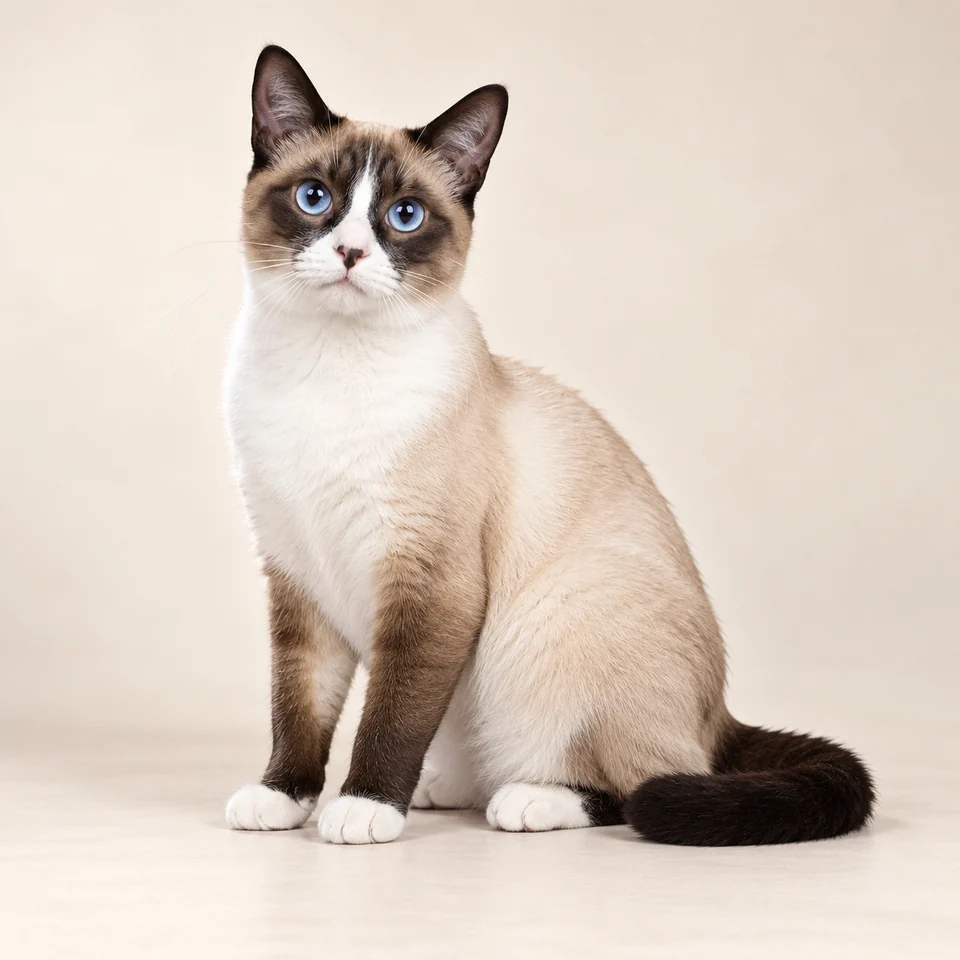
The show standard calls for a Snowshoe with blue eyes and white on all four paws.
The breed is outgoing. Some may be somewhat shy with strangers. Snowshoes are very social, very smart and extremely active.
Source:TICA
Quick facts
- Where it beganTICA
- Philadelphia, Pennsylvania, USA
- When it beganTICA
- Early 1960s
- SizeTICA
- Males are medium sized. Females are usually much smaller.
- WeightTICA
- Males weigh approximately 9 to 12 pounds. Females are usually much smaller, at approximately 7 to 10 pounds.
- LifespanTICA
- Snowshoes live 15 to 20+ years. This depends on many factors, including environment and nutrition.
- TICA statusTICA
- Championship (since 1994)
Appearance
Blue.
The show standard penalizes any eye color other than blue.
Source:TICA
Personality
Snowshoes are outgoing, though some may be somewhat shy with strangers.
Some are shy and some are bossy (but nice). Others act as caregivers. They worry about their person as if it were their life's goal.
Source:TICA
Living with a Snowshoe
Care
History
The Snowshoe goes back to the early 1960s.
Dorothy Hinds Daugherty of Philadelphia, Pennsylvania found three kittens in a Siamese litter. Each kitten had four white feet. Interest in the breed then fell. By 1977 only one breeder was left. By 1989 there were close to thirty documented breeders. The Snowshoe was accepted as a championship breed in 1994.
Source:TICA
Did you know?
- The breed began with three Siamese kittens that each had four white feet.
- By 1977 only one Snowshoe breeder was left.
Source:TICA
For breeders
Details from the TICA show standard. Cat show judges use it. It does not rate a kitten as a pet.
Points show how much each part counts when a judge scores a cat at a show. They add up to 100.
| Part | Points |
|---|---|
| Head | 30 |
| Body | 30 |
| Coat/Color/Pattern | 30 |
| Other | 10 |
Source:TICA
TICA divisions
Solid Point/white, Tortie Point/white, Tabby point/white, Silver and/or Smoke Point/white, mitted and bicolor patterns ONLY.
Source:TICA
TICA allowances
Partial: ghost barring in kittens and young cats up to 2 years of age; darker coat color in older cats; lockets.
Source:TICA
TICA penalties
Partial: no white on all four paws; plush, wooly or double undercoat; long hair; eye color other than blue.
Source:TICA
TICA disqualifications
Partial: any sign of definite challenge in temperament; Show Rules mandatory disqualifications such as a cat that bites, intent to deceive, adult whole males without two descended testicles, and all or part of the tail missing. Breed-specific items were not visible.
Source:TICA
TICA standard version
Revised 11/15/08 Snowshoe Standard, 05/01/2009 Revised 11/15/08 Snowshoe Standard, 05/01/2009
Source:TICA
Common questions
Males weigh approximately 9 to 12 pounds. Females are usually much smaller, at approximately 7 to 10 pounds.
Snowshoes live 15 to 20+ years. This depends on many factors, including environment and nutrition.
Snowshoes are outgoing, though some may be somewhat shy with strangers. Some are shy and some are bossy (but nice). Others act as caregivers. They worry about their person as if it were their life's goal.
Snowshoes are very social and get along well with children.
Snowshoes get along well with other pets.
Snowshoes are very smart and easy to train.
Brushing once a week is a good idea. It removes dead hair and spreads skin oils.
The Snowshoe goes back to the early 1960s. Dorothy Hinds Daugherty of Philadelphia, Pennsylvania found three kittens in a Siamese litter. Each kitten had four white feet. Interest in the breed then fell. By 1977 only one breeder was left. By 1989 there were close to thirty documented breeders. The Snowshoe was accepted as a championship breed in 1994.
Questions to ask a breeder
- How do the kittens act with strangers and visitors?
- Have the kittens met children or other pets?
- How much white do the parents have on their paws?
- What health records do you keep for the parents?
- How active are the parents at home?
Sources
Every fact on this page comes from the cat registry TICA.
Last updated