
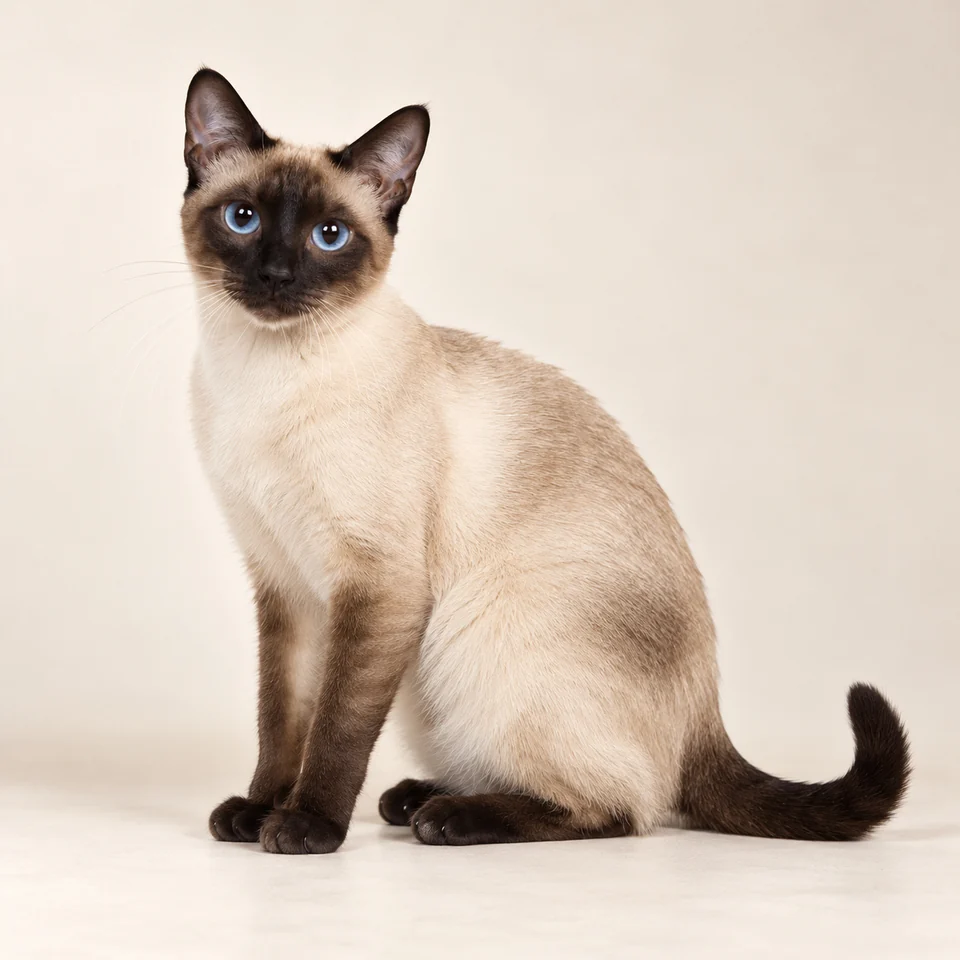
The Thai is a pointed cat from Thailand.
It is the living version of the old Thai “Wichien-maat” cat. It looks like the moderate Siamese of the early 1900s. The Thai should not be extreme in any way. It is a communicative and very people-oriented breed.
Source:TICA
Quick facts
- Where it beganTICA
- Thailand. The Thai descends from and resembles the native pointed cats of Thailand.
- When it beganTICA
- The breed began in the 1950s, when breeders kept breeding moderate, early 20th century Siamese. It is the living equivalent of the “Wichien-maat” of ancient Siam.
- SizeTICA
- Medium to slightly large. Females tend to be smaller and finer boned than males.
- Coat lengthTICA
- Shorthair (very short to short)
- Coat feelTICA
- Silky and close-lying, but not a “painted on” coat
- WeightTICA
- Adult females weigh 7–9 lb and adult males 9–12 lb.
- LifespanTICA
- Some cats live into their late teens or early twenties.
Appearance
The Thai is medium to slightly large.
Its trademark is the head. The upper head is rounded, and the muzzle is a clear wedge. The eyes are blue and a full almond shape. The body is long and graceful, like a small panther. The coat is very short to short and silky. The body is pale, with darker points.
Source:TICA
Body
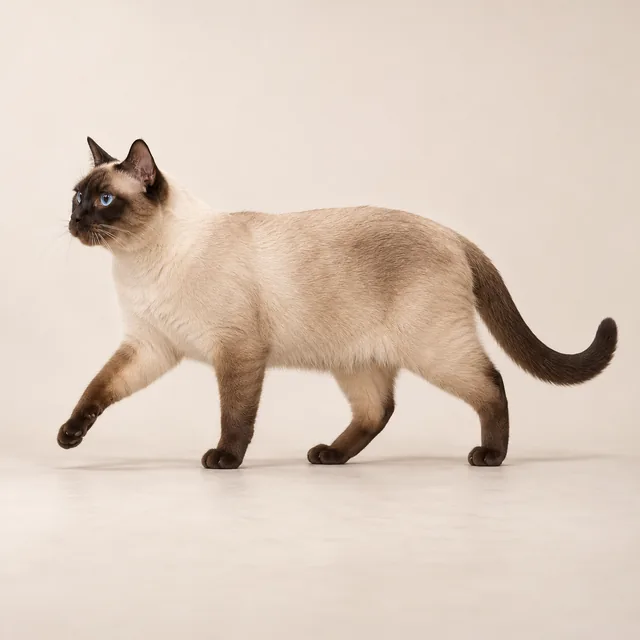
Moderately long, lithe and graceful “like a small panther”; neither tubular nor compact; medium boning
Source:TICA
Colors and patterns
Pointed: a pale off-white body with darker points on the mask, ears, feet and tail. All colors are accepted in solid, tabby and tortie divisions.
Source:TICA
Eye colors
Blue. Deep blue is preferred, but brilliance matters more than depth. Any other eye color withholds awards.
Source:TICA
Personality
Living with a Thai
Thais love to play with children.
Source:TICA
Care
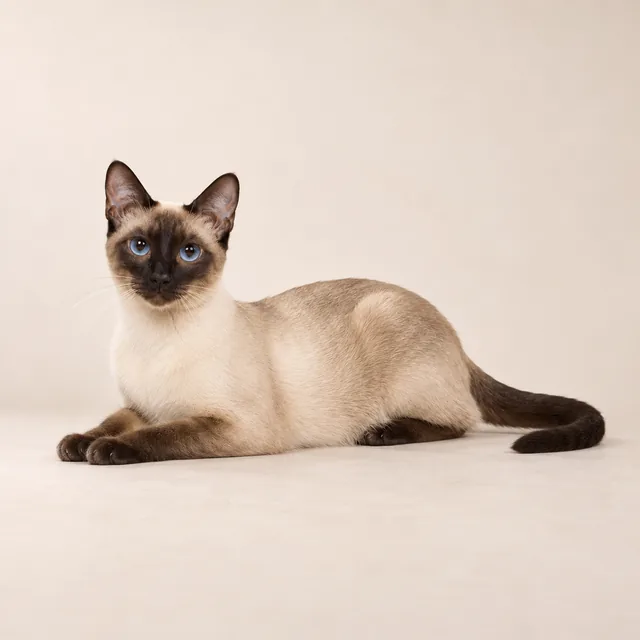
A Thai can keep up its own coat and bathe itself.
The exception is when the coat gets soiled with something harmful if licked.
Source:TICA
Undercoat
Very little undercoat. Excess undercoat is a show fault, and a dense “teddy bear” coat loses all awards.
Source:TICA
Nails, ears, eyes and teeth
Nail trims every two weeks and regular ear care are recommended.
Source:TICA
Health
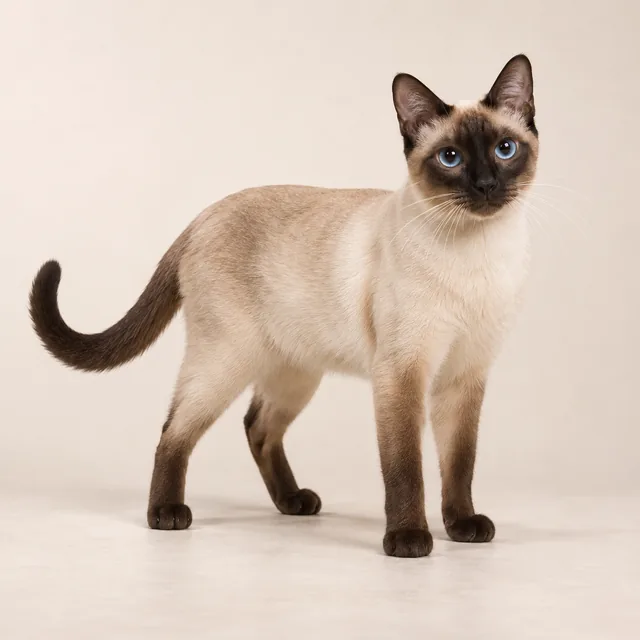
Thais are generally a healthy, natural breed.
Source:TICA
This is what TICA says about the breed. It is not a health promise for any kitten. TrueKitten verifies breeder identities and documents, but that does not guarantee a kitten's health. Ask the breeder for test results and talk to your vet.
History
The Thai descends from the native pointed cats of Thailand.
The breed began in the 1950s. Breeders around the world kept breeding the moderate Siamese type of the early 1900s. The first breed clubs formed in the 1980s in the United States and Europe. In 1990, the World Cat Federation in Europe gave the breed championship status and named it Thai. In 2001, breeders began importing native pointed cats from Thailand.
Source:TICA
Did you know?
- In Thailand the breed is called the Wichienmaat. Elsewhere it is called the “Old-Style Siamese”.
- The Thai’s very short coat was first clearly described in the West by Harrison Weir in 1889.
- A Thai should weigh about as much as, or slightly more than, it looks.
- The Thai is not, and should not look like, a native Western breed.
Source:TICA
For breeders
Details from the TICA show standard. Cat show judges use it. It does not rate a kitten as a pet.
What the show standards ask for
- General: medium to slightly large pointed cat of foreign type; not extreme in any way.
- Head: modified wedge of medium width with rounded cheeks; longer than wide but not extreme or narrow; laterally rounded upper head with a distinctly wedge-shaped muzzle.
- Muzzle: like a tapering garden spade with a rounded end; little or no whisker break.
- Profile: nearly straight with a slight downhill slope from just above to just below the eyes.
- Eyes: medium to slightly large, very full almond shape, not oriental; blue, brilliance over depth.
- Ears: medium to slightly large, wide at base, oval tips; very light furnishings allowed.
- Body: moderately long, lithe, graceful like a small panther; neither tubular nor compact; medium boning.
- Legs and tail: medium-length graceful legs; oval feet; tail as long as the torso, tapering gradually.
- Coat: very short to short, silky, very little undercoat, close-lying but not painted on.
- Color: very pale off-white body; dense, even, matching points.
Source:TICA
Points show how much each part counts when a judge scores a cat at a show. They add up to 100.
| Part | Points |
|---|---|
| Head | 40 |
| Body | 40 |
| Coat/Color/Pattern | 20 |
Source:TICA
TICA allowances
Incomplete point color and mask in kittens and young adults up to 12 months; slight tabby markings on the body of lynx points with good contrast to the points; darker body shading in older cats with definite contrast; stud jowls in males; females tend to be smaller, slightly finer boned and less muscular; very light ear furnishings.
Source:TICA
TICA penalties
Genuinely round eyes; extreme oriental eyes; blunt or pointy muzzle; narrow upper head; small, very large or low-set ears; compact or distinctly tubular body; whippy tail; excess undercoat (plush coat); ghost markings in non-agouti adults.
Source:TICA
TICA disqualifications
DQ: visible tail fault; crossed eyes; visible protrusion of the cartilage at the end of the sternum (xiphoid process); any sign of definite challenge in temperament. Withhold all awards: pronounced stop in profile; pronounced convex forehead; distinct ear tufts; fluffy fur with dense undercoat (“teddy bear” coat); cobby body; obesity; white lockets and buttons; white toes and feet (including paw pads); patches of white in the points; eye color other than blue. Plus Show Rules Article Sixteen mandatory disqualifications.
Source:TICA
TICA breeding notes
The Siamese is a permitted outcross. Breeders began importing native pointed cats from Thailand in 2001. The aim was to expand and preserve a healthy gene pool.
Source:TICA
TICA standard version
Thai Breed Standard, 05/01/2010 (footer also reads "Revised 05/01/2010")
Source:TICA
Common questions
Adult females weigh 7–9 lb and adult males 9–12 lb.
Thais are not necessarily loud, but they are chatty.
Thais love to play with children.
A Thai can keep up its own coat and bathe itself. The exception is when the coat gets soiled with something harmful if licked.
The Thai is medium to slightly large. Its trademark is the head. The upper head is rounded, and the muzzle is a clear wedge. The eyes are blue and a full almond shape. The body is long and graceful, like a small panther. The coat is very short to short and silky. The body is pale, with darker points.
Thais are generally a healthy, natural breed.
Questions to ask a breeder
- Is this kitten registered as a Thai?
- Are there any Siamese outcrosses or imported Thai cats in this pedigree?
- What health testing or veterinary checks have the parents had?
- How much time does this kitten spend with people and children?
- How have you handled nail trims and ear cleaning with this kitten?
Sources
Every fact on this page comes from the cat registry TICA.
Last updated